by Eric
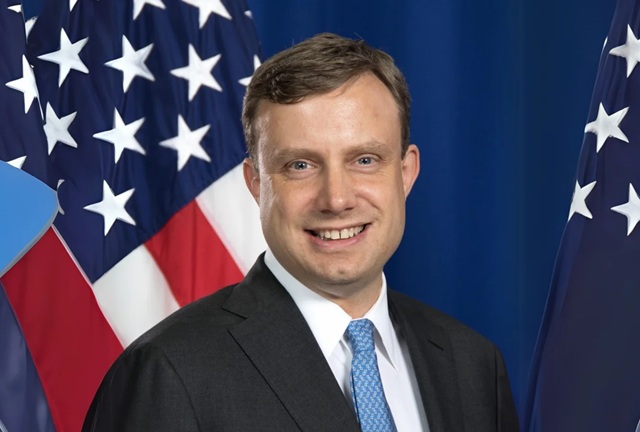
Congratulations are in order. Eric Meyer, a career diplomat with decades of global experience, has been nominated as the next United States Ambassador to Sri Lanka. This is no small posting—Colombo is both a geopolitical fulcrum and a troubled democracy navigating between two giants: India and China. Meyer’s selection, therefore, is not merely a bureaucratic decision, but a statement. It says something about what Washington wants from Colombo—and what it may be prepared to tolerate.
On the surface, Meyer’s credentials are impeccable. A graduate of the University of California Berkeley, with an MBA from Georgetown, he cut his teeth not in the political scene but in the private sector—specifically in the airline industry’s government relations and corporate sales. That background gives him a rare blend of bureaucratic fluency and commercial savvy, traits that have served him well in postings as varied as Phnom Penh and Almaty, Buenos Aires and Helsinki.
But what makes Meyer interesting is not his résumé—it’s the subtle pattern of the assignments he has been trusted with. He is a diplomat often posted to sensitive geopolitical junctions, countries where U.S. policy must strike a delicate balance between strategic assertion and diplomatic subtlety. He was in North Macedonia during its bid to join NATO—an effort fiercely opposed by Russia. He served in Kazakhstan, a linchpin of Central Asia, where he led the only U.S. Consulate in the region at a time when Chinese and Russian influence were on the rise. His tour in Cambodia, meanwhile, placed him in a country sliding into authoritarianism while welcoming large-scale Chinese investment.
These are not backwater assignments. They are pressure points in America’s global strategy. And now, with Washington’s eyes keenly fixed on South Asia amidst rising concerns about maritime security, Chinese port investments, and democratic backsliding, Meyer lands in Colombo.
So what kind of ambassador will he be?
A lesser-known but telling episode from Meyer’s early career might offer a clue. While posted in Beirut, Meyer was instrumental in what has come to be known informally as the “Mecca Airlift”. When hundreds of Turkish Muslims found themselves stranded in Lebanon due to a logistical failure during the Hajj season, it was Meyer and his embassy team who arranged, astonishingly, for 14 American C-54 aircraft to evacuate them to Saudi Arabia—one every hour on the hour. It was a rare moment of bureaucratic agility and cultural sensitivity in a region where America is often criticised for lacking both. More importantly, it was not a grand gesture of diplomacy—it was problem-solving with consequences for real people, and it won considerable goodwill in the Muslim world.
Contrast that image with his later, more high-level work—particularly in Washington, where Meyer served as Special Assistant and Senior Advisor in the Bureau of South and Central Asian Affairs. That role placed him at the heart of shaping policy across a region riddled with conflict, suspicion, and old wounds. He was not the public face of policy, but he was close to the levers. His input would have shaped responses to issues from Kashmir to Kabul, from Uyghur repression to Bangladeshi elections. Yet very little from this period of his service is publicly recorded or debated. This absence speaks volumes. Meyer is effective precisely because he does not draw attention to himself. He is a quiet operator in a profession that often rewards theatrical diplomacy.
It’s also worth noting that while he has never been tied to any public scandal or controversial leak—indeed, his name is conspicuously absent from WikiLeaks cables—his career path reflects a trend among career diplomats who operate near, but not in, the domain of covert influence. He was in Skopje, after all, during a pivotal time for North Macedonia’s alignment with Western institutions, and in Cambodia while civil liberties were being eroded and media was being silenced. While he likely did not drive regime change, his presence suggests that Washington trusts him to navigate nations in transition—or turmoil.
That brings us to Sri Lanka. Meyer enters at a time when the country is still emerging from the shadow of economic collapse and wrestling with its democratic identity. The Rajapaksa era may technically be over, but its legacy looms large. Chinese infrastructure projects like Hambantota Port and the Colombo Port City continue to draw both investment and suspicion. Anti-Western sentiment flares periodically, often fanned by political opportunism and misinformation. In short, Meyer is entering not a vacuum, but a battleground of narratives. Washington may hope he brings calm and pragmatism. Beijing will be watching for how subtly—or overtly—he throws Washington’s weight around.
Will Meyer push for stronger human rights monitoring in the North and East? Will he quietly encourage reforms in the military, or greater transparency in economic governance? Or will he pursue a more transactional diplomacy—offering trade and aid in exchange for strategic alignments, such as military access or votes in international forums? Based on his record, Meyer is unlikely to make loud declarations. But his agenda will be clear, even if unspoken: to restore U.S. influence in a country that, at times, appears determined to pivot eastward.
One must also question what kind of relationship he’ll build with Sri Lanka’s civil society. In Phnom Penh, he was seen as a steady hand, someone who engaged civil actors even as the space for dissent narrowed. In Helsinki, he sat on the Fulbright Commission, a post that reflects a belief in soft power. But Colombo is no European capital. Civil society here is fractured, politicised, and often under surveillance. Will he take the risk of engaging the fringe voices, the journalists and activists who need support the most? Or will he, like many diplomats before him, keep to Colombo 7 and the well-paved diplomatic circuit?
Perhaps the most striking quality about Meyer is his multilingualism. He speaks Danish, French, Khmer, Russian, and Spanish. Not just European tongues, but languages that require deep immersion and a willingness to be shaped by the culture they represent. That, more than any policy position, suggests a man willing to listen before acting. In a country like Sri Lanka—where colonial legacies and foreign interference are sore points—that could be the difference between being welcomed as a partner or rejected as a meddler.
Still, the risks are real. With elections looming and populist rhetoric likely to rise, America’s role in Sri Lanka could once again be cast in a suspicious light. If Meyer is to succeed, he will need to do what he has done quietly and competently for decades: avoid the spotlight while influencing the script. But Colombo is not a quiet stage. It remains to be seen whether he can maintain his careful balance—or whether this assignment will be the one that finally tests the limits of Washington’s soft-footed diplomacy.
Welcome, Mr Meyer. Sri Lanka awaits—attentive, sceptical, and watching.