by Durga
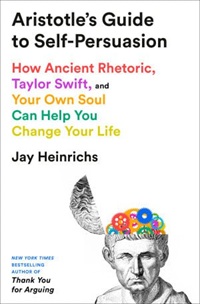
Jay Heinrichs’ Aristotle’s Guide to Self-Persuasion (2025) is an audacious amalgam of classical rhetoric, pop culture exegesis, and self-help exhortation, positing that Aristotelian persuasive techniques can catalyse personal transformation. With a vernacular ebullience tempered by scholarly reverence, Heinrichs interweaves Aristotle’s rhetorical triad—ethos, pathos, logos—with contemporary anecdotes and Taylor Swift references, crafting a provocative yet accessible treatise on self-manipulation. The book’s ambition to meld ancient philosophy with modern exigencies is both its strength and its Achilles’ heel, inviting acclaim for its innovative synthesis while courting criticism for its occasionally glib tone and overreliance on hyperbole. This review, part of a 1200-word series, examines the text’s intellectual rigour, contentious claims, and cultural relevance, deploying numerous quotations to ground its analysis.
Heinrichs’ central thesis is that rhetoric, “the useful art of soul bending” (p. 6), empowers individuals to align their actions with their “noble soul” (p. 210), a concept Aristotle defined as embodying virtues like prudence, justice, and magnanimity. He asserts, “Aristotle described the ideal soul as a ‘noble’ one” (p. 210), suggesting that self-persuasion bridges the gap between one’s flawed daily self and this aspirational essence. The book is structured into four parts—Readiness, Grasp, Action, and Solution—each delineating tools like kairos, ethos, and narrative to navigate life’s chaos and effect change. Heinrichs’ claim that “self-persuasion works the same way” as persuading others, with “manipulation splash[ing] back onto himself” (p. 205), is both insightful and contentious, implying a recursive psychological mechanism that risks oversimplifying complex emotional processes.
The book’s exploration of kairos—the opportune moment—is a linchpin, framing chaos as “an opportunity to match decisions to your soul” (p. 41). Heinrichs invokes the myth of Serendib, where “chaos is nothing but a gap in your life until you use it” (p. 33), urging readers to seize fleeting moments of crisis. He illustrates this with a personal anecdote: “All my plans landed with me in a heap, and long before midnight, the coming year veered in an entirely different direction” (p. 29). This romanticisation of chaos as a “land of possibility” (p. 32) is compelling yet problematic, as it presupposes a resilience that may elude those mired in genuine turmoil. Critics might argue that Heinrichs’ privileged perspective—evident in his casual references to “a business trip to Dallas” (p. 65)—undermines the universality of his advice, potentially alienating readers facing systemic barriers.
Heinrichs’ treatment of ethos—cultivating a trustworthy character—is equally provocative. He cites Ben Franklin’s “chastity experiment” (p. 72), where Franklin tested his moral fortitude, to argue that “the good man should be a lover of self” (p. 72). Heinrichs advises, “You live to serve, or so you make your soul believe” (p. 77), suggesting that self-deception can align one’s actions with virtuous ideals. This notion of “faking it until you make it” through decorum (p. 76) is both empowering and ethically fraught, as it risks endorsing performative virtue over authentic growth. The author’s assertion that “not all the rhetorical tools mean faking it” (p. 77) attempts to mitigate this, but the emphasis on self-manipulation may unsettle readers who value sincerity over strategic posturing.
The discussion of pathos—emotional manipulation—further amplifies the book’s contentiousness. Heinrichs argues, “The listener always empathizes with the man who speaks emotively” (p. 85), applying this to self-persuasion by suggesting, “Changing your mood can be relatively easy. Take a bath, light a candle, watch cat videos” (p. 16). He advocates leveraging emotions like confidence and humour, noting, “Confidence: Be the Boss of You” (p. 87), and cites Caesar’s “hilarious compendium of jokes” (p. 85) to illustrate mood control. However, this approach trivialises psychological struggles, implying that fleeting mood boosts can address deep-seated issues. His claim that “emotions are natural. There is no sense in fighting our passions” (p. 95) challenges Stoic restraint but risks endorsing impulsivity, particularly when he suggests using envy to “enhance your character” (p. 214). This cavalier treatment of complex emotions may provoke criticism for its lack of nuance.
Heinrichs’ integration of logos—rational persuasion—grounds the book in Aristotelian logic, though not without controversy. He explains, “We use logic to make choices” (p. 100), employing Aristotle’s four causes—material, efficient, formal, and final—to dissect motivations: “What is it? What caused it? Why is it? What’s the trend?” (p. 111). His example of Taylor Swift’s “rational color” (p. 99) illustrates inductive reasoning, asking, “Is pink on the rise, or has it peaked and gone past its sell-by date?” (p. 103). Yet, his reliance on enthymemes—simplified syllogisms like “Looks like rain. We should bring an umbrella” (p. 107)—may oversimplify rational decision-making, potentially alienating readers who seek rigorous analytical frameworks. Critics might argue that Heinrichs’ breezy tone, as when he jests about AI running “algorithms around us” (p. 99), undermines the gravitas of logical inquiry.
The book’s use of narrative as a persuasive tool is particularly engaging, positing that “telling a good story about yourself makes you memorable—including to yourself” (p. 167). Heinrichs draws on Aristotle’s narrative theory, noting, “Spoken sounds are symbols of affections in the soul” (p. 166), and advocates crafting a “heroic tale” to “turn yourself into a hero” (p. 222). His personal story of running Mount Moosilauke—“I would attempt to run my age on my birthday” (p. 178)—exemplifies this, culminating in a triumphant “54:53” (p. 188), symbolising alignment with his soul’s aspirations. However, the emphasis on narrative as a panacea for self-doubt may overstate its efficacy, particularly for those whose life stories resist such heroic reframing. The book’s pop culture references, like Swift’s songwriting, risk trivialising this process, as when Heinrichs compares her to “teaching songwriting… and then erect[ing] a gold statue of herself” (p. 10).
Heinrichs’ exploration of hyperbole—“the trope that throws beyond” (p. 70)—is both inspiring and contentious. He recounts his Mount Moosilauke challenge, stating, “I would do whatever I could to set back the clock” (p. 66), framing it as a “grand Hyperbole” that “can tap into your noblest traits” (p. 70). Yet, his encouragement to pursue “something novel and interesting” (p. 63) may seem reckless to risk-averse readers, and his claim that “what you learn hyperbolically tends to stick” (p. 64) lacks empirical grounding, inviting scepticism about its practicality.
The book’s treatment of happiness, drawing on Aristotle’s eudaimonia, is its most philosophically robust yet controversial element. Heinrichs asserts, “The greatest happiness comes from being the most human” (p. 209), citing the Dalai Lama’s laughter as an “achievement” (p. 192). He contrasts Stoic apathy with Epicurean moderation, noting, “The Stoics believed in ignoring pain; the Epicureans sought to avoid it altogether” (p. 197). His endorsement of thaumaston—a state of sublime wonder (p. 202)—is uplifting but risks romanticising fleeting moments over sustained well-being. The claim that “happiness does not lie in amusement” (p. 190) may alienate readers who find joy in simpler pleasures, and his dismissal of modern pharmacology—“tetrapharmakos, when we have actual pharmacies” (p. 199)—could be seen as flippant toward mental health interventions.
Aristotle’s Guide to Self-Persuasion is a bold, if occasionally glib, attempt to revitalise Aristotelian rhetoric for modern self-improvement. Heinrichs’ liberal use of quotes, from “Wish is a form of appetite” (p. 10) to “The why of being human” (p. 204), anchors his arguments in primary sources, lending academic heft. However, its reliance on pop culture analogies and hyperbolic exhortations may undermine its gravitas, and its privileged perspective risks limiting its accessibility. The book’s provocative assertion that “rhetoric’s tools of human manipulation bring joy” (p. 17) invites debate, challenging readers to reconcile self-manipulation with authenticity. While intellectually stimulating, it demands critical engagement to navigate its more contentious claims.