by Our Correspondent in Colombo
In a dramatic and controversial reversal, the National Police Commission (NPC) has decided to dismiss Senior Deputy Inspector General (DIG) Nilantha Jayawardena from the Sri Lanka Police, citing grave misconduct in connection with the 2019 Easter Sunday terrorist attacks. The move comes despite a prior ruling by the same Commission that cleared him of disciplinary liability—raising serious concerns about procedural consistency and possible political pressure.
Local media in Colombo have reported growing unease within legal and administrative circles, with accusations of duplicity now being leveled against the NPC itself.
Police Commission’s old decision
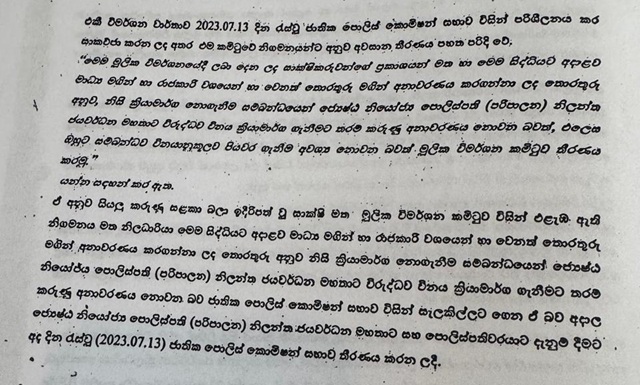
In a decision announced on July 13, 2023, the NPC—after a preliminary disciplinary inquiry—declared there was insufficient evidence to take action against him. That decision, according to official documentation from the NPC, was based on “statements of witnesses, media disclosures, and other information” that failed to meet the threshold for disciplinary misconduct. At the time, the Commission formally communicated this conclusion to both Jayawardena and the Inspector General of Police (IGP).
However, in an unexpected about-face this week, the Commission rescinded its prior stance. Citing findings from a newly completed formal disciplinary investigation, the NPC ruled on July 17, 2025, to terminate Jayawardena from service with immediate effect. The decision was made during a meeting chaired by retired High Court Judge Lalith Ekanayake.
According to the official NPC statement, the three-member tribunal that conducted the inquiry found Jayawardena guilty on all charges listed in Charge Sheet No. PC/EST/DISC/ASP/1/2023, issued in November 2023. The charges stem from his failure to act on credible intelligence prior to the 2019 attacks, a dereliction considered punishable under the Establishments Code for public officers.
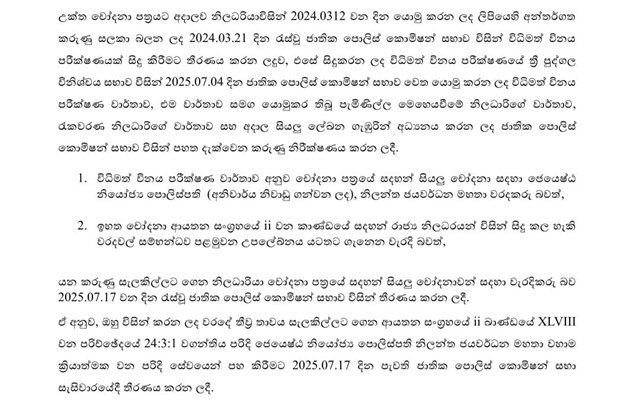
The NPC said the decision was made under Section 24:3:1 of Chapter XLVIII of the Establishments Code, which allows for dismissal on grounds of serious misconduct.
However, according to reliable sources within the Attorney General’s Department, the Director of the State Intelligence Service (SIS) in Sri Lanka does not fall under the direct purview of the Police Ordinance or Police Regulations. The SIS is a distinct civilian intelligence agency operating under the Ministry of Defence, separate from the Sri Lanka Police Service, although it frequently includes personnel with police or military backgrounds.
“While individuals appointed to lead the SIS—such as DIG Nilantha Jayawardena—may be drawn from police ranks, they serve in an intelligence role under the Ministry of Defence,” the sources emphasized. “Accordingly, the Director of SIS cannot be prosecuted or subjected to inquiry under the provisions of the Police Ordinance or Police Regulations, as the position exists outside that legal and institutional framework.”
Police Commission’s new decision
The Commission’s abrupt reversal has drawn criticism and confusion. Several Colombo-based analysts and commentators questioned whether the change in stance was the result of internal pressure, political expediency, or an evolving legal strategy. Others accused the NPC of damaging public trust by appearing to vacillate on matters of national security accountability.
“First they said there was no basis for action. Now, a year later, they’re dismissing the same officer for the same allegations, based on a second report,” a senior jurist told on condition of anonymity. “It’s not just the officer’s conduct in question—it’s the Commission’s credibility too.”