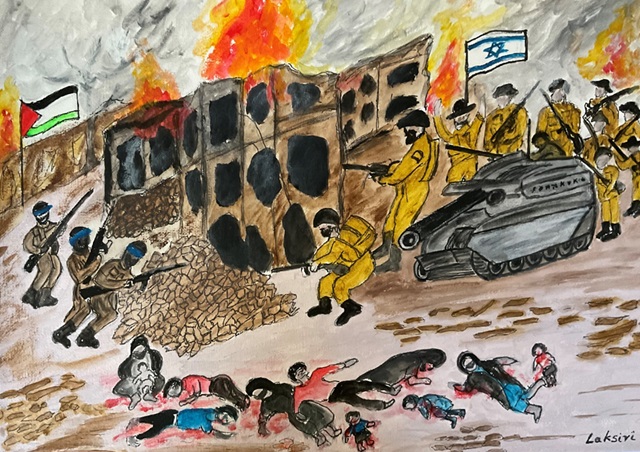
I use the term ‘struggle’ in the title of this article to mean ‘work,’ and not ‘fight.’ The advocacy for peace in the world is old as the history of war and violence. But that has failed so far at least to moderate conflicts and war. Today the world has come to a high point after the second world war as two of the conflicts, between Russia and Ukraine and Ukraine and Palestine, with a great potential of creating a disastrous world war.
There are over 20 countries at present involved in internal or external wars. Wikipedia gives a broad description of the situation and based on the figures of death toll during 2024 those countries can be listed as follows with numbers of mortality.
Ukraine 72,960, Palestine 29,772, Myanmar 19,771, Sudan 15,526, Ethiopia 10,180, Nigeria 9,155, Mexico 8,208, Burkina Faso 7,522, Syria 6,847, Somalia 5,472, Russia 4,737, Mali 4,001, Lebanon 3,813, Congo 3,785, Afghanistan 3,208, Pakistan 2,964, Haiti 2,441, Cameroon 2,186, Yemen 1,794, Colombia 1,708
There is no question that above are the most unfortunate countries that are involved in internal and external wars. However, most or some of the figures are underestimated. For example, the death toll in Palestine cannot be just above Myanmar! Given the circumstances, the death toll among Palestinians can even be higher than Ukraine. Most tragic is the way people, particularly children, are dying because of hunger. When we take all figures together it adds up to 216,050. These are not just figures but human lives. The actual number of deaths due to internal and external wars can be 3 times the numbers presently counted.
Why do we have wars? Why cannot we have internal and external peace in our countries? The main reasons depend on the way we think and act. There is something terribly wrong in our thinking. According to the Stockholm International Peace Research Institute (SIPRI) world military expenditure reached $2718 billion in 2024. This was an increase of 9.4 percent in real terms from 2023 and the highest since the Second World War. Most rapid increases were in Europe and in the Middle East. If these moneys were spent on social work and peace activities, poverty and hunger could be reduced in the world, motivating the deprived populations for productive work.
According to the World Bank, approximately 700 million people live in extreme poverty. This is 8.5% of the global population. They survive at less than $2.15 per day. If we calculate their needs in contrast to the military expenditure (2,718 billion) in the world, hypothetically their situation can be improved by 5 times if the military expenditure can be eliminated and spent on poverty alleviation. Of course, this is hypothetical.
Apart from war, there is violence in this world. War in fact is an extension of violent mindset of the humans irrespective of country, region, culture, religion and the rich-poor differences. This is what we must address. Conflicts and violence are present in families, society, countries and internationally. Women are most vulnerable in domestic violence. From the Buddha, Jesus Christ and to Prophet Muhammad there are religious leaders who have attempted to address this issue. However, their followers have largely deviated even in creating conflicts among themselves.
There are also secular philosophers from Socrates to Bertrand Russell or even later, who have attempted to address this issue. However, there are not many followers, or their theoretical arguments were not completely practical or valid. More importantly, what is necessary is not arguments but practical measures to change the minds of people from childhood to old age. The views of Greek philosophers, Socrates, Plato and Aristotal, could be considered extremely elitist emphasizing the need for wisdom to avoid violence and war. However, they also had the ‘wisdom’ to point out that the human body’s desires and greed are the main reasons for conflict and war.
During the modern period (since 1500) there were several ideologies particularly in the West. Liberalism and Marxism were the two main streams. Marxism advocated class struggle, and war or violence could be justified under certain circumstances. Liberalism was ambiguous and different views were expressed by different theoreticians. In the case of Bertrand Russell, although his general views were against war and violence, he had to justify the war against fascism. Even in the case of theory (Why Men Fight), he expressed that some human impulses and desires lead the humans to become violent. In the Asian context, Mahatma Ghandi and his philosophy would be one of the best in advocating peace and non-violence.
The United Nations can be considered the foremost organization that was formed after the Second World War to establish and maintain peace and security in the world. This is very clear from the Preamble and the Articles of the United Nations Charter. However, it is a governmental organization. And as a result, there are limitations to the organization and its affiliated entities. Nevertheless, no one should disregard this organization, and maximum opportunities should be utilized to build peace in the world.
There are nearly a hundred organizations advocating and working for peace within countries and internationally. Some of them originated decades or even a century ago. Swedish Peace and Arbitration Society (SPAS), International Peace Bureau (IPB), German Peace Society (GPS), National Peace Council (NPC, UK), and Women’s International League for Peace and Freedom (WILPF) are some of the oldest.
Some of the most active contemporary peace organizations can be considered the World Peace Council (WPC), Pax Christi, World Peace Foundation (WPF), Institute for Economics and Peace (IEP), World Peace Foundation, International Peace Institute (IPI), US Institute of Peace, Crisis Group (UK), International Confederation for Peace (ICP), Peace Research Institute, Oslo, Berghof Foundation etc. However, none of these are anchored in the South or the East. Apart from that geographical limitation, there is not much common activity or cooperation between them. There are organizations like the Inter Parliamentary Union that work for peace among other matters.
What might be needed under the circumstances is the building of a broad-based international movement, actively working on behalf of the victims and advocating peace and harmony in the countries that are affected and beyond. For a broad-based movement, and for cooperation between existing organizations, a primary center can be based in India or Sri Lanka. There can be other centers in Africa, Latin America, Europe and in the Middle East. Even if the first initiative is in Sri Lanka, the Indian support would be necessary, and Mahatma Gandhi can be an iconic figure in building peace and harmony in the world.