by Luxman Aravind
That was rather funny how this government works and how they are being bullied, yet they talk high with super ego. Prime Minister Harini Amarasuriya, long hailed an “intellect,” yet again buried the dignity of this government in the Parliament while justifying the satellite deal which was finalised during what the present government itself describes as the most corrupt regime in Sri Lankan history. Harini hammered all those liars, including her own superiors, and justified the Rajapaksas’ investment. Then the others began the damage-control rituals of this government; first Trade Minister Wasantha Samarasinghe produced the rather convenient theory that Harini had been “misled” by officials in the Board of Investment, and then President Anura Kumara Dissanayake leapt into the chamber to deliver a special speech in which he uncovered “new conspiracies” against the government.
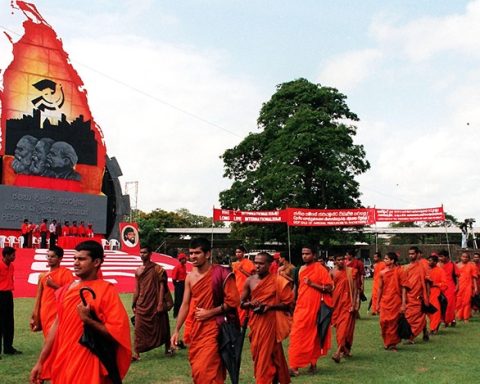
Almost a year has passed since this administration assumed office, and day by day they expose not the enemies without, but their own inability to forge tangible solutions to serious issues, substituting hollow rhetoric for genuine governance. The same deal-brokers and opportunists who haunted every prior administration have hijacked this one too. The only difference is that now JVP members have been embedded across government institutions — their role reduced to the apathy of merely “sitting and monitoring” — the infamous pelawatte appointments which now infest the bureaucracy, whether in secretarial posts or administrative offices.
What we are witnessing is not simply the teething troubles of a young government; it is the public unmasking of a regime that has survived thus far on the twin crutches of deceptive propaganda and an electorate’s residual hope. But propaganda has the half-life of cheap fireworks: it burns brightly in the moment, yet leaves only acrid smoke for the morning after. The so-called honeymoon period has ended. This is the stage where governments meet the granite wall of reality, and where slogans dissolve into the brackish water of policy failure. The Punadura (To characterise this as a renaissance would be a misnomer; it was, in truth, yet another rhetorical device wielded to intimidate and delude the public.) government, with its revolutionary posturing and moral grandstanding, has now entered the most perilous phase of its existence — the one where the governed begin to notice the gap between the sermon and the deed.
The Harini episode is emblematic of a deeper malaise. Her intervention in Parliament was less an act of whistle-blowing than an exhibition of political immaturity, a failure to comprehend the intricate calculus of statecraft in which timing, framing, and discretion are often more valuable than the raw truth. In politics, as Thucydides warned in his History of the Peloponnesian War, “the strong do what they can, and the weak suffer what they must.” Harini’s blunt defence of a dubious investment was not the act of a strong political strategist but of a novice intoxicated by the sound of her own moral certitude, oblivious to the tectonic pressures of coalition survival. She not only undercut her superiors but handed the opposition a loaded weapon, which they have since been firing with glee.
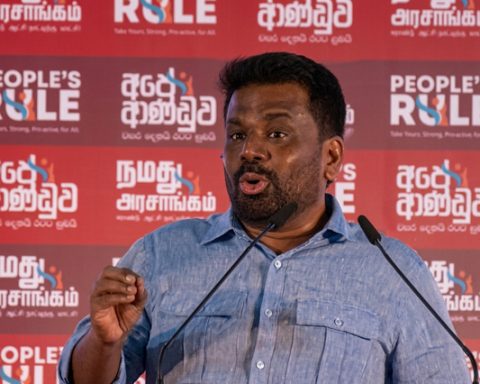
The government’s response was textbook damage control — Samarasinghe’s disavowal framed as an “error” by officials, a narrative designed to distance the Prime Minister from her own words without overtly rebuking her. Then came the President’s grand oration, a sprawling performance in which economic statistics, geopolitical grievances, and moralistic warnings were stitched together into a narrative of resilience besieged by conspirators. This was Anura Kumara Dissanayake not merely as statesman, but as the high priest of a political religion whose central tenet is that criticism equals conspiracy. His speech was a study in controlled paranoia — insisting on the stability of the dollar, the growth of exports, and the sanctity of the rule of law, while repeatedly warning that shadowy forces were plotting to overthrow the NPP Government. It was as if the ghost of Richard Nixon, in his most paranoid Watergate days, had found a reincarnation on the floor of the Sri Lankan Parliament.
The irony is that the more this administration talks of stability, the more it reveals the fragility of its own edifice. Stability, in the classical sense, is not declared; it is perceived. The Athenian democracy of Pericles’ era did not need to issue daily assurances of its endurance, just as Franklin D. Roosevelt’s wartime government did not constantly proclaim its legitimacy — their stability was self-evident in the trust they commanded. When a government must repeatedly insist that it will not collapse, one suspects it has already entered the gravitational pull of decline.
What the Punadura regime is encountering now is the limits of narrative control. In its first months, it could dismiss critics as relics of the ancien régime, point to inherited crises, and posture as the moral antithesis to corruption. But governing is not the art of perpetual campaign; it is the grim arithmetic of trade-offs, where ideology collides with fiscal constraints and lofty promises with bureaucratic inertia. The satellite saga exposes precisely this collision — a government that came to power lambasting the old order now finding itself defending, and even rationalising, the relics of that order when convenient.
Globally, such moments often mark the beginning of a government’s irreversible decline in public credibility. Consider Mikhail Gorbachev in the late 1980s, whose Glasnost rhetoric unravelled as the Soviet system’s structural rot became undeniable, or Tony Blair in the post-Iraq years, when the sheen of “New Labour” progressivism gave way to the cynicism of a public that felt deceived. In each case, the leadership’s initial moral authority became a liability once it was revealed to be contingent on selective truths.
The Punadura government’s recent conduct also illustrates a phenomenon political scientists call institutional capture by incumbency. The insertion of party loyalists — the “pelawatte appointments” — into key bureaucratic positions mirrors the very clientelist practices this regime once vowed to dismantle. This is not reform; it is replication. As Max Weber observed, bureaucracies can be both the instrument and the grave of transformative politics: they either execute reform or, once captured, suffocate it under the weight of procedural inertia and patronage. In Sri Lanka’s case, the latter appears ascendant.
President Dissanayake’s repeated invocation of “conspiracies” — external and internal — signals a leadership that is increasingly framing dissent as sabotage. This is politically effective in the short term; history is replete with leaders who consolidated power by manufacturing an existential threat. Julius Caesar’s crossing of the Rubicon was justified in part by the claim that the Senate was plotting against the Republic’s stability. In the modern era, Recep Tayyip Erdoğan’s consolidation of power in Turkey has leaned heavily on the narrative of perpetual coup attempts and foreign meddling. But such rhetoric is a double-edged sword: once the public perceives the “threat” as exaggerated or fabricated, the very language of vigilance begins to sound like the whimper of insecurity.
The satellite exoneration episode — from Harini’s maladroit defence to Samarasinghe’s bureaucratic scapegoating and Dissanayake’s conspiracy theatre — thus serves as a microcosm of the government’s evolving survival strategy. It is no longer enough to invoke revolutionary virtue or parade economic data; the administration must now manufacture and manage crises to keep the political base mobilised. This is the survival game — not one of delivering tangible transformation, but of perpetually shifting the spotlight away from performance and onto imagined plots, thereby recasting political opposition as existential treachery.
Yet this game has limits, and those limits are approaching. The electorate’s patience is finite, especially in a nation whose recent history is a pendulum swinging between messianic hope and crushing disillusionment. Propaganda is a bridge, not a destination; it can carry a government across the turbulent waters of transition, but once ashore, the people expect roads, not more bridges. The Punadura regime’s task is not merely to fend off the opposition, but to confront the structural malaise it inherited — and which it is now, wittingly or not, perpetuating. If it fails, it will learn the lesson of all regimes that mistake political theatre for governance: the audience eventually leaves.
In the Mahabharata, there is a moment when Duryodhana, confronted with the consequences of his own hubris, declares, “I know what is right, but I cannot do it; I know what is wrong, but I cannot desist from it.” One suspects that this government, ensnared in the very webs of patronage, propaganda, and paranoia it once denounced, may soon find itself in a similar confession — though perhaps without the self-awareness to articulate it. The honeymoon is over; the applause is fading; and no amount of satellite talk, exoneration or conspiracy, will substitute for the unglamorous, unending labour of governing well.