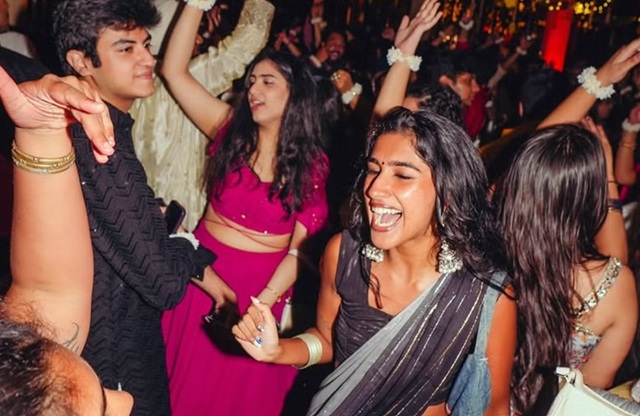
In a nation where weddings drive a nearly £100 billion industry, a growing number of young urban Indians are choosing to celebrate without commitment. Across Delhi, Bengaluru, and Hyderabad, a new phenomenon is taking hold: ticketed “fake weddings” that mimic the glamour and joy of traditional Indian ceremonies — without the rituals, the family drama, or the staggering expense. These events feature marigold garlands, shimmering sarees, thumping Bollywood playlists, and endless dancing, but no actual couple tying the knot. For a few pounds, guests can step into the spectacle of a wedding without the emotional or financial weight that usually accompanies it.
The trend began as a playful experiment in Delhi earlier this year, when event organiser Jummaa Ki Raat hosted a “Fake Sangeet” night. The founders decorated the venue with floral backdrops resembling a wedding stage and encouraged guests to arrive dressed for a real celebration. “You dress up like you’re going to a wedding, dance to the songs, decorate like a wedding — that’s about it,” co-founder Sahib Gujral told The Independent (UK). The event quickly went viral, drawing hundreds who came not to witness vows but to revel in the collective joy that weddings bring. Soon, similar parties began springing up in other major cities, attracting crowds eager for a taste of extravagance without responsibility.
For many, the appeal lies in escaping the pressures of India’s multi-day, ritual-heavy weddings. With over ten million weddings held annually, families often spend years saving for celebrations that can last up to a week and host thousands of guests. Industry analysts estimate the Indian wedding services sector at more than £75 billion, with luxury nuptials setting new records each year. Last year’s marriage of billionaire heir Anant Ambani to Radhika Merchant, for instance, featured international stars like Rihanna, Katy Perry, and Andrea Bocelli, and reportedly cost hundreds of millions of dollars. Such spectacles have come to symbolise status and aspiration — but also excess.
The fake wedding movement flips that script. Attendees pay between £4 and £60 for entry, don bright wedding attire, pose for staged photos, and join choreographed dance routines. Strangers invent playful roles, calling themselves the “bride’s side” or “groom’s side” even though neither exists. By midnight, the dance floor becomes a blur of colours and laughter, indistinguishable from the real thing. For 21-year-old student Arjun, the experience felt more inclusive than a nightclub. “People don’t just stick to their groups,” he said. “Everyone’s there to celebrate together.”
The phenomenon is also serving unexpected social purposes. In Bengaluru and Hyderabad, curators Vaibhav Kumar Modi and Ashish Chopra launched Shadi Mubarak, a queer-centred fake wedding event that offered LGBTQ+ communities a space to experience the symbolism of marriage. “It was nothing less than magic,” Chopra told The Independent (UK). “It was a glimpse of the marriage I couldn’t legally have in India.” Modi added that even his mother, who had never been to a nightclub, attended and felt at home amid the lights, décor, and music. “It didn’t feel like an event,” he said. “It felt like we had come home.”
While the concept has faced minimal backlash, not all reactions have been positive. Authorities in Maharashtra recently raided a “fake marriage party” where minors were found drinking, and organisers were charged under child protection laws. Still, most events continue unchallenged, drawing both young professionals and older attendees who missed out on weddings during the pandemic. Critics argue the trend is a fleeting social media fad, but organisers see potential longevity in smaller towns, where immersive entertainment remains rare.
For Gujral and others behind the movement, the fake wedding is both satire and celebration — a reflection of how India’s relationship with weddings is evolving. “The industry has sold us the idea that the bigger the wedding, the better,” he said. “We’ve just decided to take that fantasy and turn it into something anyone can experience.”
In a country where weddings often blur the line between sacred duty and financial performance, these faux ceremonies may offer something refreshingly honest: a night of music, colour and collective joy — a wedding stripped of its burdens but not its beauty.