Editorial
Yet another battle is over—that’s what we hear. But the war isn’t over; history keeps teaching us this lesson repeatedly. Yet, what happened in Sharm El-Sheikh is important. This is the place through which Moses led his people through the waters of the Red Sea, embarking on a harrowing journey toward the Promised Land. The symbolism is inescapable. Here, in a city whose sands have witnessed millennia of human struggle and divine myth, the leaders of our fractured world gathered to ink a ceasefire that purports to end a war yet whose roots run far deeper than the last two years of Gaza’s carnage. This is not a mere armistice; it is a negotiation with history itself, a gamble that the present can finally reconcile with centuries of accumulated grief, dispossession, and vengeance.
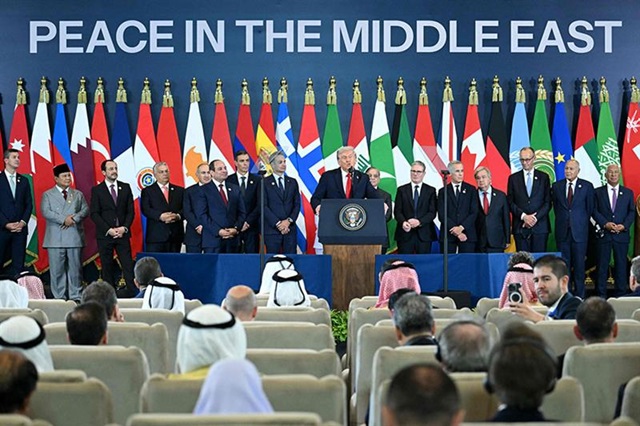
The Sharm El-Sheikh Peace Summit was attended by an unparalleled constellation of power, from Washington to Doha, Ankara to Paris, from capitals that have long wielded influence over the Middle East. Yet the very magnitude of this congregation exposes a profound paradox: the war has always been as much about global posturing as about human survival. The Palestinian people, trapped in a cycle of blockade, bombardment, and bureaucratic neglect, are not merely pawns in a geopolitical chessboard; they are living witnesses to the failure of international diplomacy. The agreement, signed by the presidents of Egypt, the United States, Turkey, and Qatar, heralds an immediate cessation of hostilities, yet it does not address the structural injustices that have made Gaza a necropolis of human despair. Temporary cessation is not liberation; it is the suspension of suffering, a brief reprieve before history exacts its next toll.
Egypt’s role in orchestrating this accord cannot be overstated. President Abdel-Fattah El-Sisi invoked the moral authority of his nation’s historical legacy, recalling Anwar El-Sadat’s audacious 1977 visit to Jerusalem, when peace required the courage to transgress expectation and defy entrenched enmity. But contemporary Egypt is navigating a far more treacherous terrain, balancing domestic authoritarian consolidation with the demands of regional diplomacy. Its mediation rests not only on moral legitimacy but on the delicate leverage it exercises over Hamas—a leverage that is far from absolute. The Egyptian narrative of stewardship, of guardian of order and arbiter of peace, is compelling, yet it risks eliding the fact that true Palestinian self-determination remains contingent upon the acquiescence of regional and global powers whose priorities are not always aligned with justice.
President Donald Trump’s rhetoric at the summit was emblematic of this tension between spectacle and substance. “Three thousand years to get to this point,” he claimed, a statement at once hyperbolic and telling. History, he implied, has finally yielded to diplomacy. Yet this ostensible triumph conceals a more uncomfortable reality: peace imposed from the heights of power is rarely internalised at the level of lived experience. A ceasefire decreed in Sharm El-Sheikh is not the same as security or recognition for the individuals who have borne the brunt of bombardment and siege. It is a temporary reprieve sanctioned by elites, whose access to power shields them from the existential precarity that defines daily life in Gaza. Therein lies the enduring paradox of Middle Eastern peacemaking: agreements flourish in ceremonial grandeur even as the human terrain they purport to transform remains mired in deprivation, trauma, and injustice.
The symbolism of the location—the Sinai Peninsula, the Red Sea, the historical path of Moses—is impossible to ignore. The narrative of liberation is seductive: the notion that a people can be led out of bondage into a promised future resonates with any society that has endured subjugation. Yet there is a darker reading. History in this region is not linear but cyclical, and promises of liberation have repeatedly been deferred, co-opted, or betrayed. The Gaza ceasefire, however celebrated, must be measured against this continuum of failure. Will it be remembered as the moment when diplomacy triumphed over violence, or as yet another ephemeral pause before the machinery of war revives?
Consider the human dimension. Over 1,900 prisoners were released as part of the agreement, a gesture hailed as a triumph of justice, yet dozens were expelled to foreign lands, severed from the communities they call home. Palestinians who survived the conflagration return not to streets restored, but to rubble and blockade. Hospitals struggle with shortages, schools lie in ruin, and families are bereft of loved ones. The rhetoric of leaders about a “new dawn” risks being an abstraction, a ceremonial flourish divorced from the tangible exigencies of life under occupation. Human suffering cannot be legislated away; it must be remedied through sustained, equitable, and unflinching intervention—yet such intervention remains conspicuously absent.
The broader geopolitical theatre complicates matters further. Turkey and Qatar, by virtue of their relationships with Hamas, wield influence but also inject competing agendas into the negotiation. Israel, whose existential concerns underpin its military calculus, remains fixated on security imperatives, often at the expense of human rights or reconciliation. The United States, despite its diplomatic heft, is constrained by domestic politics and historical entanglements that skew the discourse of fairness. Europe’s presence, symbolically vital, is also pragmatically tentative, reflecting the reluctance of far-off powers to commit beyond rhetorical endorsement. Peace, in such a lattice of interests, is less a guaranteed outcome than a precarious negotiation suspended in a balance of self-interest.
This ceasefire also forces a confrontation with uncomfortable truths about the morality of war. If peace is defined merely as the absence of active conflict, then the summit is an unqualified success. Yet if it is defined as the establishment of justice, equity, and the conditions for cohabitation, then Sharm El-Sheikh is only a first, faltering step. The moral calculus of conflict requires acknowledgment of historical wrongs, restitution for dispossession, and mechanisms to prevent recurrence. Without these, any agreement risks being a veneer of civility overlaying an unresolved injustice. To celebrate the end of hostilities without confronting these structural inequities is to sanction their persistence under the guise of pragmatism.
Perhaps the most provocative lesson of Sharm El-Sheikh is that leadership is measured not by the capacity to wage war but by the willingness to cease it. Yet the paradox remains: the cessation of violence in Gaza has been brokered by powers whose own histories are replete with military intervention and coercion. The juxtaposition is stark and uncomfortable: moral authority and strategic self-interest are entwined, and the legitimacy of the peace is inseparable from the contradictions of those who broker it. For the citizens of Gaza, the calculus is simple: life or death, dignity or subjugation. For the states of the world, the calculus is infinitely more complex, yet no less consequential.
The significance of Sharm El-Sheikh lies not in the signature on paper but in the potential to transform temporality into trajectory. History has shown that cycles of violence are perpetuated by neglect, injustice, and the abdication of responsibility. The challenge now is whether the ceasefire can catalyse a paradigm in which security and sovereignty are not mutually exclusive, in which liberation is not a myth retold but a reality enacted, and in which the promises of a place sacred in memory can be reconciled with the imperatives of justice in the present.
The world has witnessed a moment of fragile hope, a ceasefire inked amid the sands where Moses once led a people toward freedom. Yet the task ahead is Herculean. It requires honesty about power, courage to confront injustice, and the recognition that peace is not a singular event but a continuum of moral and political commitments. Sharm El-Sheikh offers a pause, a possibility, a glimmer. Whether it becomes the harbinger of durable peace or another ephemeral gesture of diplomacy remains to be seen. What is indisputable is that the people of Gaza, and indeed the region, cannot afford illusions: history will not be kind to those who mistake the silence of guns for the presence of justice.