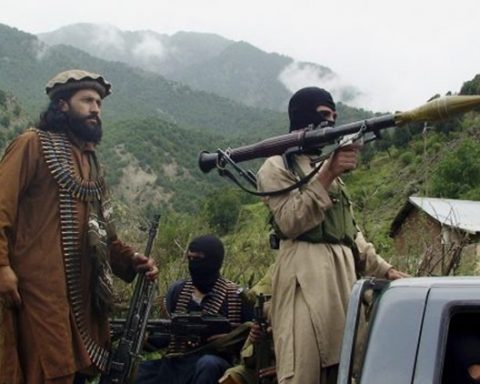
On October 20, National Mobilization Front (NMF) fighters carried out a targeted operation in Kabul city in the vicinity of the First District. The target of this operation was a prominent ‘commander’ of the Tehreek-e-Taliban (TTP). No further discloser has been made.
In the intervening night of October 13-14, a series of operations by NMF fighters were carried out against the (Afghan) Taliban on the main road of Takhar University in the Sixth District of Taloqan city, in Taloqan Province, in which one Taliban fighter was killed and another two were injured. A Taliban Ranger vehicle was also partially destroyed.
On September 23, NMF killed a Taliban intelligence officer after a vehicle of the Kabul Intelligence Directorate belonging to the Taliban was targeted by its fighters in the Ghaibi Baba settlement area of 17th District in Kabul.
On September 12, NMF fighters targeted Qari Shabir Ahmad, the Intelligence Director of Shigal District in Kunar Province, killing him inside his home.
On June 25, NMF fighters conducted an operation, killing one Taliban fighter and injuring two, at the Jaldak Checkpoint in the Khum-Zargar area of Hesa-e-Awal District in Kapisa Province
Apart from these violent attacks, NMF has been very vocal on various ‘policies’ of the Taliban regime. On September 18, 2025, for instance, it released a statement on X, condemning the Taliban imposed internet ban, declaring, “The internet shutdown in the provinces demonstrates the weakness and inability of this group against the freedom fighters…” Earlier, on August 25, NMF critizised the Taliban’s decision to hand over a number of Afghans who cooperated with North Atlantic Treaty Organization (NATO), specifically those related to the United Kingdom, to Iran.
As reported on October 4, 2023, a number of soldiers of the previous Afghanistan government under National Mobilization Front aka National Basij Front, officially announced their existence and objectives against the Taliban group in Afghanistan. According to these former soldiers, after the Taliban assumed power in Afghanistan on August 15, 2021, most of the country’s erstwhile military personnel abandoned their weapons and fled the country. Taliban also arrested, tortured and killed many soldiers in different provinces under various pretexts and buried some of them in mass graves in Baghlan, Herat, Nangarhar, Panjshir, and Parwan provinces.
The founding leadership of NMF remains shadowy, though Afghan-language media name Jawed Deh Sabzai as the General Commander of the group. NMF is active in at least 12 to 14 provinces, including Takhar, Baghlan, Parwan, Kapisa, and Kabul. The group highlights that it operates covertly and without overt external association.
NMF’s statement disclose that its members pledge to defend Afghanistan “until the last drop of their blood” and to fight Taliban rule. It also publicly supports cooperation or unity with other anti-Taliban fronts. On September 8, 2025, for example, NMF welcomed the announcement of the Afghanistan Peace & Freedom Movement (APFM) as a collective effort to “free Afghanistan from Taliban and establish an inclusive government.”
The group has identified the Taliban regime as its main enemy, which it views to be a traitor to the national cause and unlawful. It positions itself as open to all Afghan youth and former Security Forces’ personnel who are willing to fight. It also considers Islamic State of Khorasan Province (ISKP) to be its adversary. On June 3, an NMF post on X disclosed that a group of youths led by ‘Commander’ Idris Sediq, the ‘military officer’ in charge of Shakardara (in Kabul Province), had announced that they would fight against the Taliban and ISKP within the framework of the NMF of Afghanistan.
NMF has emerged as a new constituent of Afghanistan’s evolving anti-Taliban resistance, operating through small, mobile guerrilla units across multiple provinces. Its appearance reflects, at once, the continued fragmentation of opposition forces as well as the persistence of organized dissent within Afghanistan. For the Taliban regime, it represents a direct challenge to claims of nationwide dominance. NMF’s activities are another index of the continuing instability of Afghanistan’s security environment and the complex interplay between internal resistance and regional strategic interests.