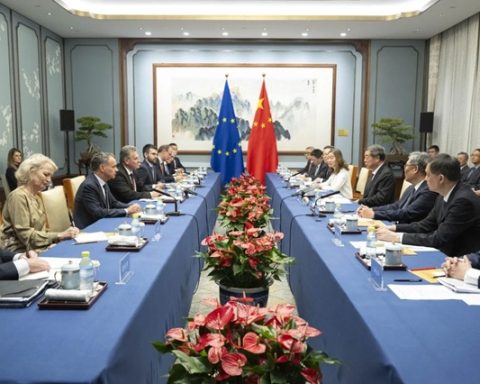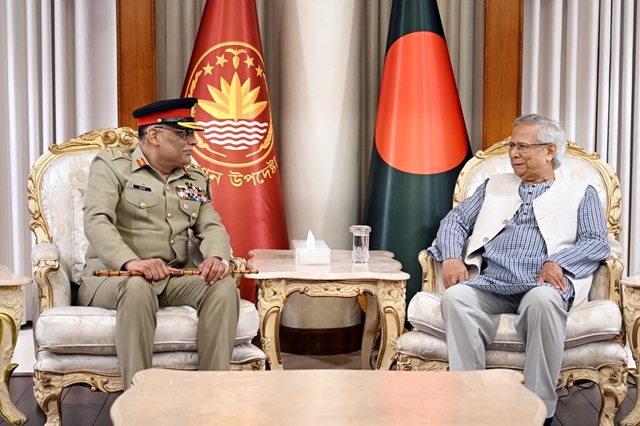
Pakistani Joint Chiefs of Staff Committee Chairman General Sahir Shamshad Mirza met with Bangladesh Chief Adviser Muhammad Yunus on Saturday in Dhaka, marking the highest-level visit by a Pakistani official to Bangladesh in years. The meeting underscores a potential rapprochement between the two South Asian nations, which share a turbulent history dating back to the 1971 war that led to Bangladesh’s independence from Pakistan.
According to a social media post by the Yunus administration, the officials discussed enhancing bilateral trade, investment, and defense ties. Pakistan conveyed its interest in deepening cooperation across multiple sectors, highlighting the potential for growth in connectivity and commerce between the two countries. Mirza noted that a shipping route between Karachi and Chittagong has already begun operating, while a Dhaka-Karachi air route is expected to open in the coming months.
The visit follows the August 2024 ousting of former Bangladesh Prime Minister Sheikh Hasina, whose government had been widely regarded as pro-India. Since taking office, Yunus has sought to pivot Dhaka’s foreign policy away from New Delhi, signaling a willingness to strengthen ties with Islamabad. In August, the two countries signed six cooperation agreements, including provisions for visa-free travel for diplomats and government officials, aimed at deepening engagement.
The talks were overshadowed by a diplomatic stir with India after Yunus presented Mirza with a gift alleged to feature a map showing parts of northeast India as Bangladeshi territory. India has not issued an official response but had protested strongly last year when a similar map circulated online.
The legacy of the 1971 Liberation War remains a sensitive issue. Since the change in government, local media reports indicate that over 1,400 sculptures, reliefs, and murals commemorating the conflict have been vandalized, destroyed, or removed across 59 districts, including at the Mujibnagar Memorial Complex. Veterans and historians have expressed concern that the destruction of monuments and revision of historical narratives signal a significant shift in how Bangladesh is remembering its war of independence.
Despite this, Pakistan maintains a stance of regret over past transgressions. Former Pakistani Defense Minister Aziz Ahmed had previously stated that Pakistan “condemned and deeply regretted” any wrongdoing by its military during the conflict. As Dhaka reorients its foreign policy, analysts suggest that economic and defense engagement with Islamabad could become a cornerstone of the new government’s strategy, reshaping a fraught regional dynamic.