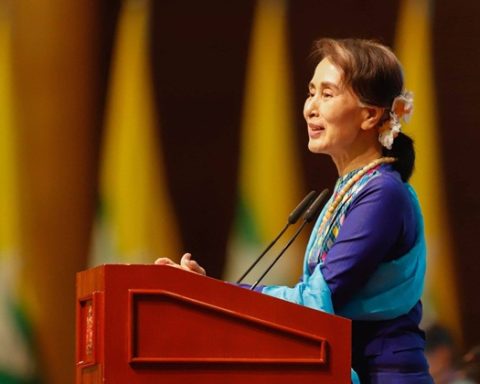
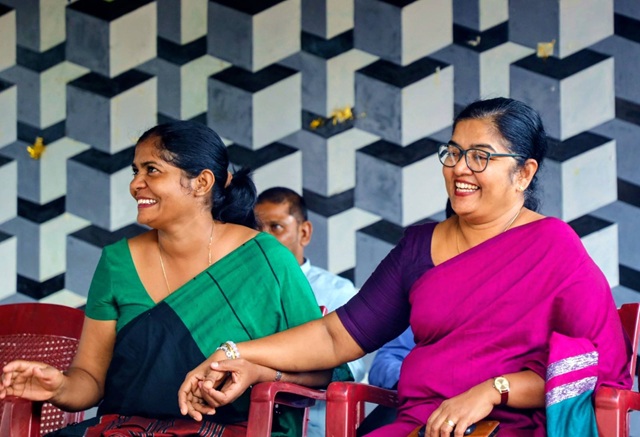
Women and Child Affairs Minister Saroja Savithri Paulraj recently proudly declared that the national election wins, secured by the National People’s Power (NPP) last year, transformed the country for the better by elevating all citizens, irrespective of race or religion, as equals before the law enforcers?.
The first Tamil Member of Parliament, elected from the Matara District ever, Paulraj said that the Tamil community greatly feared whether justice would be done if members of the community visited police stations. They were also frightened that the armed forces would treat them differently, the first-time MP, who is also a member of the NPP’s National Executive Committee said, adding that the Tamil community had been also apprehensive whether they would be accepted as citizens of Sri Lanka. However, the NPP’s triumph changed the ground situation.
At the onset of this statement, lawmaker Paulraj said that she must repeat the same in Tamil. The declaration was made at a public gathering in the UK. Among those who had been on stage at that moment were Justice and National Integration Minister Harshana Nanayakkara and Health and Mass Media Minister and Chief Government Whip Dr. Nalinda Jayatissa.
During the second JVP insurgency (1987-1990), anti-subversive operations targeted the Sinhalese. The writer, on many occasions, observed the police and military manning checkpoints leaving out Tamils, Muslims and Sinhala Catholics when buses entering the City were checked. That was the general practice all over the country.
A section of the social media criticised Minister Paulraj over her UK statement. Minister Paulraj had been on a parliamentary delegation, led by Speaker Dr. Jagath Wickramaratne, that undertook a visit to the UK from 26 to 29 October, 2025. The Parliament, in a statement issued after the conclusion of the UK funded visit, declared that the visit was aimed at strengthening inter-parliamentary collaboration, advancing democratic governance, and promoting institutional transparency and accountability.
Paulraj is the President of the UK–Sri Lanka Parliamentary Friendship Association, in addition to being the Chairperson of the Women Parliamentarians’ Caucus.
The delegation included Hansa Abeyratne, Assistant Secretary General of Parliament. Minister Paulraj also called for a focused discussion on advancing gender equality and women’s empowerment through parliamentary action with Harriet Harman, UK Prime Minister’s Special Envoy for Women and Girls.
British High Commissioner to Sri Lanka Andrew Patrick accompanied the delegation. It would be pertinent to ask whether the British HC here asked the Parliament to restrict the delegation to members of the ruling NPP. The JVP-led NPP won a staggering 159 seats, out of 225, at the last parliamentary election.
SJB frontline MP Mujibur Rahman, has questioned the decision to restrict the UK visit to NPP lawmakers. The former UNPer said that if the UK had extended private invitations to a select group of NPPers, Parliament should explain as to why Assistant Secretary General of Parliament Hansa Abeyratne joined the delegation.
Let me examine Minister Paulraj’s recent controversial comments made in the UK, taking into consideration the gradual transformation of the armed forces and police to meet separatist Tamil terrorist threat. Over the years, that threat changed into an unprecedented conventional military challenge. The British conveniently turned a blind eye to LTTE operations, directed from British soil, over several decades, as Sri Lanka struggled to resist the group on the Northern and Eastern battlefields. The UK allowed terrorism to flourish, even after the group assassinated two world leaders Rajiv Gandhi of India, in May 1991, and Sri Lankan President Ranasinghe Premadasa, in May 1993. Both of them played ball with the LTTE at different times and finally paid with their lives.
Minister Paulraj is absolutely right. Tamil people dreaded the police and armed forces as the LTTE consisted of Tamils, men, women and children. The armed forces and police had no option but to take maximum precautions and consider all possibilities as the LTTE infiltrated political parties at all levels and brazenly exploited security loopholes to advance their macabre cause.
The Matara district, represented by Minister Paulraj, experienced LTTE terror on 10 March, 2009, when a suicide bomber blew himself up at a religious parade near Godapitiya Jumma mosque, in Akuressa, killing 14 and injuring 35 – all civilians.
Members of the NPP delegation, invited by the UK, couldn’t have been unaware that the man who ‘supervised’ the terror campaign, Anton Balasingham, enjoyed privileged status as a British citizen. The former British HC employee, at its Colombo mission, was married to Adele (she now lives comfortably in the UK), who encouraged the conscription of child ‘soldiers’, including girls, operated there with the full knowledge of successive British governments.
Child soldiers
The Tamil community feared all groups that were sponsored by the LTTE. Velupillai Prabhakaran’s LTTE is definitely not an exception. The group used children as cannon fodder in high intensity battles and even during the Puthumathalan evacuations, Prabhakaran made a desperate bid to forcibly conscript child soldiers. That was during January-May 2009 as ground forces fought their way into a rapidly shrinking area held by the deeply demoralised Tiger units, surrounded by a human shield made up of their own hapless people, many of whom were held against their will.
If the NPP government bothered to peruse the reports made available by the Norway-led Scandinavian truce monitoring mission during February 2002 – January 2008, Minister Paulraj, in her capacity as Women and Child Affairs Minister, could easily understand the gravity of the then situation. The LTTE conscripted children and also deployed women, regardless of consequences. The number of child soldiers and women cadres’ deaths may horrify the Matara district NPP leader.
The LTTE used women suicide cadres as a strategic weapon. As Chairperson of the Women Parliamentarians’ Caucus, Minister Paulraj should undertake a comprehensive examination of the use of women in combat and suicide missions. That murderous enterprise continued until a soldier put a bullet through Velupillai Prabhakaran’s head on the banks of the Nanthikadal lagoon.
At the time the military brought the war to an end in May 2009, the NPP hadn’t been established. Having thrown its weight behind the war effort, at the onset of the Eelam War IV, in 2006, the JVP withdrew its support and finally ended up in a coalition, led by the UNP, that backed retired General Sarath Fonseka’s candidature at the 2010 presidential election. The coalition included the now defunct Tamil National Alliance (TNA) that formally recognised the LTTE/Velupillai Prabhakaran as the sole representatives of the Tamil speaking people. That recognition, granted in 2001, at gun point, remained until the fighting machine disintegrated during a two-year and 10-month long all-out campaign by the security forces to defeat LTTE terrorism.
Lawmaker Paulraj should seriously examine the circumstances of the Tamil community living in all parts of the country, including the Northern and Eastern regions, overwhelmingly voting for Fonseka whose Army eradicated the LTE conventional fighting capacity. The Tamils, particularly those living in former war zones, were the main beneficiaries of the LTTE’s annihilation. Had the LTTE through some jugglery, managed to work out a ceasefire, in May 2009, and save its top leadership, the child conscription may not have ended.
Sri Lanka’s triumph over terrorism ended child conscription. That achievement may not receive the approval of duplicitous and insensitive politicians and political parties but the ordinary Tamil people appreciate that.
During Chandrika Bandaranaike Kumaratunga’s presidency, her government made a strong attempt to halt forcible conscriptions. That effort involved both the UN and the ICRC but the LTTE never kept its promise to discontinue forcible conscription. Regardless of signing an agreement with the international community, the LTTE abducted children, sometimes while they were on their way to school or returning from school.
The LTTE actions never bothered the British, though some Colombo-based diplomats took a different stance. David Tatham, who served as the British HC here during the period 1996 – 1999, perhaps recognised the disruptive role played by the Tamil Diaspora in Sri Lanka. Tatham didn’t mince his words in Jaffna when he declared his opposition to the Tamil Diaspora funding the war here. Tatham made his statement three years after the armed forces brought back the Jaffna peninsula under the government rule.
During a visit to Jaffna, in August 1998, Tatham urged the Tamil community to stop funding the on-going war. Tatham knew the destruction caused by such unlimited funding. The British diplomat took a courageous stand to publicly appeal for an end to Tamil Diaspora funding. The appeal was made at a time the British allowed a free hand to the LTTE on their territory. The Tamil Diaspora received direct orders from the North. They worked at the behest of the LTTE. That ended in May 2009.
The LTTE-Tamil Diaspora adopted a simple strategy. They assured major political parties in Europe of support at parliamentary elections and the arrangement worked perfectly. The LTTE-Tamil Diaspora influenced British parliamentarians to make unsubstantiated allegations. The accusations, directed by various politicians, culminated with the Canadian Parliament formally declaring that Sri Lanka perpetrated genocide against Tamils.
LTTE sets up own ‘police’ unit
The LTTE established a police unit in 1992 and also operated a court system. Unfortunately, interested parties have conveniently forgotten how the LTTE controlled the civilian population living in areas under its control. Before Velupillai Prabhakaran developed the ‘law enforcement’ arm and rapidly expanded it, in the wake of the 2002 Ceasefire Agreement, the LTTE and other Tamil groups the targeted police.
Paulraj, as the Minister in Charge of Women and Child Affairs, should know how the LTTE strategies brought fear among the Tamil community. Let me remind the Minister of two senseless political killings carried out by the LTTE. The LTTE assassinated Rajani Thiranagama (née Rajasingham), in Jaffna, on 21 September, 1989. This happened during the deployment of the Indian Army in terms of an agreement that had been forced on Sri Lanka. The LTTE ordered her death for being critical of the atrocities perpetrated by them.
At the time of the high profile assassination, Thiranagama served as the head of the Department of Anatomy of the Medical Faculty of the Jaffna University and an active member and one of the founders of the University Teachers for Human Rights, Jaffna. The LTTE assassinated Jaffna Mayor Mrs. Sarojini Yogeswaran on 17 May, 1998, at her Jaffna residence.
Those who continuously find fault with the military, and the police, never condemn the LTTE, or other Tamil groups, for mindless violence unleashed on the Tamil community. Perhaps, a census should be conducted to identify the individual killings carried out by successive governments and Tamil groups.
Sarojini Yogeswaran’s husband former MP, Vettivelu, had been among those politicians killed by the LTTE. Vettivelu and former Opposition Leader and the foremost Tamil leader Appapillai Amirthalingam were killed during the Premadasa-Prabhakaran honeymoon (May 1989 to June 1990). LTTE hitmen killed them on 13 July, 1989, in Colombo. If Amirthalingam had allowed his Sinhala police bodyguards to check all visitors who entered the premises, this heinous crime could have been averted. Unfortunately, Amirthalingam prevented the police from interfering with the secretly arranged meeting because he didn’t want to offend the LTTE. But one Sinhala policeman shot dead all three gunmen. Had they managed to flee, the killings could have been conveniently blamed on the government.
Those who complain of security checks must be reminded of senseless killings. The Fort Railway Station, bombing on 03 February, 2008, killed 12 civilians and injured more than 100. Among the dead were eight schoolchildren of D. S. Senanayake College baseball team and their coach/teacher-in-charge.
JD before LLRC
Have we ever heard of apologists for Tigers demanding justice for those who had been killed by the LTTE? Never. The civil society never takes up killings carried out by the LTTE. Can there be a rational explanation for the assassination of Dr. Neelan Tiruchelvam, PC, on 29 July, 1999.
At the time of his assassination, the legal scholar served as a National List member of Parliament and was the Director of the International Centre for Ethnic Studies.
Who empowered the LTTE? The LTTE thrived on support extended by foreign governments. The British allowed a free hand to the LTTE operation, though the group was banned there, only in 2001, under the Terrorism Act 2000, and subsequent regulations making it a criminal offence to be a member of, or support, the group in the UK. But the group was allowed to continue and law enforcement authorities turned a blind eye to the display of LTTE flags. The displaying of LTTE flags, perhaps, is the least of the illegal acts perpetrated by the group.
One of Sri Lanka’s celebrated career diplomats, the late Jayantha Dhanapala, explained the issue of accountability when he addressed the Lessons Learnt and Reconciliation Commission (LLRC), headed by one-time Attorney General, the late C. R. de Silva, on 25 August, 2010. The writer was present there on that occasion.
Dhanapala, in his submissions, said: “Now I think it is important for us to expand that concept to bring in the culpability of those members of the international community who have subscribed to the situation that has caused injury to the civilians of a nation. I talk about the way in which terrorist groups are given sanctuary; harboured; and supplied with arms and training by some countries with regard to their neighbours or with regard to other countries. We know that in our case this has happened, and I don’t want to name countries, but even countries which have allowed their financial procedures and systems to be abused in such a way that money can flow from their countries in order to buy arms and ammunition that cause deaths, maiming and destruction of property in Sri Lanka are to blame and there is therefore a responsibility to protect our civilians and the civilians of other nations from that kind of behaviour on the part of members of the international community. And I think this is something that will echo within many countries in the Non-Aligned Movement, where Sri Lanka has a much respected position and where I hope we will be able to raise this issue.”
Dhanapala also stressed on the accountability on the part of Western governments, which conveniently turned a blind eye to massive fundraising operations in their countries, in support of the LTTE operations. It is no secret that the LTTE would never have been able to emerge as a conventional fighting force without having the wherewithal abroad, mainly in the Western countries, to procure arms, ammunition and equipment. But, the government never acted on Dhanapala’s advice.
The UK, in March this year, imposed sanctions on former Chief of Staff of the Sri Lankan Armed Forces, Shavendra Silva, former Commander of the Navy Wasantha Karannagoda and former Commander of the Army Jagath Jayasuriya, as well as Vinayagamoorthy Muralitharan, known as Karuna Amman formerly of the LTTE. Sri Lanka never had the courage to point out how the UK allowed the LTTE to build conventional military capacity.