Editorial
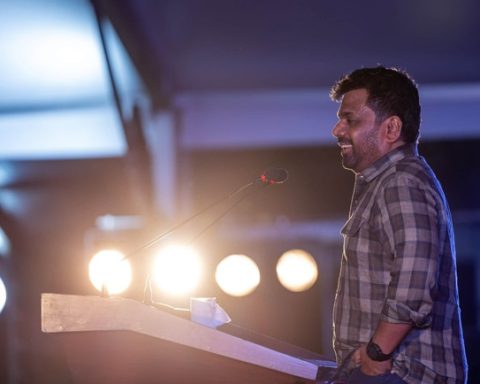
Sri Lanka continues to suffer from the havoc of a disaster that every credible warning had foretold, yet the government chose to sidestep. President Dissanayake, emerging almost 72 hours after the catastrophe, finally appeared on national television—his address packaged not as leadership but as theatre, as though he were auditioning for the principal role in some Shakespearean tragedy rather than accepting responsibility for his government’s inertia. After ignoring repeated calls to take precautionary measures, he resurfaced draped in melodrama, lamenting as though he were a victim rather than the head of state entrusted with safeguarding 22 million lives.
The country did not need a soliloquy. It needed a leader who recognised danger early, acted decisively, and mobilised competent teams instead of clinging to an inner circle marred by dubious loyalties and opaque motives. Since ascending to office with a supermajority, the President has surrounded himself not with experts but with individuals whose credentials crumble under scrutiny—one adviser simultaneously employed by a globally controversial audit firm, another “volunteering” in digitalisation while conveniently protecting the commercial interests of his true employer by obstructing telecommunications upgrades, and yet another who swiftly arranged a diplomatic post for his niece. These are not the architects of national resilience; they are the symptoms of a government weakened from within.
The mishandled vehicle import relaxation was yet another blistering indictment. The moment the gazette was issued, Chinese vehicles flooded the market in hours—an impossibility unless insiders were informed well in advance. This was not policy; it was pre-arranged advantage. It is difficult to differentiate such governance from that of past administrations the President so zealously denounced. Indeed, some of his predecessors, for all their failures, at least understood the basics of crisis command.
The most unforgivable failure lies in disaster preparedness. The entire region—Thailand, the Philippines, Indonesia—had sounded the alarm with their own early devastation. Local experts had urged immediate action. Yet the government, busy uprooting institutions in the name of “reform,” dismantled crucial structures such as the Chief of Defence Staff role, one of the most essential mechanisms for disaster coordination. The SOPs for emergencies—Operation Cloud Burst—existed in full detail, ready for activation, but the post required to implement them had been rendered impotent. When the waters rose and the land disappeared, who stepped in? Not the glossy committees. Not the hand-picked advisers. It was the military—an institution many foreign actors and domestic activists have spent years trying to shrink, discredit, or prosecute—that executed the real rescue effort.
And yet the President’s message dwelled not on frank admission but on florid sentiment. His declaration that he would “hesitate at nothing to restore life to the dead” was not leadership—it was melodrama of the most unhelpful kind, reducing a national crisis to an emotive spectacle. Leaders are expected to command reality, not romanticise defeat. His speech sounded less like a briefing from a head of state and more like the mournful wailing of a man trying to soothe his own guilt under the guise of compassion.
The country deserved hard truths: that negligence cost lives, that warnings were ignored, that institutional dismantling left Sri Lanka exposed, that the government’s appointments were reckless, and that disorganisation amplified the scale of destruction. Instead, it received a sentimental fog.
No amount of poetic imagery can substitute for the responsibilities that were abandoned. The people watched their homes disappear, their livelihoods drown, their loved ones swept away. They do not need consolations about “humanity” and “courage” from a government that failed to summon its own.
The President’s call for unity might have carried weight had he demonstrated even a fraction of the competence he demands from the public. His appeals for collective rebuilding ring hollow when foundational data systems are flawed, emergency protocols are dormant, and key institutions remain in disarray. His emotional overtures cannot erase the fact that he walked into this tragedy with warnings in his hands and chose to look away.
Sri Lanka now faces an arduous path of reconstruction—roads shattered, schools submerged, farms ruined, industries paralysed. But long-term recovery requires more than emergency circulars or hurried committees. It requires a government that is not driven by insecurity, not manipulated by insiders, and not consumed by theatrics while the nation sinks.
The President must understand that the people will no longer tolerate leadership that substitutes action with apologies, and accountability with aspiration. If he truly intends to rebuild the nation, he must first rebuild his own administration—cutting loose the dubious, the conflicted, the incompetent—and restore the operational structures his team dismantled.
The disaster may have been natural, but the scale of destruction was political. The rain fell from the sky, but the collapse came from the top.