What does India’s recently presented Union Budget signify beyond its ledger of receipts and expenditures? Can it confront structural constraints, manage the trade imbalance, and sustain domestic financial stability in an increasingly uncertain global economy? On 10 February, two noted economists convened at the Prime Ministers Museum & Library in New Delhi to interrogate these very questions and to unpack the deeper economic architecture underlying the Budget’s design.
The discussion was organised at the Prime Ministers Museum & Library and opened by Ravi Mishra, Joint Director at PMML, who framed the session as a dialogue on fiscal direction, growth constraints, and institutional readiness. Santosh Mehrotra spoke first, followed by Rakesh Mohan, after which the floor was opened for questions from academics, policy practitioners, and researchers.
Santosh Mehrotra’s work over several decades has centred on employment, skills, inequality, and development policy. He has held positions at the Planning Commission, international organisations, and research institutions, and has written on labour markets, demographic change, and education systems. His publications have examined what he identifies as structural weaknesses in job creation and the need for public investment in human capabilities. Rakesh Mohan’s career has combined academic research with senior roles in government and the Reserve Bank of India. His writing has addressed infrastructure finance, urbanisation, industrialisation, and macroeconomic management, drawing on direct administrative experience.
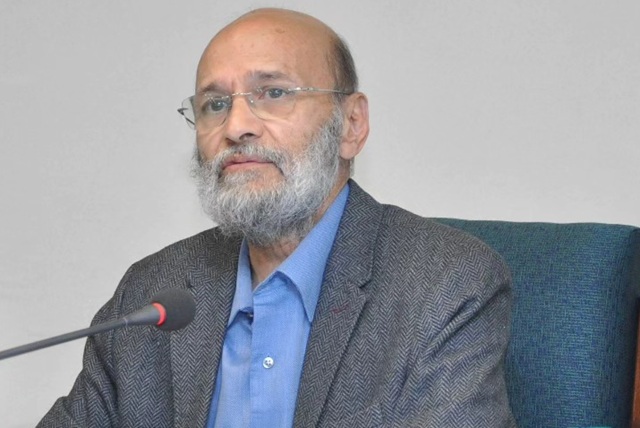
Mehrotra began with a focus on public expenditure and its composition. He said, “Much of what is being spent is not on policies and programs that are going to produce growth, jobs, employment, human development, etc. over the long run.” He linked fiscal allocations to employment outcomes and argued that expenditure patterns must be read in relation to demand creation.
He then turned to taxation, stating that revenue systems must expand alongside income growth. “If you structured your tax system… all need to work in tandem to make sure that as incomes rise, revenues automatically rise,” he said. He referred to long-run historical evidence from Europe and North America, noting that “between 1880 and 1980… the now-industrialized countries had an expenditure-to-GDP ratio of around 10–11%.” According to him, this gradual expansion reflected fiscal adaptation to development rather than a single reform moment.
Mehrotra stressed that excluding large sections of the population from taxation weakens institutional participation. “You don’t leave people out from below the threshold,” he said. “If you keep leaving them out, they will not even pay the 2%, the 3%, the 4%, the 5%, and they will never get used to the idea that I am also a taxpayer.”
His remarks moved to corporate taxation and investment behaviour. Referring to reductions in corporate tax, he said that the outcome “led to a rise in profits of the large companies,” but investment did not follow. “They didn’t invest, but they retired their own debt,” he said, adding that firms “amortized all their debt” while profits remained elevated. He connected this to demand conditions: “They didn’t invest because they could see that aggregate demand is just not there.”
Employment was presented as the central link in this chain. Mehrotra said, “If the jobs are not happening, the aggregate demand will not rise.” Referring to agricultural performance, he noted that growth figures alone do not explain consumption trends. “Agricultural GDP growth… has been 4.3 percent… Fantastic, I’m delighted, but why is the rural demand not rising? That’s the real question.”
He described what he called “an intermediate strategy” based on strengthening production linkages. “We have to ensure… we connect between these MSMEs and the large companies,” he said, adding that policy must actively support such integration rather than assume automatic coordination.
Rakesh Mohan’s presentation approached the same economic questions through infrastructure, logistics, and city-level development. His research and administrative work have long dealt with transport corridors, financial systems, and metropolitan governance. Responding to discussion on freight infrastructure, he said dedicated freight corridors “would be a totally life-changing thing that we should do.”
He explained that freight reform is tied to export competitiveness and industrial distribution. “We are about 50 years late in containerization,” he said, noting that Indian railways historically depended heavily on coal transport. “Almost all the freight is bulk freight… very few general freight. It all goes in trucks.” For him, containerisation and freight corridors are necessary to shift this pattern.
Mohan also spoke about the implications of changes in energy use. Railways, he said, risk financial strain if coal transport declines without diversification. Freight modernisation was described as essential for both logistics and revenue stability.
Urbanisation formed another major part of his remarks. Manufacturing growth, he argued, depends on functioning urban systems. He said, “We have a completely outdated system of urban governance, where the mayors have no power.” Without institutional authority at the city level, he suggested, industrial clusters cannot operate efficiently.
Audience questions introduced further themes, including industrial policy, reform outcomes, and state-level implementation. One participant asked whether decades of reforms had altered the growth trajectory significantly, noting that growth averages remained within a narrow band. Another raised concerns about infrastructure becoming more capital intensive and therefore less employment-generating.
Mehrotra responded by returning to what he called the question of “state capacity.” He clarified that he meant capacity “at the central government level, state government level, as well as the local government level,” referring to this collectively as “capital S state.” According to him, administrative resources remain limited. “India has one of the lowest government staff to 1,000 population ratio[s]… one of the lowest in the world,” he said.
He explained staffing distribution at the state level, noting that “80% are accounted for by essentially three types of services—health, education, and police,” leaving relatively few personnel for economic administration. Many sanctioned posts remain vacant, which he linked to fiscal constraints. “In the absence of government raising tax revenue, how is it going to actually reduce costs?” he asked.
He further described the composition of public employment. “Eighty-nine percent of all government staff… are either group C or B,” he said, while senior administrative cadres form a small minority. This structure, he argued, affects policy execution. Industrial strategy requires trained personnel able to design and manage programmes.
Mohan addressed compliance and administrative reach through technology. Referring to digital systems, he said expanded reporting is now feasible: “If you can do UPI… every shop has to be registered… All traders can be covered.” He argued that earlier limitations in monitoring economic activity no longer apply in the same way.
Comparisons with other countries also entered the exchange. Mohan remarked, “We say we can’t even do what Indonesia does,” suggesting that implementation gaps rather than conceptual disagreements explain some differences in outcomes.
Questions from participants covered tariff structures, manufacturing ecosystems, and supply chains. One attendee referred to high duties on raw materials and their effect on production costs. Another asked how India could become “strategically indispensable in the global supply chain.” Issues of infrastructure support for data centres, electricity reliability, and logistics integration were also raised.
Federal fiscal arrangements were discussed when a participant asked about revenue sharing between the Union and the states and whether allocation patterns would change. Others asked about migration from agriculture to services and whether planning frameworks existed to manage this transition.
Mehrotra reiterated that industrial transformation requires administrative depth. “We are all agreed… about the need for manufacturing… but that requires state capacity,” he said. He referred to East Asian experience as an example of sustained institutional investment rather than short-term intervention.
Mohan linked manufacturing prospects to urban conditions and cluster development. Efficient cities, he said, allow collaboration between firms of different sizes and create the environment in which labour-intensive industries expand.
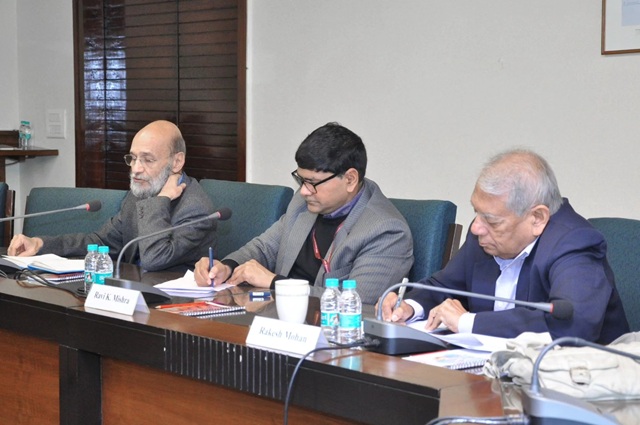
Both speakers referred at various points to their own professional experience. Mohan described earlier debates in government about transport investments and said freight corridors had long been proposed but implemented slowly. Mehrotra referred to his work in employment and development policy discussions over several decades.
The exchange remained focused on practical relationships between taxation, spending, administration, and production. Mehrotra emphasised revenue mobilisation and demand generation. Mohan emphasised logistics, infrastructure, and governance systems that enable economic activity.
When discussing public administration, Mehrotra said capacity building requires sustained hiring and training. “You cannot build capacity if you don’t spend,” he said, linking fiscal resources directly to institutional capability.
Mohan, addressing infrastructure sequencing, argued that transport choices influence industrial geography and export performance. Freight efficiency, urban management, and manufacturing location were presented as interrelated decisions rather than separate policy areas.
The session concluded after further questions on services-sector growth and labour mobility. The discussion did not move toward a summary resolution but remained centred on the interaction between fiscal policy, administrative structure, and economic activity.
Santosh Mehrotra’s remarks repeatedly returned to employment, taxation participation, and demand creation. Rakesh Mohan’s remarks repeatedly returned to infrastructure, city governance, and logistics reform. Their contributions reflected their respective research traditions and policy engagements, presented in direct response to the Union Budget and its structural implications.