


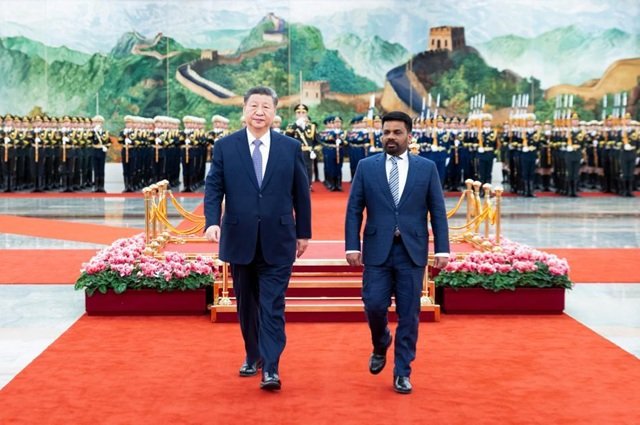
When Wei Huaxiang, the new Chinese Ambassador, arrived in Sri Lanka to assume duties, a delegation from the China Communications Construction Company met President Anura. Reports stated that the delegation discussed the initiation of eight investment projects in Colombo Port City. It appears that the government has placed high expectations on the new ambassador.
The reason is that former Chinese Ambassador Qi Zhenhong served in Sri Lanka for a long period and worked closely with former presidents during his tenure. In particular, there was a close relationship between the former ambassador and the Rajapaksa family. He arrived in Sri Lanka at a time when Gotabaya Rajapaksa was President and Mahinda Rajapaksa was Prime Minister, and during that period, he built strong ties with the Rajapaksa family.
When Anura’s government came to power, and Mahinda Rajapaksa was removed from his official residence, it was the Chinese Ambassador who went to meet him—at the very moment Mahinda was moving his belongings out. Rumours also circulated that the ambassador acted as a channel of communication between Anura’s government and the Rajapaksa family regarding the court cases filed against them. These reports, however, were never confirmed. What is clear is that the relationship between the former Chinese Ambassador and the Rajapaksas became a problem for Anura’s government.
At the party level, the Communist Party of China maintained close ties with the JVP. But in terms of state relations, China stood close to the Rajapaksas. The former ambassador followed this policy. China did not seem to believe that the JVP would ever come to power. Thus, the former ambassador found himself caught between the state-level relationship with the Rajapaksas and the party-level ties with the JVP.
The main reason he had to leave Sri Lanka was his failure to get the ban on Chinese research vessels lifted. Unofficial sources claim he informed the Sri Lankan government of this matter. China’s decision to send a new ambassador came only after studying all the issues faced by his predecessor.
According to Chinese sources, the new ambassador is expected to strengthen ties with the government while maintaining relations with the opposition in a way that does not cause difficulties for the government. China’s diplomatic tradition is to work with ruling administrations. Previous ambassadors dealt with the opposition only within a limited framework. The former ambassador broke with that tradition and built close ties with the opposition. The government now seems to expect that the new ambassador will fall in line with the tradition of only dealing closely with the government.










