by Nil
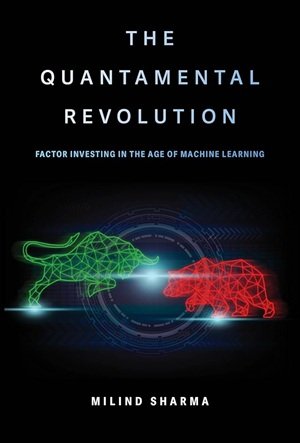
Milind Sharma’s The Quantamental Revolution arrives with the unmistakable confidence of a manifesto, a text that seeks not merely to describe a transformation in finance but to accelerate it. From its opening anecdote—“in the bitter cold of an upstate New York winter in 1994” (p. 27)—the book situates itself within a familiar Wall Street Bildungsroman, tracing a trajectory from naïve ambition to technical mastery. Yet this personal framing is quickly subsumed into a larger argument: that the era of discretionary, intuition-driven investing is not only waning but intellectually indefensible. Sharma’s tone oscillates between evangelism and critique, and it is precisely this dual posture that gives the book its energy while also exposing its internal tensions.
At the heart of Sharma’s thesis lies a sustained assault on the mythology of traditional asset management. The efficient market hypothesis, popularised by Burton Malkiel, is initially invoked as “simple and elegant” (p. 28), but Sharma quickly moves beyond it, arguing that both passive and active paradigms have been superseded by a hybrid “quantamental” approach. His critique of star fund managers is particularly pointed: the supposed alchemy of discretionary investing is reduced to a set of decomposable “Lego building blocks” (p. 30), which can be systematised, replicated, and improved upon. The implication is clear and provocative: what was once considered skill is, in fact, a bundle of risk premia obscured by narrative. This demystification is compelling, but it also risks overstating the extent to which human judgement can be fully formalised without loss.
Sharma’s historical narrative reinforces this argument by portraying Wall Street as an industry driven as much by cultural myth as by financial logic. The lingering influence of Wall Street and its “greed is good” ethos (p. 27) is presented not merely as a cultural artefact but as a structuring force that shaped generations of investors. Yet Sharma’s critique here is curiously ambivalent. While he mocks the “frat boys and the high-fiving, back-slapping monkeys” (p. 29) of an earlier era, he simultaneously indulges in a kind of nostalgia for a time when markets were less efficient and therefore more exploitable. The fully automated present, in which “algos were designed to pick off” such actors (p. 29), is both a triumph of rationality and a loss of human texture. This ambivalence runs throughout the book, complicating its otherwise linear narrative of progress.
The technical core of The Quantamental Revolution is built on the systematisation of factors and the pursuit of parsimony. Sharma’s identification of a “parsimonious subset of predictors” (p. 109) reflects a broader commitment to reducing complexity without sacrificing explanatory power. Yet this commitment is constantly under pressure from the very phenomena it seeks to tame. The “explosive growth of the factor zoo” (p. 63) and the persistent problem of multicollinearity—where “linear dependence… can make the estimated coefficients unreliable” (p. 106)—suggest that the search for clean, orthogonal signals may be more aspirational than achievable. Sharma acknowledges these challenges, but his confidence in the ultimate tractability of the problem sometimes borders on determinism.
Nowhere is this tension more evident than in his treatment of data. Sharma insists that “the sky is not the limit—data, compute, and energy are” (p. 36), foregrounding the material constraints that shape quantitative research. At the same time, he warns against an overreliance on mathematical elegance, noting that much of a quant’s career is spent “cleaning data” (p. 37). This dual emphasis on abundance and scarcity—data as both limitless resource and binding constraint—captures a central paradox of modern finance. Sharma’s invocation of analogies from physics, including the data-intensive work of the Large Hadron Collider, reinforces his argument that finance is becoming an empirical science. Yet he ultimately concedes a crucial distinction: “fear and greed… makes phynance inherently distinct from… physics” (p. 378). This admission undermines the book’s more scientistic tendencies, reminding the reader that markets remain irreducibly human systems.
The book’s engagement with behavioural limitations is sharpened through its critique of high-profile failures. Sharma’s reference to Bill Ackman’s “disastrous trade in Herbalife” (p. 33) serves as a cautionary tale about the dangers of unchecked conviction. The argument is not merely that Ackman was wrong, but that he failed to “triangulate his stubborn instincts with quant models” (p. 33). This framing positions quantamental investing as a corrective to human bias, an epistemological safeguard against overconfidence. Yet Sharma’s formulation—echoing Paul Tudor Jones—that “man with a machine is better than man versus machine” (p. 33) reveals an unresolved tension. If machines are to serve as complements rather than replacements, then the question of how to integrate human judgement remains open, rather than settled.
Sharma’s proposed solution lies in regime-based modelling and the pursuit of interpretability. His critique of hidden Markov models—prone to “more churn than conviction” (p. 193)—leads him to favour approaches that produce “stickier” and more economically meaningful regimes (p. 200). The emphasis on interpretability is particularly striking in an era dominated by black-box machine learning. Sharma insists that models must generate explanations that practitioners can act upon: “volatility spikes and credit spreads drove the shift” (p. 200). This insistence reflects a pragmatic understanding of institutional constraints, where decisions must be justified to committees and clients. Yet it also signals a retreat from the frontier of machine learning, where interpretability is often sacrificed for predictive power. The trade-off is acknowledged but not fully resolved.
The latter sections of the book expand its scope from technical methodology to broader philosophical speculation, particularly concerning artificial intelligence. Sharma’s claim that we are “on the precipice of AGI” (p. 371) and perhaps already beyond it is delivered with characteristic boldness. He envisions a future in which “the explicit cost of intelligence asymptotes to zero” (p. 372), rendering much of human knowledge work obsolete. This vision is both exhilarating and unsettling, raising profound questions about the future of labour, inequality, and governance. Sharma does not shy away from these implications, warning of a “two-tier society” (p. 373) and the potential for political destabilisation. Yet his argument here is notably speculative, relying on extrapolation rather than empirical grounding.
This speculative turn introduces a new set of tensions. On one hand, Sharma emphasises the limitations of current AI in finance, noting the “paucity of live trading data” (p. 377) and the challenges of applying deep learning in low-frequency contexts. On the other hand, he predicts a near-total transformation of the industry through “agentic AI” (p. 384). The coexistence of these positions—AI as both constrained and all-conquering—reflects the broader uncertainty surrounding technological change. Sharma’s willingness to entertain both possibilities is intellectually honest, but it also leaves the reader with an unresolved sense of direction.
Perhaps the most compelling aspect of The Quantamental Revolution is its insistence on humility in the face of complexity. Despite his advocacy for systematic approaches, Sharma repeatedly acknowledges the limits of knowledge. “Prediction is always hard” (p. 29), he reminds us, and even the most sophisticated models are subject to overfitting, p-hacking, and regime shifts. His critique of causal inference—where “this is the deadliest sin” (p. 349)—highlights the fragility of claims to scientific certainty in finance. At the same time, he concedes that “predictive usefulness and economic intuition often carry more weight than formal causal identification” (p. 351), a statement that subtly reintroduces the very human judgement his framework seeks to discipline.
In its final pages, the book adopts an almost existential tone. Sharma warns of a “gladiatorial tryst” with AGI (p. 409), suggesting that the ultimate stakes of technological progress extend far beyond finance. This apocalyptic rhetoric sits uneasily alongside the book’s earlier technical precision, raising questions about the coherence of its overall argument. Is the quantamental revolution a pragmatic evolution within asset management, or a precursor to a broader transformation of human society? Sharma seems to suggest both, but the connection between these scales is not fully articulated.
The Quantamental Revolution is, in the end, a work of considerable ambition and uneven execution. Its critique of traditional finance is incisive, its technical insights are often valuable, and its forward-looking vision is undeniably provocative. Yet its very breadth generates tensions that it cannot entirely resolve. Sharma seeks to reconcile human judgement with machine intelligence, empirical rigour with narrative meaning, and technical specificity with philosophical speculation. That he does not fully succeed is perhaps less a failure than a reflection of the complexity of the terrain he is mapping. The book’s enduring value lies not in its answers but in the questions it forces the reader to confront about the future of finance and the place of human agency within it.