by Nil
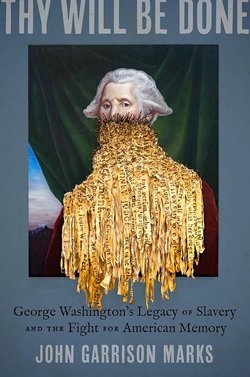
What, exactly, does it mean to topple a statue and then argue about its meaning? “Yeah, he’s the founder of the country, but 300 slaves is a lot of slaves” (p. 1) is not a historical argument so much as a moral rupture compressed into a single sentence. Yet it sits uneasily alongside the absolutist certainty that “enslavers were amoral monsters… Slave owners should not be honored with monuments in public spaces” (p. 2). Between these two positions—one pragmatic, one moral totalisation—Thy Will Be Done stages its inquiry into George Washington as less a historical figure than a perpetual argument Americans are unable to conclude. The unsettling question the book forces upon its reader is not whether Washington was good or bad, but why “Americans have been mostly running in circles for more than two centuries” (p. 11) without arriving at any stable interpretive settlement. Is this intellectual failure, political necessity, or something deeper in the structure of national memory itself?
Marks’s answer is that Washington is not simply remembered but continuously re-authored. “Washington’s complex relationship with slavery… has allowed different groups of Americans to see vastly different versions of Washington at the same time” (p. 3–4). This insight anchors the book’s methodological ambition: to treat historical memory as an active, contested field rather than a repository of settled facts. The claim that “we have always approached history not just as a window to another time but also as a mirror reflecting our own” (p. 5) is both persuasive and troubling. It is persuasive because the archival record abundantly demonstrates projection—abolitionists, Confederates, civil rights historians, and modern culture warriors all remake Washington in their own image. But it is troubling because the mirror metaphor risks collapsing asymmetries of power into interpretive equivalence. If every generation merely sees itself, what becomes of the enslaved individuals whose lives are not projections but material suffering?
This tension becomes sharper when Marks confronts Washington’s own contradictions. The familiar defence—“There is not a man living who wishes more sincerely than I do, to see a plan adopted for the abolition of it” (p. 26)—is set against the uncompromising brutality of plantation discipline: “If the Negros will not do their duty by fair means, they must be compelled to do it” (p. 18, 33). The juxtaposition is deliberately destabilising, and Marks refuses to resolve it into moral coherence. Washington “enslaved other human beings for the entirety of his adult life… Even while harboring misgivings, he rarely wavered in his commitment to his own role as enslaver” (p. 14). This insistence on simultaneity—misgivings coexisting with domination—undermines both heroic and purely condemnatory readings. Yet it also raises a difficult analytical question: does the refusal to adjudicate risk flattening ethical clarity into interpretive relativism?
Nowhere is this more visible than in Washington’s pursuit of Ona Judge, where emancipation rhetoric collides with coercive practice. “However well disposed I might be to a gradual abolition… it would be neither politic or just to reward unfaithfulness” (p. 31) exposes the conceptual elasticity of “gradualism” when confronted with self-emancipation. Marks’s reading of this episode as structural hypocrisy is compelling, especially given that Washington “saw no contradiction between his views about gradual emancipation and his persistent effort to recapture enslaved people who had emancipated themselves” (p. 31). The moral tension is not simply personal but systemic: the language of enlightenment reform is shown to be fully compatible with the machinery of bondage.
The book’s treatment of Washington’s will further complicates this portrait. Its emphatic injunction—“I do hereby expressly forbid the sale or transportation out of [Virginia] any slave I may die possessed of” (p. 36)—is often read as moral redemption. The repetition of legal intensity—“most positively, and most solemnly enjoin it upon my executors… without evasion, neglect, or delay” (p. 36)—suggests emotional urgency rare in eighteenth-century testamentary language. Yet Marks resists celebratory closure, noting that posthumous emancipation is structurally limited by the fact that Washington “freed no slaves during his lifetime despite his fine phrases” (p. 149). Here the book edges toward its most provocative claim: that late-life reform functions less as ethical transformation than as reputational management across time.
This is where memory politics becomes central. The immediate posthumous interpretations already diverge radically: Washington “’dared to do his duty, and wipe off the only stain with which man could ever reproach him’” (p. 52), while abolitionists insisted he “lived and died a slaveholder!” (p. 106). The instability is not accidental but constitutive. As Marks observes, “Everyone knew, but no one talked about it” (p. 55), capturing the early national dissonance between reverence and silence. The book is at its most persuasive when showing how this silence becomes a form of governance, structuring what can and cannot be said about foundational violence.
Yet abolitionist rhetoric complicates any easy reading of moral evolution. For William Lloyd Garrison, Washington becomes both symbol and weapon: “It is far more unpopular and hazardous to arraign the conduct of Washington, than to speak against Jesus Christ” (p. 104). This sacralisation of the Founding Father intensifies critique even as it risks theological overreach. Parker Pillsbury’s escalation—“The Revolution itself was a failure; the Declaration of Independence was a failure; Washington himself was a failure” (p. 105)—reveals how Washington becomes a proxy for the legitimacy of the entire national project. Marks is careful not to endorse this totalising condemnation, but he is equally unwilling to dismiss its rhetorical force.
Equally significant is how proslavery and Confederate reinterpretations invert the moral valence entirely. Washington is claimed as “one of us—a slaveholder and a planter” (p. 118), while Confederate currency bears his image (p. 119), demonstrating how symbolic authority can be detached from ethical context. The book’s point is not simply that Washington is contested, but that contestation itself becomes the mechanism through which slavery is continuously re-naturalised within American identity.
This dynamic extends into twentieth-century education debates, where Washington becomes a battlefield in the politics of historical knowledge. The assertion that historical teaching “destroys pride in America’s past, develops a guilt complex” (p. 172) is countered by warnings that such pride depends on selective amnesia. The claim that “our nation is witnessing a merciless campaign to wipe out our history” (p. 182) echoes earlier anxieties, suggesting that memory wars are structurally repetitive rather than historically progressive. Even the rhetorical question—“Who deserves more attention in an American history text: George Washington or Marilyn Monroe?” (p. 175)—exposes the underlying struggle over what kinds of lives are deemed historically constitutive.
Perhaps the most ethically charged sections of the book concern public history and Mount Vernon. The memorial inscription—“In Memory of the Many Faithful Colored Servants of the Washington Family” (p. 198)—is presented as both recognition and erasure. Critics note how “they didn’t even want the word mentioned” (p. 202), while visitors encounter a landscape where “an eerie sense of isolation surrounds the place where an unknown number of Washington’s 317 slaves were buried” (p. 203). The emotional force of these passages lies in their spatial argument: memory is not abstract but embedded in geography, pathways, and silences.
Yet perhaps the most unsettling intervention comes from descendants themselves, who refuse incorporation into either celebratory or purely condemnatory frameworks. “My sense of family history is not defined by Mount Vernon” (p. 194) asserts autonomy from institutional memory, while another voice insists, “What do you say about a person who, at the end of his life, does the right thing?” (p. 214–15) but rejects its adequacy. These testimonies disrupt scholarly abstraction, forcing the question of who owns historical interpretation in the first place.
Ultimately, Marks concludes that “to fully reckon with our history… we must learn to sit together with history’s uncomfortable ambiguity” (p. 235). This is both an ethical appeal and an epistemological surrender. The strength of Thy Will Be Done lies in demonstrating that Washington is not a stable object of knowledge but a shifting field of political struggle. Its limitation lies in whether “uncomfortable ambiguity” is a sufficient endpoint for histories rooted in systemic violence. If ambiguity becomes the final intellectual refuge, does it risk muting the urgency of moral judgement?
The book leaves the reader suspended between two irreconcilable impulses: the desire to historicise complexity and the demand to name wrongdoing plainly. Washington’s final words—“I die hard; but I am not afraid to go” (p. 44)—echo through the text not as closure but as deferral. Marks’s achievement is to show that American memory itself dies hard, and refuses, still, to go.