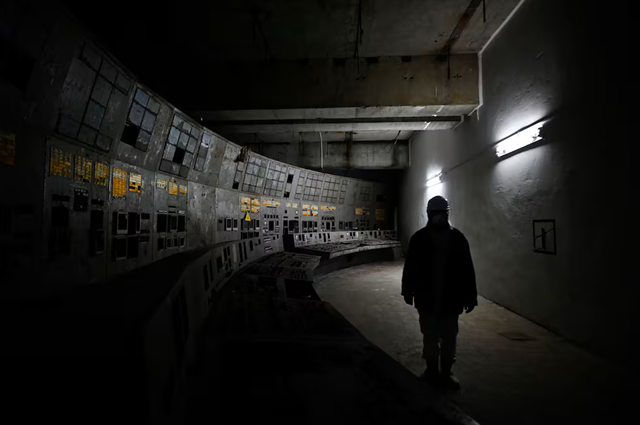
At four in the morning, tragedy in Chernobyl has a way of announcing itself. It did so on April 26, 1986, when a telephone rang in the home of Olexander Zelentsov, calling him to what he was told was a minor fire at the nuclear power plant. It happened again decades later, on February 24, 2022, when another early morning call warned that Russian troops were crossing into Ukraine through the same contaminated territory. In both moments, disbelief quickly gave way to reality. Chernobyl, already etched into global memory as one of the worst nuclear disasters in history, was once again becoming the setting for another crisis.
Forty years after reactor number four exploded, and several years after Russian forces occupied the exclusion zone, Chernobyl remains a place where some people still live. According to reporting highlighted by El Pais, a handful of residents continue to stay inside the restricted area, refusing to leave the land that has defined their lives despite radiation, war, and decades of isolation. Their presence challenges the very idea that this territory is uninhabitable.
The exclusion zone, a 30 kilometer radius around the plant, was designed to be permanently empty. In the aftermath of the explosion, Soviet authorities evacuated tens of thousands of people in a matter of days, leaving behind entire towns that seemed frozen in time. Homes were abandoned mid-meal, toys left on floors, photographs still hanging on walls. What was once a living community became an empty landscape of silence and decay. Today, only authorized workers—those monitoring radiation or maintaining the site—are permitted to enter, and even they must rotate in shifts to limit exposure. Yet within this controlled system, a fragile and unofficial human presence endures.
For those who lived through the Russian occupation in 2022, the sense of isolation deepened into fear. When Russian troops entered the zone from Belarus, they encountered little resistance. Ukrainian forces avoided direct confrontation in such a contaminated area, allowing Russian units to establish a logistical base while advancing toward Kyiv. For 36 days, Chernobyl was transformed into a militarized zone layered on top of an already dangerous environment.
Workers who were unable to leave described life under occupation as a form of captivity. Some were confined to their homes, only allowed outside under strict conditions. Food supplies dwindled, heating was restricted, and access to clean water became uncertain. The already harsh conditions of the exclusion zone were compounded by the presence of armed soldiers and constant uncertainty. Yet even in these circumstances, small acts of solidarity emerged. Workers quietly organized networks to share food, gather information, and support one another, risking punishment if discovered.
For many, the experience echoed stories passed down through generations about wartime occupation. What had once sounded distant and historical suddenly became immediate and real. The combination of military control and radioactive surroundings created a reality that felt almost surreal, as though the past and present had collapsed into one.
Long before the war, however, Chernobyl had already reshaped countless lives. Zelentsov, one of the first men to enter the plant after the explosion, remembers the moment he realized the scale of the disaster. As he drove toward the reactor that morning, something was wrong. The structure he had seen every day was gone. In its place was an absence so profound it was difficult to comprehend.
He and other workers entered the damaged plant under extreme conditions, wading through contaminated water and navigating unstable structures to prevent further explosions. Their task was urgent: disconnect systems that could trigger a chain reaction capable of causing even greater devastation. Many of those who took part in the operation later died from radiation exposure. Zelentsov survived, though he recalls the physical toll—hair loss, burns, and the long recovery in hospital—alongside the memory of colleagues who did not live to tell their stories.
The human cost of the disaster remains a subject of debate. Official Soviet figures initially reported only a limited number of deaths, but later studies by international organizations suggested that thousands may have died in the years that followed due to radiation related illnesses. Beyond the statistics lies a deeper impact: communities erased, families separated, and a lasting psychological scar that continues to shape lives decades later.
Yet not everyone accepted evacuation as permanent. One of the most remarkable aspects of Chernobyl today is the presence of the samosely, the self settlers who either returned after the evacuation or never truly left. Mostly elderly women, many of them widows, they live in scattered homes across the exclusion zone, often alone and far from any neighbors.
One such resident is Galina Voloshina, who has spent most of her life in Chernobyl. She remembers the town as it once was—not as a symbol of disaster, but as a vibrant place where people came to отдых by the river, children played in the streets, and life felt full of possibility. After being evacuated in 1986, she returned within days and has remained ever since. At the entrance to her home, a painted message reads simply, “People live here.” It is both a statement of fact and an act of defiance.
For Voloshina and others like her, leaving is unthinkable. Their connection to the land is rooted in memory, identity, and a sense of belonging that cannot be replaced. Even after the Russian invasion introduced new dangers—military checkpoints, fortifications, and the constant presence of soldiers—they chose to stay. The risks, while real, are outweighed by the certainty that this is where they belong.
The physical landscape of Chernobyl reflects this tension between abandonment and persistence. Entire neighborhoods have been overtaken by nature. Trees grow through the windows of apartment blocks, vines wrap around crumbling structures, and roads have faded into dirt paths. In nearby Pripyat, once a city of 50,000 people, buildings stand empty and silent. An amusement park that was set to open days after the disaster remains frozen in time, its rusting ferris wheel an enduring symbol of interrupted life.
At the same time, life has returned in unexpected ways. Wildlife has flourished in the absence of human activity. Deer, wild horses, foxes, and even wolves now roam freely through forests and empty streets. Scientists have noted that while radiation remains a concern, the absence of human interference has allowed ecosystems to recover and even thrive. In a paradoxical way, the disaster created a refuge for nature.
Inside the nuclear plant, however, the danger is carefully managed but ever present. A massive steel structure installed over the destroyed reactor in 2016 serves as a protective shield, preventing the release of further radiation. Beneath it lies the remains of the original reactor, including highly radioactive material that still poses a threat. Workers continue to monitor the site daily, maintaining equipment and ensuring that the containment systems remain stable.
The process of fully dismantling the plant is expected to take decades. The removal and storage of nuclear fuel from other reactors remain complex and risky tasks, further complicated by the ongoing war. Chernobyl is not just a relic of the past; it is an active challenge that continues to demand attention and resources.
For the few residents who remain, daily life is shaped by both routine and resilience. Marusia Zaiornaia, an elderly woman living alone in a remote village within the zone, spends her days tending her garden, collecting firewood, and caring for animals. Her family, who live in Kyiv, repeatedly urge her to leave. She refuses.
“This is my home,” she says. “If I leave, I will die.”
Her words capture a sentiment shared by many of the samosely. Their decision to stay is not based on denial of risk, but on a deep emotional connection to place. For them, the land is not defined by disaster, but by a lifetime of memories.
Another resident, Valentina Kuharenko, recalls the moment of the explosion. She was fishing by the river with her husband when they saw a strange glow in the distance. At the time, they did not realize that everything had changed. Today, she reflects on the past with a mixture of nostalgia and sorrow. The town that once brought prosperity and happiness, she says, ultimately destroyed itself.
“Chernobyl was born centuries ago,” she reflects, “but it died in 1986.”
Yet the story is not entirely one of death. Despite the devastation, despite the radiation, despite the war, life continues in small and stubborn ways. Workers still travel into the zone, maintaining the plant and monitoring the environment. A few residents continue to live in their homes, preserving a connection to a place that the rest of the world has abandoned.
Chernobyl today exists in layers. It is a site of historical catastrophe, a symbol of technological failure, a battlefield in a modern war, and a place where human resilience quietly persists. The exclusion zone, once intended as a permanent void, has become something more complex—a space where memory, danger, and life coexist.
As Ukraine continues to endure the pressures of ongoing conflict, the story of Chernobyl takes on new meaning. It is no longer only about a nuclear disaster, but about the capacity of people to endure in the face of overlapping crises. The residents who remain are not simply survivors of the past; they are witnesses to the present and, in their own way, guardians of a place that refuses to disappear.
Against radiation, against war, and against the passage of time, they remain. In a landscape defined by absence, their presence is a quiet but powerful declaration: life, even here, goes on.