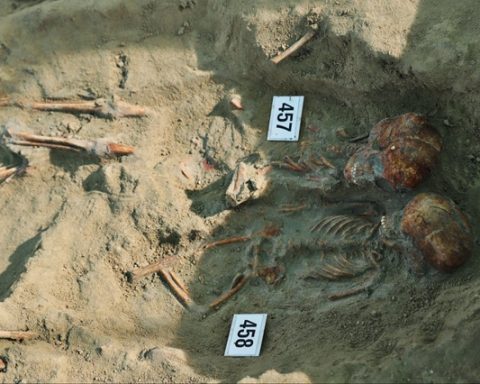
Every April 24, the Armenian world pauses in collective remembrance of a catastrophe that still defines its identity and politics. The date marks the beginning of the genocide carried out by the Ottoman Empire, the predecessor of modern Turkey, in which an estimated 1.5 million Armenians were killed between 1915 and 1918. The commemoration centers on April 24, 1915, a day remembered as Red Sunday, when Ottoman Interior Minister Talaat Pasha ordered the arrest and execution of 250 Armenian intellectuals, including writers, clergy, and political leaders. They were taken toward Ankara and killed, setting in motion a systematic campaign of extermination that would unfold over the following three years.
The violence was not spontaneous but carefully organized. The ruling Committee of Union and Progress, known as the Young Turks, envisioned a homogenized empire and pursued policies aimed at eliminating the Armenian population. Deportation orders forced entire communities into marches across the Syrian desert without food or water. Survivors recount families torn apart, bodies left along desolate routes, and rivers filled with the dead. Women and girls were subjected to enslavement, sexual violence, and forced assimilation. Those who survived often did so only by fleeing abroad with nothing but their lives and the psychological burden of survival.
Reporting on these events has been shaped not only by historical documentation but also by ongoing political tensions. As El Pais has noted in its coverage, the Armenian genocide remains one of the most disputed and sensitive historical episodes in international relations, largely due to Turkey’s continued refusal to formally recognize it. This denial has transformed memory into a diplomatic fault line that extends far beyond historical debate and into contemporary geopolitics.
Within Armenia itself, however, the question of memory has become increasingly complex. The current government has adopted a pragmatic stance that places less emphasis on international recognition of the genocide as a foreign policy priority. In 2024, Armenian officials suggested that recognition efforts were no longer central to diplomatic strategy, while Prime Minister Nikol Pashinyan has publicly questioned why global mobilization around the genocide intensified decades after the events themselves. Without denying the historical reality outright, this approach reflects a political calculation aimed at normalizing relations with Turkey. Yet for many Armenians, such positioning feels like an unsettling departure from a foundational element of national identity.
The tension lies in the fact that the genocide is not simply a historical episode but a core component of Armenian collective identity. It is embedded in language, cultural practices, family narratives, and even everyday habits passed across generations. Sociologist Maurice Halbwachs’ theory of collective memory helps explain why such trauma persists: individual memory does not exist in isolation but is sustained by the social group. When the state itself begins to question the centrality of that memory, it creates a symbolic rupture that is deeply destabilizing.
Psychologists and trauma researchers describe the Armenian experience as one of transgenerational trauma. Feelings of persistent anxiety, hypervigilance, and grief are transmitted across generations, often without explicit verbalization. Some researchers in epigenetics suggest that trauma may even leave biological traces that affect descendants. Within Armenian families, this inheritance is reflected in subtle but enduring cultural behaviors: an emphasis on frugality, the sanctity of family cohesion, and an unspoken sense of responsibility to honor those who did not survive.
The consequences of this unresolved trauma are compounded by the persistent reality of denial. The refusal by Turkey to acknowledge the genocide has significant psychological implications. Trauma specialists argue that denial prevents mourning, effectively trapping descendants in a state between memory and erasure. If a crime is officially denied, the act of grieving becomes destabilized, leaving victims’ descendants unable to fully process loss. This dynamic transforms historical violence into an ongoing emotional condition, reinforced by the absence of accountability.
The legacy of violence did not end in 1915. In the late 1980s, as the Soviet Union weakened, anti-Armenian violence erupted in Azerbaijan, notably in Sumgait in 1988 and Baku in 1990, forcing thousands of Armenians to flee once again. These events reopened historical wounds that many believed had long been sealed. More recently, in 2023, over 100,000 Armenians were displaced from Nagorno-Karabakh following a military offensive by Azerbaijan. The mass exodus revived collective memories of forced removal and survival, reinforcing the perception that vulnerability remains a recurring condition.
These repeated displacements have contributed to what some analysts describe as a form of learned defensiveness in Armenian society. Political scientist Inesa Nersisyan has argued that the country’s development has been constrained by a century marked by pogroms, genocide, earthquakes, wars, and repeated waves of forced migration. In such conditions, long-term planning becomes difficult, and societies often focus on immediate survival rather than future projection.
Despite this history, Armenian cultural resilience remains a defining feature of its global diaspora. The writer William Saroyan once expressed this endurance in a phrase that continues to resonate widely: “When two Armenians meet anywhere in the world, they will create a new Armenia.” It captures both the fragility and persistence of a people shaped by catastrophe yet continuously reconstructing identity across borders.
Still, fundamental questions remain unresolved. How does a society heal from trauma that is not officially acknowledged by all parties? How can mourning occur when history itself is contested? And what happens when political normalization requires the softening of collective memory?
For Armenians, these questions are not abstract. They sit at the intersection of history, identity, and survival. And as long as remembrance and denial coexist, April 24 will remain not only a day of mourning, but a reminder that some histories continue to live in the present rather than the past.