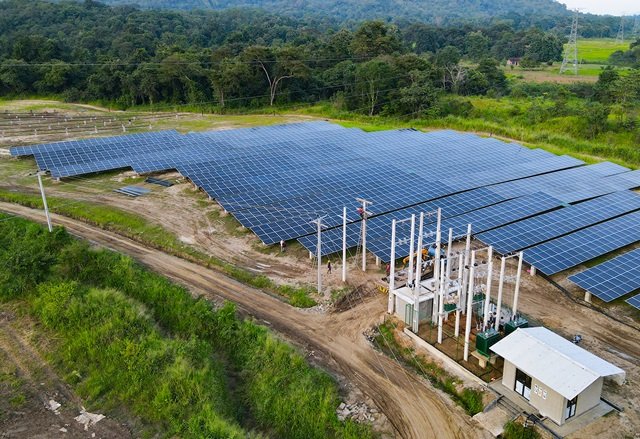
A major renewable energy project in Sri Lanka’s Hambantota region has come under intense scrutiny following allegations that around 1,000 acres of forest land bordering the Hambantota Elephant Management Reserve have been illegally cleared to make way for a 150-megawatt solar power development. According to the information presented, the affected areas in Sinuccugala, Orukengala, and Kapapuwawa—within the Hambantota Divisional Secretariat—are critical habitats for elephants and other wildlife. The clearance is alleged to have been carried out by a network of 17 companies operating under a broader umbrella project identified as the Hambanthota 150 MW Solar PV Project – Group of Companies.
The project, reportedly promoted as a USD 150 million investment, is said to have proceeded with the involvement of multiple regulatory bodies, including the Sustainable Energy Authority of Sri Lanka, the Mahaweli Authority of Sri Lanka, and the Central Environmental Authority. However, the allegations suggest that approvals were granted under fragmented corporate identities, potentially obscuring the true scale and unified control of the project. Critics argue that presenting multiple companies as separate entities may have enabled the developers to bypass more rigorous environmental impact assessments and simplify access to land leases managed under the Mahaweli development system.
At the center of the controversy are claims that several companies involved in the project are either unregistered or closely interlinked through shared directorships. Eight companies, including Geneco Pvt Ltd, Solargen Pvt Ltd, Stallion Energy Solar Pvt Ltd, Elephant Power International Pvt Ltd, Madunagala Agrico Pvt Ltd, Leisure Creation Pvt Ltd, Talna Solar Pvt Ltd, and Greenline Solar Pvt Ltd, are reported to be connected through overlapping directors. Among those repeatedly named are individuals identified as Palavinnage Charana Mitsuka Kumaranatunga, Dulanga Kumaranatunga, and Madusanka Purawarana Fernando, alongside a Chinese national referred to as Liu Kai, who is described as a key investor and a director across multiple entities. One of the Sri Lankan-linked directors is alleged to be involved in several of the companies simultaneously, suggesting a tightly controlled corporate structure operating under different legal shells.
Further concerns arise from reports that two additional companies—Electrolyte Pvt Ltd and Circle Line Pvt Ltd—associated with the same project group may not be formally registered legal entities. If confirmed, this would raise serious questions about how such entities could have entered into agreements for land leasing and power purchase arrangements with state institutions and grid authorities. The involvement of the Ceylon Electricity Board in contractual arrangements has been implied within the broader project structure, intensifying scrutiny over how procurement and grid integration decisions were made without identifying potential irregularities in corporate legitimacy or compliance.
Environmental and social consequences form a central part of the concerns raised. The clearance of approximately 1,000 acres of forest land along the boundary of the elephant management reserve is reported to have severely disrupted elephant corridors, pushing herds into nearby villages with increasing frequency. The resulting human–elephant conflict has reportedly escalated to dangerous levels, with incidents of property destruction, injuries, and fatalities becoming more common. Communities in the Mayurapura division—where over 5,000 farming families reside under the Walawa Left Bank settlement scheme—along with agricultural populations in Gonnooruwa, Meegahajadura, Thanamalwila, and Galwewa, are said to be directly affected. Farmers in some areas have reportedly abandoned cultivation due to persistent wildlife incursions and safety risks, transforming what was once an agricultural concern into a broader socio-economic crisis.
The allegations further claim that state institutions may have failed to properly verify environmental compliance and corporate legitimacy before granting approvals. By structuring the project across multiple companies with shared leadership, developers are accused of fragmenting environmental impact responsibilities, potentially avoiding comprehensive assessments required for large-scale land conversion. Critics argue that this approach may have been facilitated either through regulatory negligence or deliberate misrepresentation, though no formal findings have confirmed wrongdoing. The apparent absence of effective intervention from relevant authorities despite emerging concerns has intensified public debate over institutional accountability and governance integrity in environmental decision-making.
At a constitutional level, the issue has been framed by critics as a potential violation of fundamental rights, particularly those relating to equality before the law and environmental protection. Under Sri Lanka’s constitutional framework, the state carries a responsibility to safeguard the environment for public welfare, while citizens are entitled to protection from unlawful or arbitrary administrative actions that degrade ecological systems. The allegations suggest that regulatory bodies may have acted in ways that prioritize investment facilitation over environmental protection, raising questions about whether public institutions are adequately balancing development goals with ecological and community safeguards.
Calls are now growing for urgent intervention by oversight and anti-corruption mechanisms, including the Commission to Investigate Allegations of Bribery or Corruption, the Auditor General’s Department, and the Attorney General’s Department. Observers argue that a full independent review is necessary to determine whether environmental approvals, land leases, and corporate registrations were handled in accordance with the law. As the situation develops, the controversy surrounding the Hambantota solar project has become a flashpoint in Sri Lanka’s broader struggle to reconcile renewable energy ambitions with environmental conservation and institutional transparency.