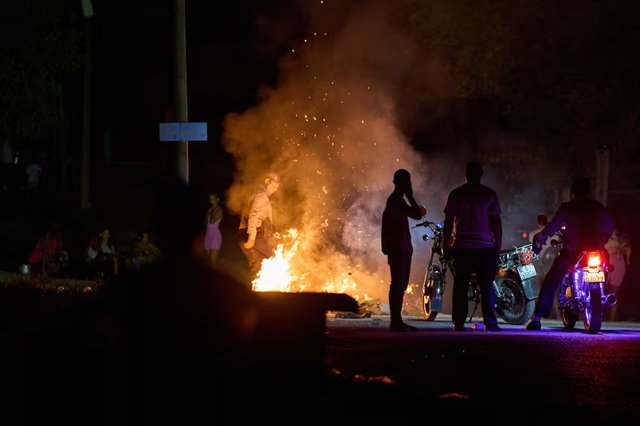
This report is based on field reporting originally published by El País, which documents a rapidly deteriorating humanitarian and political situation across Cuba, where daily life in neighborhoods of Centro Habana has become defined by electricity cuts, food scarcity and rising desperation. At midday, bread still has not arrived in one of Havana’s districts. Inside a bakery with empty shelves, workers explain the cause that residents already know well: without electricity, nothing can be baked. In the heavy Caribbean heat, the smell of uncollected garbage mixes with humidity and exhaustion, while residents queue for basic goods such as eggs sold by unit because a full carton costs more than half a monthly pension.
The crisis is not abstract but deeply physical, shaping every moment of daily life. Streets filled with potholes and stagnant water are crossed by bicycles, electric tricycles and occasional trucks carrying potable water. Andrés, a 37-year-old veterinary doctor who also works weekends as a bicitaxi driver, describes working up to 15 hours a day under the sun just to make ends meet. Despite earning above the national average, he says life remains “very difficult,” especially with a teenage daughter at home. He reports going days without water and enduring near-total electricity loss in his household, reflecting a broader collapse in basic services across the capital.
Much of this breakdown is linked by residents and officials alike to what Cuban authorities describe as intensified external pressure under U.S. President Donald Trump. The government claims that sanctions and energy restrictions have deepened an already fragile system, with fuel reserves reportedly depleted after months of shortages and minimal diesel imports. Only one Russian ship has delivered fuel in recent months, according to official acknowledgements, while power generation capacity has continued to decline. The result is a fourth month of severe energy paralysis that has spread beyond Havana into nationwide disruption.
The political dimension of the crisis has also escalated sharply. Washington has increased sanctions on Cuban institutions, including the military-run conglomerate GAESA, which controls a large share of the economy. At the same time, a U.S. court in Florida recently brought a historic indictment against Raúl Castro over his alleged role in the 1996 downing of civilian aircraft, marking the first criminal proceedings against Cuba’s revolutionary leadership in decades. Cuban officials responded with large state-organized demonstrations condemning what they describe as foreign aggression and “economic warfare.”
On the streets of Havana, however, the language of geopolitics is filtered through immediate hardship. For many residents, survival has replaced ideology. A 22-year-old vendor who left school early says he avoids protests out of fear of police violence but admits that “no one agrees with this situation.” He describes constant blackouts, lack of sleep due to heat and mosquitoes, and a daily struggle to feed his family. His mother, who requires proper nutrition due to a thyroid condition, often goes without food, a situation mirrored in many households where meals are skipped entirely.
Others express a growing sense that change may only come through external force or dramatic political rupture. Some residents referenced past regional interventions as examples, even as they voiced unease about violence. The idea of a foreign intervention is discussed in contradictory terms: feared for its potential destructiveness, yet also seen by some as a possible escape from prolonged stagnation. This ambivalence reflects a deeper loss of faith in domestic political solutions after decades of economic decline and limited reform.
The government, meanwhile, continues to frame the crisis in terms of resistance and sovereignty. Officials have warned of possible military escalation and reaffirmed their commitment to defend the revolution. State media recently highlighted the collection of millions of signatures supporting the leadership’s position against what it calls a blockade and economic siege. Yet on the ground, many Cubans express disbelief at official narratives, pointing instead to shortages of food, medicine and reliable infrastructure.
The social consequences are visible in both urban and domestic spaces. Families report cooking with charcoal indoors, collecting water in buckets during brief supply windows, and sleeping outdoors or on floors to escape extreme heat. A retired construction worker describes injury after falling while carrying water containers, while others rely heavily on relatives abroad for financial survival. At the same time, migration has become a central aspiration for younger generations, who see leaving the country as the only viable path to stability.
In intellectual and academic circles, criticism of the system has also intensified. Some Cuban scholars argue that the state has entered a cycle of reaction rather than reform, with political legitimacy eroding as living conditions deteriorate. While official discourse continues to emphasize unity and resistance, critics warn that the gap between the state narrative and everyday reality has become too wide to ignore.
Despite these tensions, organized political opposition remains fragmented, and past protests have been met with arrests and repression. The memory of the 2021 demonstrations, which resulted in mass detentions, still shapes public caution. According to human rights organizations, more than a thousand political prisoners remain in Cuban jails, reinforcing a climate of fear that limits collective action even amid widespread discontent.
El País reporting highlights that the central paradox of the current moment is a society that is increasingly disillusioned yet uncertain about any alternative path. While some still hope for internal reform, others believe only external pressure or systemic collapse will bring change. In both cases, the immediate reality is the same: daily survival in a country where electricity, food and water can no longer be taken for granted.
As Cuba navigates a tightening web of sanctions, diplomatic confrontation and internal exhaustion, its population remains caught between competing political narratives. For most citizens, however, ideology has been overtaken by urgency. The crisis is no longer about abstract political systems, but about whether the lights will come on, whether food will arrive, and whether another day of endurance can be managed in a country where, for many, survival itself has become the only certainty.