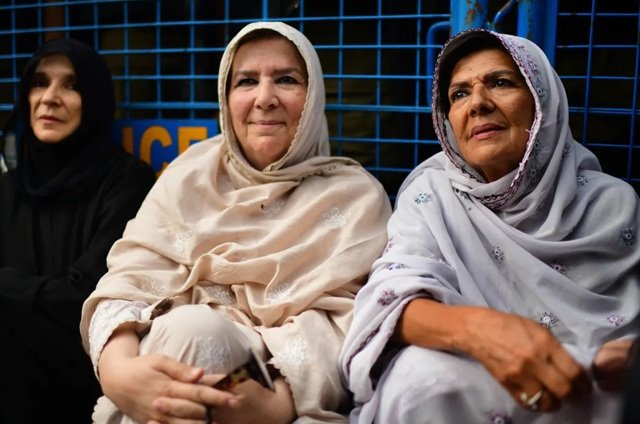
At the gates of Adiala Jail on the outskirts of Rawalpindi, a weekly ritual has hardened into a symbol of Pakistan’s deep political divide. Three elderly sisters of imprisoned former prime minister Imran Khan sit for hours on the roadside facing a heavy police barricade, refusing to leave despite heat, cold, and the presence of riot officers. They say they are being systematically denied access to their brother, who has been held for nearly three years and, according to them, confined in solitary conditions for the past seven months. Their account, reported by Times UK, paints a picture of isolation, political coercion and a struggle that now extends far beyond one family.
The scene repeats itself every Tuesday, the official visiting day at Pakistan’s most high-security prison, where political prisoners are held alongside convicted criminals. The sisters—Uzma Khanum, Aleema Khanum and Noreen Niazi—arrive from different cities, only to be stopped by barricades and police cordons that force them to walk long distances through disrupted roads. They sit in silence or under chanting crowds of supporters from Khan’s Pakistan Tehreek-e-Insaf (PTI) party, who call out his name while police in helmets and shields gradually increase in number. The women say they have endured baton charges, tear gas, and water cannons, yet continue returning each week in the hope of a court-ordered meeting that never materialises.
Their frustration is rooted in what they describe as an escalating denial of basic contact with Imran Khan. Uzma Khanum, a retired surgeon, says she last saw her brother more than six months ago, and that even then he was already in distress after weeks of isolation. She alleges that prison guards were instructed not to speak to him and that he has now spent months without meaningful human interaction. According to the sisters, Khan has repeatedly told them that “nothing is worse than solitary confinement” and that authorities are attempting to “break” him psychologically.
The claims extend beyond isolation. Uzma and her sisters say they fear Khan may be losing vision in one eye due to untreated medical complications. They allege that when his lawyers were permitted brief access earlier this year, he complained of severe vision loss and was told by a government doctor that a blood clot had caused significant, possibly permanent damage. They also say that access to reading material—once his primary source of mental resilience—has been heavily restricted, reducing the number of books allowed into his cell and rejecting some on political grounds. The family argues that such conditions amount to deliberate deprivation aimed at weakening him further.
The political backdrop to his imprisonment is equally contested. Imran Khan, a former international cricket star turned populist leader, was ousted from office in 2022 after a parliamentary no-confidence vote. His supporters argue that the move was orchestrated with military backing, while critics say it reflected political instability and governance failures. He was arrested in August 2023 on multiple charges, including corruption and leaking state secrets, and later convicted in connection with the so-called state gifts case. Although some convictions have since been overturned, he remains in custody serving a lengthy sentence. His party, PTI, was barred from contesting elections directly, though independent candidates aligned with it still performed strongly in the 2024 polls.
Central to the family’s allegations is Pakistan’s military leadership, particularly army chief Asim Munir. The sisters accuse him of orchestrating Khan’s detention and isolation, claiming long-standing personal and institutional tensions dating back to Khan’s tenure as prime minister when he removed Munir from a senior intelligence post. The military has not publicly responded to these specific allegations. However, its influence over Pakistan’s political system remains widely acknowledged, and Khan’s supporters argue that his imprisonment reflects a broader pattern of military dominance over civilian leadership.
Legal avenues appear increasingly exhausted. The family says court orders allowing weekly visits by relatives and lawyers are routinely ignored, despite repeated petitions to both high and supreme courts. PTI officials claim they have filed dozens of legal motions without success, describing what they call a “systemic collapse of judicial enforcement” in politically sensitive cases. Government representatives, however, insist that Khan is receiving adequate facilities and medical attention, and have described some of the family’s claims as exaggerated or unverified.
The situation has drawn limited international attention but some concern from political and sporting figures abroad. A group of former cricket captains and commentators reportedly called for Khan to receive proper medical care, citing his deteriorating health and long-standing global profile as a former World Cup-winning captain. His sons, who live in London, have also spoken of growing frustration at limited communication with their father, saying phone calls have become rare and heavily restricted. The Times UK report highlights how even this limited contact has become a point of emotional strain within the family.
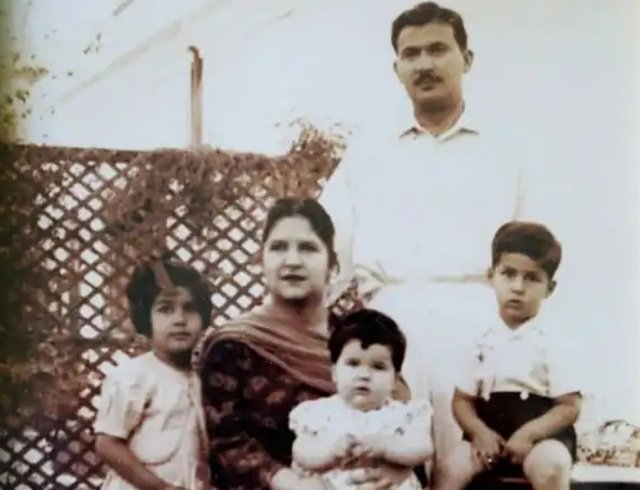
Meanwhile, Khan’s sisters say the consequences of the case now extend beyond prison walls. Members of their extended family have been detained or prosecuted in connection with protests, while PTI supporters continue to face arrests following unrest in 2023. One of the sisters, Noreen Niazi, describes a sense of permanent dislocation, saying their lives have become defined entirely by court hearings, prison visits, and police checkpoints. Another, Aleema Khanum, says she has effectively paused her business and philanthropic work to pursue legal and advocacy efforts full time.
As the weekly sit-ins continue outside Adiala Jail, the broader question of Khan’s fate has become entangled in Pakistan’s enduring struggle between civilian politics and military authority. His supporters warn that prolonged isolation and restricted access to family and legal counsel could have irreversible consequences for his health and even his life. Critics of the government argue that his own political legacy includes imprisoning rivals during his time in power, suggesting a cycle of retribution that has repeatedly defined Pakistani politics.
For now, the barricades remain in place, and the sisters return each week to sit on the roadside facing armed police. Their presence has become a fixed point in an escalating political confrontation, one that shows no sign of resolution. As reported by Times UK, what began as a family’s effort to visit a detained relative has evolved into a highly visible challenge to Pakistan’s current power structure, with Imran Khan at its centre and his isolation at its core.