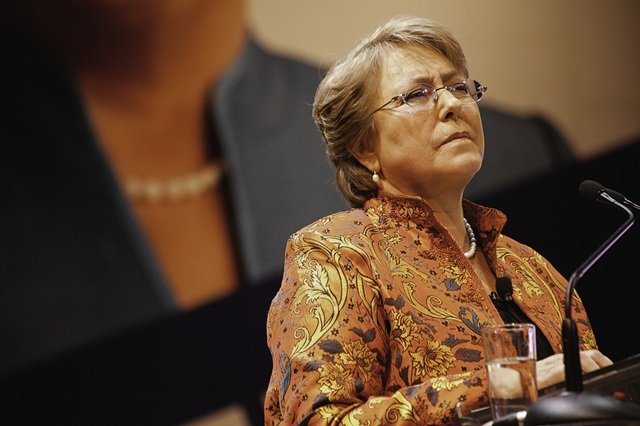
The former president of Chile, Michelle Bachelet, has said she would regard a possible veto against her candidacy for United Nations Secretary-General as a point of honor if it were based on her support for democracy, multilateralism, women’s rights and human rights.
Speaking in Geneva, Switzerland, Bachelet addressed the prospect of opposition from the five permanent members of the UN Security Council, stating: “No debería decir esto, pero lo voy a decir porque realmente lo creo. Si alguien me veta porque creo en la democracia, porque creo en el multilateralismo, porque creo en los derechos de las mujeres, porque creo en los derechos humanos, me sentiré honrada.” She added in English: “If somebody vetoes me because I believe in democracy, because I believe in multilateralism, because I believe in women’s rights, because I believe in human rights, I will be honored.”
The remarks were made during a press point organized after a debate in Geneva, where Bachelet appeared alongside fellow candidates Rebeca Grynspan and María Fernanda Espinosa. The event formed part of a wider series of engagements involving contenders for the post of UN Secretary-General, as the current mandate of António Guterres is set to conclude on 31 December.
Bachelet is among five declared candidates seeking to lead the United Nations. She is backed in her candidacy by Mexico and Brazil, according to the information presented, while her native Chile has withdrawn its support. The text attributes that shift to Chilean President José Antonio Kast, described as representing the right-wing conservative political sector, reversing backing previously associated with former President Gabriel Boric’s administration.
The selection process for the UN’s top post involves the 15-member Security Council, with five permanent members holding veto power. These are the United States, China, France, Russia and the United Kingdom. Any of these states can block a nomination regardless of broader support within the Council.
During the Geneva event, Bachelet participated in a forum organized by GWL Voices, a group advocating for female leadership of the United Nations, in coordination with the United Nations Foundation in Geneva. The Argentine candidate Rafael Grossi, Director General of the International Atomic Energy Agency, did not participate in person, while former Senegalese President Macky Sall submitted a video message presenting his candidacy.
According to the statements made at the event, Bachelet outlined her vision for the role if elected, describing herself as a “secretary general independent and always on the ground.” She said she would pursue reforms aimed at making the UN “more agile, efficient and accountable,” emphasizing dialogue and consensus-building as central tools for institutional change.
Bachelet also stated that, in the event of international conflict, she would offer mediation where appropriate and insist on adherence to international law. She added that she is not afraid to speak when necessary and to travel wherever dialogue is required. In her remarks, she said that a secretary-general without the ability to act effectively risks becoming “a commentator on what happens,” underscoring her view of the role as an active mediator in global affairs.