When Zarina looked down at herself as a little girl, she saw a princess. The dress she wore that day was the one she had always wanted but had never been allowed to wear. It was bright yellow, with puffed sleeves and a high waist that fell loosely to her knees. She was not even five years old, but in that moment she felt beautiful.
Her older sister Darya, known to everyone as Dasha, took her hand and smiled. Together, they walked out of their apartment to help a woman who begged on a street corner nearby. Zarina had often asked her mother, Olga, if she could give the woman money. Her mother always refused, saying nobody helped them either. But that day, Zarina received five kopeks and proudly placed them in the woman’s hand.
Almost three decades later, Zarina still remembers that moment as one of the few happy memories from her childhood. Many of the others also involve Darya — the sister who comforted her when she cried, taught her to read, calculate, sew and draw, and became the person Zarina looked up to most.
She was also the sister whose body remained in their shared room for seven years after her death.
The story of Zarina’s childhood, reported by Die Zeit and ZEIT Verbrechen, is a chronicle of isolation, poverty, untreated mental illness and a family trapped in a distorted reality. Today, at 32, Zarina describes growing up in a 33-square-metre apartment in the eastern Ukrainian city of Kostyantynivka, where three people lived among fear, suspicion, voices and objects that her mother believed contained parts of her soul.
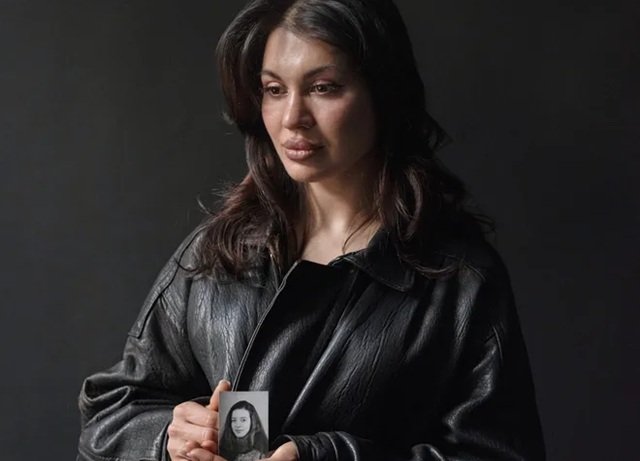
Meeting Zarina in Kyiv in February 2026, she appears carefully composed. Her appearance is important to her: styled dark hair, precise makeup, bright teeth and manicured nails. She presents herself as someone who has learned to control her life — something she could never do as a child.
Throughout the interviews, she repeatedly asks whether the people listening can handle the details of her story. Speaking about what happened is painful, but she hopes telling it can help improve systems that protect children. She believes teachers, neighbours and social services must respond more quickly when children are at risk.
Zarina was born in 1994. Her father left shortly after her birth, as Darya’s father had done before him. Olga feared that Zarina would be taken away and rarely allowed her daughter to leave the apartment alone. The family survived on maternity benefits and occasional work. For several years, Zarina says, life was difficult but ordinary.
That changed after she turned five. Olga stopped working and the family depended on unstable social support, including child benefits and Darya’s educational allowance. Payments often arrived late, leaving them without money for months. Zarina took free school meals meant for children from struggling families and brought them home to share with her mother and sister.
Inside the apartment, Olga’s fears grew. She discouraged contact with outsiders and warned her daughters about danger from strangers. She told them detailed stories about violence and abuse. At school, the girls were mocked because of their poverty. Zarina made notebooks from old newspapers and used discarded pages from Darya’s school materials. She filled them with poems, songs and rewritten biblical passages.
Both sisters experienced bullying, Zarina says. They were beaten and insulted, and Darya was once attacked with a knife.
Then Darya became ill.
She developed a skin condition, seizures and episodes where her body would collapse and her hands would tighten. Instead of seeking medical treatment, Olga took her daughter to church. After the death of Olga’s father in 2002, the family’s situation deteriorated further. Olga began experiencing increasingly intense fears and beliefs that others were plotting against her.
She believed she saw blood at her father’s funeral and became convinced that relatives had been replaced by impostors. She began reading religious publications almost exclusively and later told her daughters that she came from a wealthy German family and was related to Adolf Hitler. She claimed her daughters were not the children of their fathers but of the Holy Spirit.
As Darya’s health worsened, her world became smaller. She stopped attending vocational school, cutting off an important source of income for the family. By 2004, poverty had deepened. Darya suffered frequent episodes, became suicidal and tried several times to take her own life.
During one period lasting around three months, Olga prohibited the girls from speaking. She believed foreign souls were hiding in the walls and listening to them. The family communicated through written notes. The windows were covered, and Olga slept with an axe beneath her pillow. Their electricity and gas had been disconnected because of unpaid bills.
Darya believed her mother’s explanations. She became convinced that a demon had taken control of her.
Zarina says this was when she began to understand that something was wrong. The world around her no longer matched the reality outside their apartment. Yet she felt unable to escape. Her mother and sister were her entire universe. “I am them, and they are me,” she later recalled.
Eventually, Darya stopped leaving the apartment. Zarina, still a child, began caring for her. She watched over her sister at night, hid sharp objects and helped her through seizures. She was no longer simply a child, but she was not an adult either.
Neighbours saw signs of the family’s collapse. Olga sometimes ran outside shouting religious conspiracy theories. Yet no one intervened. Despite Ukrainian child protection laws requiring officials such as teachers to report cases of neglect, authorities were never contacted.
By late 2006, Darya’s condition had become critical. She was vomiting constantly, too weak to care for herself. Zarina helped her walk, clean herself and survive each day. When Zarina asked why her mother would not take Darya to a doctor, Olga said doctors would only take her organs.
In December 2006, Darya died.
Zarina remembers little of the day itself. She remembers her sister’s screams, the sound of running water and then sudden silence. When she found Darya motionless, she asked her mother what had happened. Olga told her that everything was fine and that Darya was getting better.
The next morning, Darya’s body remained in the same position. Olga checked for breathing and placed a mirror near her face. Nothing happened. Zarina held her sister’s hand and asked why she was cold.
Her mother answered that they needed to warm her.
They kept Darya in the apartment. They slept beside her body. Olga continued washing her and insisting that she was alive. Over time, the body decomposed and later became naturally mummified. The family remained trapped inside the apartment with the remains.
For years, Zarina carried the secret. She feared that telling anyone would lead to prison and that she and her mother would lose everything. When police eventually arrived at the apartment in late 2011 after complaints from neighbours, they saw the conditions but did not discover Darya’s body.
Zarina, then 17, was undernourished, isolated and desperate. She wanted to speak, but she remained silent.
Her first steps toward independence came when she turned 18 and began working. In June 2012, she walked outside alone for the first time. She later moved away, eventually reaching Kyiv, where she survived through various jobs and struggled with exploitation.
Years passed before she confronted what had happened. She created a new identity for herself, telling people she had a different family history. She worked as a dancer and earned money, much of which she sent back to her mother.
But the past remained.
After Russia’s full-scale invasion of Ukraine in 2022, Zarina began experiencing her own trauma differently. A period working in Switzerland gave her a sense of freedom and peace, and later meditation and therapy helped her confront memories she had buried for years.
Eventually, she told a therapist about Darya’s body still being in the apartment. A family lawyer, Switlana Sawitskaya, and her husband, criminal lawyer Dmitry Sawitsky, initially struggled to believe the account. But after Zarina wrote 107 handwritten pages describing her life, they accepted her story and contacted authorities.
In July 2025, police called Zarina with the words she had waited years to hear: “We found your sister’s body.”
Investigators entered the apartment in Kostyantynivka and discovered Darya’s remains beneath layers of clothing and blankets in the same bed where she had died. DNA testing confirmed her identity. A cause of death could not be determined, and investigators found no signs of violent injury.
A psychiatric evaluation later diagnosed Olga with continuous paranoid schizophrenia and a severe mental disorder. She was considered legally incapable of responsibility, and a court process began to determine her future treatment.
Zarina does not say she wants punishment for her mother. She says she wants her to receive help. She also wants answers about why so many warning signs went unnoticed.
After Darya’s cremation, Zarina placed her sister’s ashes in a light blue urn decorated with daffodils. The inscription reads: “You are not forgotten. You live on through me, through what you gave me. There is a life after this.”
For Zarina, the story that began with a little girl in a yellow dress is now a search for recognition — for the sister she lost, and for the childhood that disappeared with her.