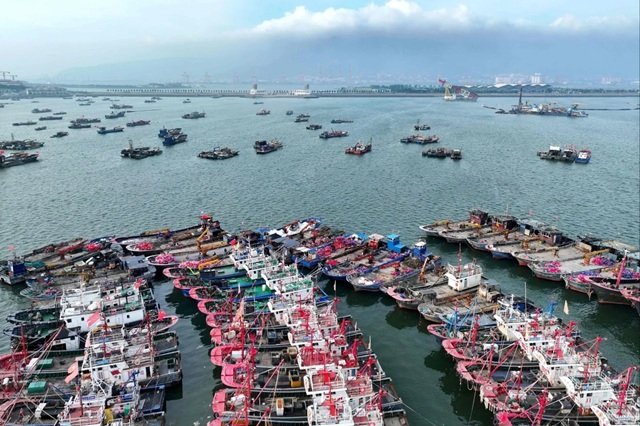
Typhoon Bavi has triggered widespread emergency preparations across East Asia, with authorities in China, Taiwan and Japan taking precautionary measures as the powerful storm moved toward the region’s coast, bringing warnings of destructive winds, torrential rain and possible coastal flooding.
China’s National Meteorological Centre (NMC) said Bavi, the ninth typhoon of the season, regained strength overnight and reached severe typhoon status at midnight before continuing toward eastern China. The storm was forecast to make landfall between Taizhou in Zhejiang province and Fuding in Fujian province in the early hours of Sunday, carrying winds of up to 45 metres per second.
The storm was located about 540 kilometres from the Zhejiang-Fujian border early Saturday and was moving northwest at speeds of up to 35 kilometres per hour. Forecasts indicated that Bavi would maintain its intensity before landfall before gradually weakening after moving inland.
Coastal communities across China began preparations ahead of the storm’s arrival. Fishing boats in eastern China’s Jiangsu province were moored on Friday as crews secured vessels ahead of the expected impact. Across Fujian, Zhejiang and other coastal areas, emergency teams, rescue personnel and power repair crews were placed on standby.
The East China Sea Rescue Bureau prepared vessels and crews for possible emergency operations, while Fujian and Taizhou activated thousands of local volunteers to remain available around the clock. The NMC issued an orange typhoon warning, the second-highest level in China’s four-tier warning system, along with additional rainstorm and severe weather alerts.
Transportation networks across eastern China faced major disruption. Flight tracking data showed that dozens of airports were expected to be affected between Friday and Monday. Taizhou Luqiao Airport cancelled all inbound and outbound flights on Saturday, while cancellation rates at Wenzhou Longwan and Fuzhou Changle airports approached 100 per cent.
Shanghai’s Pudong and Hongqiao airports were also expected to operate with reduced capacity, with hundreds of flights cancelled. Rail services were affected as Zhejiang province suspended high-speed and conventional train services, with temporary stoppages planned on several routes.
Authorities across coastal provinces introduced additional restrictions. Fujian raised its typhoon emergency response level and ordered schools, training institutions and construction sites to halt outdoor activities. Zhejiang also increased its emergency response measures, closing scenic areas, suspending ferry routes and stopping water-related construction projects.
In Guangdong, passenger ferry services were suspended, construction vessels were removed from operation and workers from offshore wind platforms were evacuated. Shanghai issued a lower-level typhoon warning, forecasting strong winds between Saturday and Monday.
Taiwan also prepared for Bavi’s arrival as the storm moved through the Pacific Ocean southeast of the island. The Central Weather Administration said the storm was expected to pass near northern Taiwan before reaching China’s southeastern coast. Officials urged residents to stock emergency supplies, including food, flashlights and other necessities.
President William Lai called on residents to prepare emergency kits capable of supporting people for three days, sharing guidance on how households could organize supplies before the storm’s arrival.
Japan also placed areas under increased alert as Bavi approached the region. The Japan Meteorological Agency urged residents in Okinawa, the country’s southernmost prefecture, to prepare for violent winds, landslides, flooding and storm surges.
Weather experts warned that Bavi had strengthened after spending a prolonged period over warm ocean waters, allowing it to gather energy and moisture. Feng Xiangbo, a tropical cyclone researcher at Imperial College London, said the storm’s path would be critical, with even small changes potentially affecting the level of damage.
Meanwhile, Bavi also sparked debate in China over the publication of unofficial AI-generated weather forecasts. State broadcaster China Media Group reported that some online bloggers were using open-source artificial intelligence weather models to post predictions about the storm, including location-specific forecasts.
Chinese authorities warned that unofficial public weather forecasts could violate the country’s Meteorology Law, which requires severe weather warnings and public forecasts to be issued through authorised meteorological agencies. Researchers said inaccurate online predictions could create confusion during emergency situations.
As Bavi continued toward the coast, authorities across East Asia remained focused on protecting coastal communities, maintaining emergency response readiness and limiting disruption from the approaching storm.