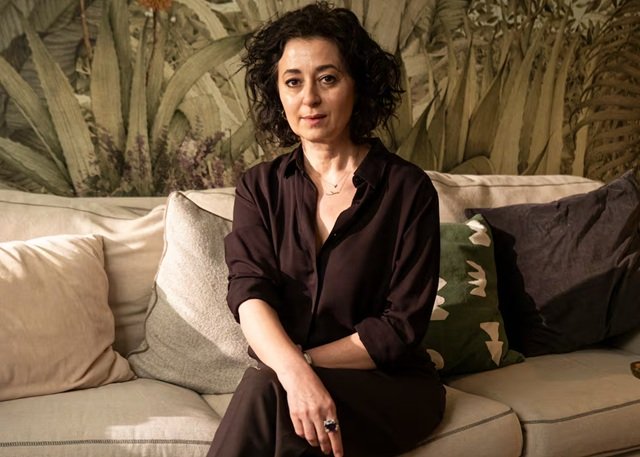
Ten years ago, Turkish journalist and writer Ece Temelkuran made a phone call she never expected to make. Speaking to her mother from Zagreb, she delivered a sentence that many migrants fear saying aloud: “Mum, I am not coming home.”
The words marked a turning point. Temelkuran, who had left Turkey as the country became increasingly authoritarian, said she immediately felt she had become a person without a home. A decade later, after moving through several European countries and rebuilding her life abroad, she has turned that experience of exile into her most personal work, “The Nation of Strangers,” published in Spanish by Anagrama.
In an interview with Spanish newspaper El País, Temelkuran described exile not only as the loss of a physical place but as a deeper question of identity, belonging, and security. She said her latest book reflects on her own displacement while also exploring a wider reality: the possibility that many people may eventually experience a similar loss of connection to their homes.
Unlike her earlier works, including “How to Lose a Country” and “Together,” Temelkuran said she initially never intended to write a personal story. Coming from a left-wing political background, she explained that focusing on herself felt uncomfortable and contrary to the tradition of placing collective struggles above individual experiences.
She said this changed after experiencing physical and emotional exhaustion and recognising that her own story reflected a broader human condition — the search for belonging when certainty disappears.
For Temelkuran, home is not simply a geographical location. She describes it as something built through relationships, friendships, words, and promises between people. However, she acknowledged that redefining home in this way is difficult because the traditional understanding of home as a physical place remains deeply connected to human identity.
“Soon we will have to redefine the concept of home,” she said, arguing that migration, conflict, and climate pressures are challenging traditional ideas of belonging.
Temelkuran said she first began feeling that Turkey was changing after Recep Tayyip Erdoğan came to power in 2002, when she believed the political movement would transform the country. However, she described the aftermath of the failed military coup attempt in 2016 as the moment when she felt completely unsafe.
She recalled hearing the Islamic prayer traditionally associated with mourning after the coup attempt and feeling that a new political order was emerging. Days later, after the iron bars on the windows of her ground-floor home were removed while nothing was stolen, she interpreted the incident as a message that she could no longer consider her home secure.
Even then, she said, leaving Turkey was not an immediate decision. It was only after spending a night in Zagreb, where she slept without fearing that authorities might come to arrest her the next morning, that she decided to remain abroad.
A decade later, Temelkuran said she wants to return to Turkey but only when she can do so without fear.
Discussing political developments beyond Turkey, she warned that other societies are experiencing similar feelings of uncertainty and alienation. She pointed to rising support for far-right movements in Europe, saying many people feel they no longer recognise their own countries.
She argued that political movements based on fear and anxiety have gained influence by offering emotional responses to social frustrations, while traditional political forces have struggled to address those concerns.
According to Temelkuran, the challenges facing democracies are not resolved simply by replacing individual leaders. She argued that deeper structural issues, including inequality and economic insecurity, must be addressed to restore public confidence in democratic systems.
She said many people have lost faith in their ability to influence political decisions after witnessing moments when public opposition failed to change government actions. She cited protests against the Iraq War as an example of people feeling that their voices were ignored.
Temelkuran also discussed the changing meaning of nations and citizenship. She suggested that traditional concepts of nation-states based on territory, language, and identity are being challenged, while displaced people and migrants represent a growing “nation of strangers.”
Having left Turkey at the age of 43, changed languages, and built a new life writing in English, Temelkuran described migration as an experience that was not entirely chosen but one that required rebuilding from the ground up.
She said writing in English gave her a different life rather than making her a different person. Although changing languages was painful, she described it as liberating because it allowed her to write without carrying the same emotional weight associated with her homeland.
Reflecting on her own journey, Temelkuran said she does not know whether her story will have the ending of a childhood book her mother read to her, where a small fish leaves home, discovers the world, and returns with stories to tell. In the original version, she noted, the fish never returns.
Her own story, she said, remains unfinished — shaped by exile, memory, and the continuing search for a place to belong.