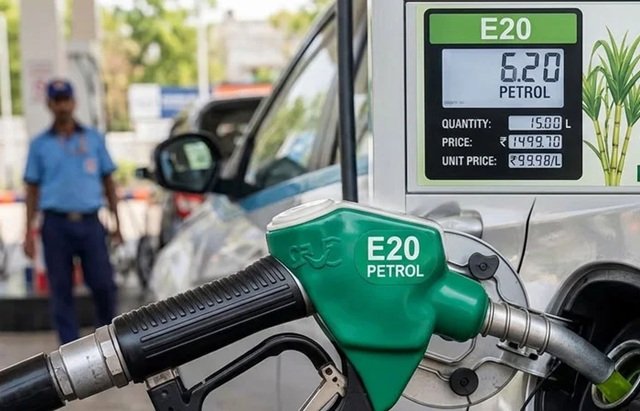
When the Government of India announced 20% ethanol blending with petrol (known as E20) as a transportation fuel, the move was opposed by some quarters.
A careful analysis of the scenario readily highlights the fact that ethanol-blended petrol is both necessary and timely. Indeed, there is a strong case for increasing the percentage of ethanol in petrol to an even higher level. Obviously, the critics have taken a negative view, as they do not appear to have adopted a holistic perspective of the overall scenario and the compelling circumstances faced by India.
India presently imports 85% to 90% of its crude oil requirement and more than 50% of its natural gas requirement. The present outflow of foreign exchange due to the import of crude oil and natural gas accounts for around 27% to 30% of the country’s total foreign exchange earnings. There is little likelihood of significantly increasing the domestic production of crude oil and natural gas in India. On the other hand, even maintaining the present level of domestic production appears to be difficult in view of the ageing oil and gas wells.
The Government of India’s efforts to increase the production of crude oil, natural gas, and coal bed methane (CBM) through exploration and the development of discovered reserves are being resisted in several regions, particularly in Tamil Nadu, due to land acquisition issues.
Due to its heavy dependence on imported crude oil and natural gas, the Indian economy has become vulnerable to international price trends and supply disruptions, largely arising from geopolitical developments that are beyond India’s control. The ongoing conflict in the Middle East has clearly revealed the extent of India’s vulnerability resulting from its heavy dependence on imported crude oil and natural gas.
The Government of India has taken several proactive measures to reduce its dependence on imported crude oil and natural gas by promoting renewable energy projects, electric vehicles, ethanol blending with petrol, and other such initiatives.
The ethanol blending programme is particularly important and significant, as the entire ethanol requirement can be met through domestic production without any foreign exchange outflow. It is gratifying that, with the encouragement provided by the Government of India, India’s ethanol production capacity has now reached almost 2,000 crore litres, enabling the country to achieve self-sufficiency in ethanol production.
The critics object to E20 petrol on the grounds that its price is not lower than that of conventional petrol despite the domestic availability of ethanol for blending, and that ethanol-blended petrol offers 3% to 5% lower fuel efficiency than pure petrol. However, the critics do not seem to have taken into consideration the several benefits of E20 petrol, including lower emissions, a higher octane rating leading to better combustion, and significant benefits to the farming community, which receives greater value addition for maize and other agricultural feedstocks used in ethanol production.
In any case, all things considered, E20 petrol should be readily accepted on the basis of an overall cost-benefit analysis.
When evaluating such matters, national priorities and interests must be given due consideration, and one should avoid adopting a tunnel vision approach.
In the past, several important projects have been delayed or stranded in India due to counterproductive and poorly informed protests. Examples include the Koodankulam Nuclear Power Project, which was delayed by more than ten years, and the closure of the important copper smelter plant in Tamil Nadu on the alleged grounds of environmental hazards. Following the closure of the copper smelter plant in Tuticorin a few years ago, no significant improvement has been observed in the surrounding environment.
It is high time to realise that knee-jerk reactions and criticism of worthwhile projects, without responsible and informed analysis, are counterproductive to India’s economic and social growth.