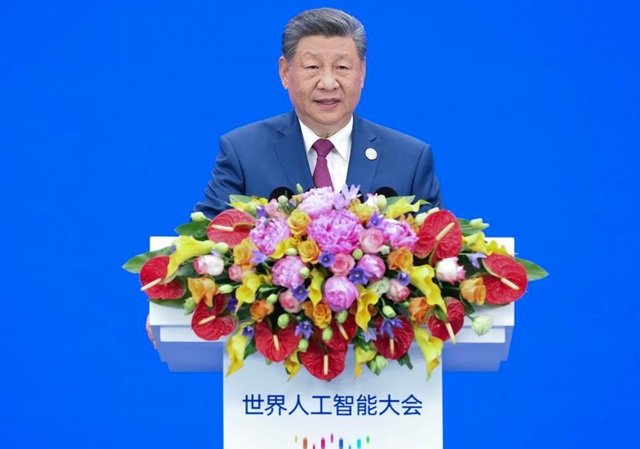
Chinese President Xi Jinping has unveiled a new international organization aimed at shaping the future of artificial intelligence, presenting it as a platform for global cooperation while highlighting the increasingly visible geopolitical competition surrounding the technology. According to a report by Die Zeit, the launch of the World AI Cooperation Organisation marks a significant moment in the evolution of global AI governance, reflecting the emergence of competing international blocs led by China and the United States.
Speaking at the opening of the World AI Conference in Shanghai, Xi framed artificial intelligence as a field that should be built through international collaboration rather than dominated by any single country. Drawing on a Chinese proverb, he said that a single string cannot produce music and a single tree does not make a forest, arguing that AI development should become a “symphony of international cooperation” instead of a solo performance by one nation.
That message accompanied the formal establishment of the World AI Cooperation Organisation, or Waico, a Chinese-led institution that Xi said would promote a more multilateral, inclusive and equitable approach to global AI development. He described the initiative as serving humanity and advancing human civilization, presenting it as a framework for broader international participation in artificial intelligence.
Behind the language of cooperation, however, the initiative reflects a rapidly changing geopolitical landscape in which AI is becoming another arena of strategic competition. As Die Zeit reports, Waico represents the consolidation of one emerging technology bloc centred on China, while the United States continues building its own network of industrial and technological partnerships.
Twenty-nine countries signed the founding document of the new organization during its launch. The group includes close Chinese partners such as Russia and Pakistan, regional countries including Indonesia, Laos and Kazakhstan, as well as developing economies that form part of what China frequently describes as the Global South. Beijing has increasingly sought to position itself as an informal leader among many of these countries across a range of international initiatives extending beyond artificial intelligence.
Although the complete list of Waico’s founding members has not been released, the coalition is expected to resemble other Chinese-backed international groupings, including the Shanghai Cooperation Organisation and the BRICS alliance. One notable exception is India, which belongs to both of those organizations but has not joined the new AI alliance despite pursuing its own ambitions in artificial intelligence.
On the opposite side stands the United States, which Xi referred to indirectly during his address without mentioning it by name. His remarks portrayed a single country as seeking technological monopoly over artificial intelligence, a description widely understood to reference Washington’s position in the global AI industry.
The United States has simultaneously expanded its own technology partnerships. Hong Kong-based political and economic adviser George Chen described China’s Waico initiative as a direct response to the US-led Pax Silica alliance, established in 2025. While Pax Silica primarily focuses on securing raw materials, semiconductor production and supply chains, Chen argued that its broader effect is to bind allied countries more closely to American technology ecosystems through continued dependence on US-designed chips, cloud infrastructure and AI platforms.
The alliance includes much of the Western world, with the European Union and many of its individual member states, including Germany, participating separately. The dividing lines between the competing technology groupings are not absolute. Kazakhstan, for example, is involved in both initiatives. Even so, Beijing is widely expected to view Pax Silica as a strategic rival, particularly because one of its objectives is reducing dependence on Chinese-controlled supply chains and critical minerals.
Taiwan’s participation as an observer in the US-led framework adds another layer of sensitivity. The self-governed island maintains close relations with the United States while Beijing considers it part of the People’s Republic of China. Taiwan’s globally significant semiconductor industry has become a critical pillar of artificial intelligence development, making its role especially important within the emerging technological competition.
Xi presented the changing global landscape as part of what he has repeatedly described as transformations unseen in a century. The phrase has become a recurring element of his political messaging, reflecting his view that the world is entering a new industrial revolution. According to Chen, Chinese policymakers increasingly see artificial intelligence as an opportunity to reshape global technological leadership after being largely excluded from establishing the rules that governed the early internet.
The World AI Conference itself has become a showcase for China’s expanding AI industry. Held annually since 2018, this year’s event carried additional significance as Xi personally opened the conference for the first time. Exhibition halls featured many of China’s leading AI developers, including DeepSeek, Zhipu and MiniMax, alongside numerous robotics companies competing in embodied artificial intelligence, an area where Chinese firms are intensifying competition with American counterparts.
China is also seeking to expand the international reach of its AI technologies. While many analysts consider leading US models to retain an overall performance advantage, Chinese alternatives are frequently distributed as open-source software, allowing users to access and modify them without licensing fees. That approach has encouraged wider adoption in developing countries, particularly across the Global South.
Xi linked that accessibility to broader principles he outlined for international AI development. He called for openness and mutually beneficial cooperation while announcing plans for approximately 5,000 development projects designed to help countries in the Global South strengthen artificial intelligence capabilities through education and technical support.
The Chinese leader also proposed additional principles that he said should guide AI governance. He argued that artificial intelligence must remain safe and controllable, that technological development should preserve the diversity of world civilizations, and that genuine multilateralism should remain central to international cooperation, with the United Nations playing a leading role. UN Secretary-General António Guterres attended the Shanghai conference, lending further international visibility to the launch of the new organization.
As global AI governance continues to evolve, Europe occupies an increasingly complex position. The European Union introduced the AI Act in March 2024, becoming the first major jurisdiction to establish a comprehensive regulatory framework for artificial intelligence. According to Die Zeit, that legislation has since lost momentum as a potential foundation for global standards, leaving Europe positioned between two expanding technology blocs whose priorities are shaped primarily by Washington and Beijing.
With China advancing Waico and the United States strengthening Pax Silica, the international landscape for artificial intelligence is becoming increasingly defined by parallel systems of cooperation. The competing initiatives illustrate how technological development, industrial strategy and international diplomacy are becoming more closely intertwined as countries seek to shape the future of artificial intelligence on a global scale.