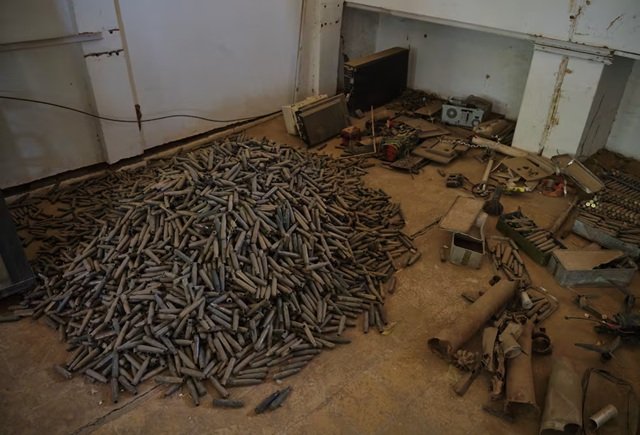
When Jamal unlocks the heavy metal door and steps inside the darkened room, the first things he sees are not ancient relics or archaeological treasures, but the remnants of war. Thousands of large-caliber shell casings cover the floor beneath a thick layer of dust. Nearby lie drones, hand grenades, mortars, DShK heavy machine guns, loaded magazines, and belts of ammunition. The scene resembles an abandoned military outpost rather than one of Africa’s most significant museums.
The room is part of Sudan’s National Museum in Khartoum, a building that spent nearly two years serving as a military stronghold after the Rapid Support Forces (RSF) seized control during Sudan’s civil war. As reported by El País, the museum became one of several cultural institutions caught in the middle of a conflict that has devastated the country, displaced millions of people, and left an extraordinary archaeological collection damaged, looted, and scattered.
Since fighting erupted on April 15, 2023, between the RSF and the Sudanese Armed Forces, Khartoum has become the site of one of the longest urban battles in African history. Government forces recaptured the capital in March 2025, but when they entered the National Museum, evidence of prolonged military occupation remained everywhere. Weapons and ammunition filled exhibition spaces, shattered glass covered the floors, burned trees surrounded the complex, and offices had collapsed after months of fighting.
While much of Khartoum’s population fled the city as violence intensified, Jamal remained behind. Assigned by Sudan’s National Corporation for Antiquities and Museums (NCAM) to represent the institution during the conflict, he became one of the few museum officials who stayed in the capital throughout the war.
His first inspection came in April 2024 at the Khalifa House Museum in Omdurman, which had also suffered extensive damage. Accompanied by government soldiers but traveling as civilians, he found smashed display cases, artifacts scattered across the floor, and objects lying outside the museum itself. An initial assessment confirmed that at least 30 artifacts had disappeared.
Nearly a year later, on March 24, 2025, Jamal entered Sudan’s National Museum for the first time after government troops regained control of the area. He described widespread destruction throughout the complex, where the RSF had transformed galleries into defensive positions during months of combat.
The scale of the damage prompted Sudanese authorities and international partners to establish the Sudan Cultural Emergency Recovery Fund in April 2025. The initiative, created by NCAM, the International Society for Nubian Studies, the Kelsey Museum of Archaeology at the University of Michigan, and other cultural institutions, aims to develop restoration plans for museums affected by the war with the long-term goal of reopening them once conditions permit.
Even amid the destruction, traces of Sudan’s ancient past remain visible. Five massive stone columns still stand in the museum courtyard, surviving the fighting largely intact. They originated in Faras, the ancient Nubian capital that disappeared beneath Lake Nasser after Egypt completed the Aswan High Dam in 1964. Before rising waters submerged the city, its monuments were carefully dismantled and relocated stone by stone to Warsaw and Khartoum. For decades, the National Museum preserved much of that rescued heritage.
Today, however, even those rescued monuments bear fresh scars. According to Rihab Khider, who leads Sudan’s heritage recovery committee, projectiles struck walls containing centuries-old hieroglyphs and inscriptions, while parts of a temple commissioned more than 3,000 years ago by Pharaoh Ramses II sustained visible damage during the fighting.
The museum’s greatest losses, however, occurred inside its vaults.
When archaeologists entered the building after the RSF withdrew, they found the secure storage area open and completely empty. Khider said investigators have determined that approximately 62 percent of the museum’s exhibition collection was looted during the occupation. The missing artifacts include gold objects, jewelry, ceramics, statues, and other archaeological treasures regarded as irreplaceable because of their historical and cultural significance.
Ironically, many of the museum’s most valuable collections had already been moved into secure storage before the war began. As part of a UNESCO restoration project financed by Italy, the museum’s principal galleries had been dismantled for renovation, and precious objects, including extensive collections of Kushite gold, were transferred into vaults for safekeeping. The prolonged occupation ultimately allowed the paramilitary forces enough time to locate the vault key, reportedly stored inside the museum director’s desk, and gain access.
Founded in 1971, Sudan’s National Museum housed the country’s largest archaeological collection and one of the world’s most comprehensive collections of Nubian art. Before the war, roughly 100,000 artifacts documented Sudan’s history from prehistoric civilizations through the Kingdom of Kush, the Christian kingdoms of Nubia, and the Islamic period. The museum also contained significant collections from the Napatan era dating back to the eighth and seventh centuries BCE.
Reconstructing that collection has become an immense challenge. Khider explained that museum officials never possessed a fully comprehensive inventory documenting every object in detail, making it difficult to determine precisely what remains and what has disappeared.
Inside the museum today, restoration teams are photographing surviving artifacts individually against white backgrounds while carefully recording dates, physical characteristics, and current condition. The painstaking process amounts to rebuilding the museum one object at a time, even as the full extent of the losses remains unknown.
Among the greatest uncertainties is the fate of more than 2,000 gold artifacts belonging to the Kingdom of Kush, one of ancient Africa’s most powerful civilizations. Geoff Emberling, associate researcher at the Kelsey Museum and co-director of the Sudan Cultural Emergency Recovery Fund, said investigators currently consider two principal possibilities. The gold may have been melted down, representing the worst-case scenario, or it may have been smuggled abroad, potentially to the United Arab Emirates or other countries.
Sudanese authorities say joint efforts involving the military and intelligence services have already recovered scattered archaeological objects throughout Khartoum and neighboring Omdurman, including pottery, statues, and other artifacts. However, no confirmed trace of the Kushite gold collection has yet emerged.
Khider said recent investigations identified additional looted artifacts in Chad, raising hopes that international cooperation may eventually lead to the recovery of more stolen objects. For now, however, much of Sudan’s cultural inheritance remains missing.
Museum officials describe the consequences as extending far beyond the disappearance of valuable antiquities. Khider told El País that the looting represents a loss of Sudanese identity, collective memory, and historical continuity. Jamal similarly described every missing artifact as an irreplaceable piece of history, noting that each object tells its own story and possesses unique characteristics that cannot be replicated.
While archaeologists continue documenting recovered collections, another gallery has deliberately been left untouched. Inside, the ammunition, mortars, grenades, shell casings, and abandoned weapons remain exactly where they were found after the RSF retreated. Rather than removing them immediately, museum officials intend to preserve the room as a permanent exhibition documenting the building’s transformation from a repository of civilization into a battlefield.
For those leading the recovery effort, the display will serve as a lasting record of what happened within the museum’s walls during Sudan’s war. Alongside the painstaking work of restoring damaged artifacts and searching for those still missing, it will preserve another chapter of the museum’s history—one written not by ancient kingdoms, but by a modern conflict that reached into the heart of the nation’s cultural heritage.