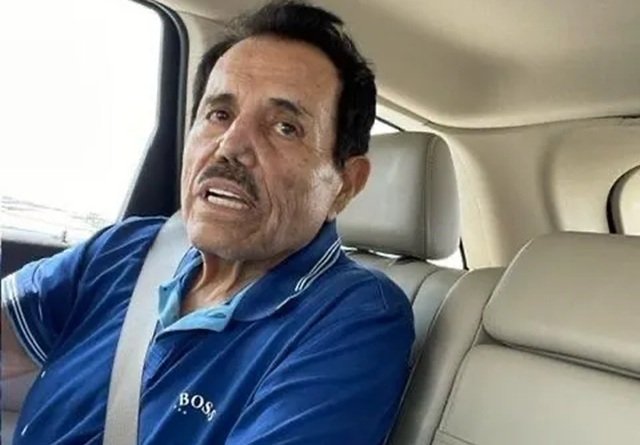
Sinaloa Cartel co-founder Ismael “El Mayo” Zambada is expected to be sentenced to life imprisonment on Monday in a U.S. federal court after pleading guilty to leading one of the world’s most powerful drug trafficking organizations and agreeing to forfeit up to $15 billion in criminal proceeds, according to the Financial Times.
The 76-year-old Mexican cartel leader reached a plea agreement with U.S. authorities last year, admitting to operating a continuing criminal enterprise and participating in a racketeering conspiracy. The forfeiture agreement, based on the estimated revenues generated by the Sinaloa Cartel over more than three decades, ranks among the largest criminal forfeiture orders ever sought by U.S. prosecutors.
Federal prosecutors described Zambada as one of the most prolific and influential drug traffickers in history. In court filings submitted ahead of sentencing, prosecutors said that under his leadership the Sinaloa Cartel distributed at least 1.5 million kilograms of cocaine while expanding its operations into heroin and fentanyl trafficking, contributing to a global narcotics network that stretched across Mexico, the United States and beyond.
According to prosecutors, Zambada played a central strategic role within the cartel after co-founding the organization alongside Joaquín “El Chapo” Guzmán in the late 1980s. While Guzmán was widely viewed as the public face of the cartel, Zambada developed a reputation for operating behind the scenes, overseeing bribery networks involving politicians and military officials to facilitate the movement of drugs into the United States.
The government alleged that the cartel under Zambada’s leadership carried out kidnappings and assassinations while pioneering sophisticated drug transportation methods, including the use of rail networks and cross-border tunnels linking Mexico and the United States.
Although prosecutors are seeking a $15 billion forfeiture judgment, legal experts told the Financial Times that recovering assets of that scale is unlikely. Zambada’s attorney, Frank Perez, described the forfeiture amount as the largest he had encountered, while former federal asset forfeiture specialist Stefan Cassella noted that such judgments represent legal claims that depend on locating and seizing assets before funds can be recovered. Any recovered proceeds may be directed toward victims and certain law enforcement activities.
The forfeiture amount is among the largest in U.S. criminal history, although it remains significantly below the $171 billion forfeiture order imposed against financier Bernard Madoff.
Born into poor farming communities in the Mexican state of Sinaloa, Zambada entered the drug trade during the late 1960s by cultivating marijuana before rising through the ranks of organized crime. Over the following decades he became one of the most influential figures in international narcotics trafficking and has faced 16 separate indictments in U.S. courts since 2009.
Former Drug Enforcement Administration operations chief Ray Donovan, who led U.S. efforts to capture Guzmán, characterized Zambada as the strategist behind the cartel, contrasting him with Guzmán, whom he described as relying more heavily on force.
The organization itself evolved significantly during Zambada’s leadership as global drug markets shifted toward synthetic narcotics. The Sinaloa Cartel expanded into fentanyl production and trafficking, supplying a drug that has contributed to hundreds of thousands of overdose deaths in the United States and become one of the leading causes of death among young Americans.
Zambada’s transfer to the United States in 2024 followed his reported kidnapping by Joaquín Guzmán López, one of El Chapo’s sons. According to prosecutors, that incident triggered a violent internal conflict within the Sinaloa Cartel that has since resulted in thousands of deaths. Local newspaper Noroeste reported that more than 3,552 violent deaths and 4,153 disappearances have been recorded in Sinaloa since Zambada’s arrival in U.S. custody.
President Donald Trump’s administration has designated several Mexican drug cartels as terrorist organizations, expanding U.S. legal authorities to pursue cartel networks and individuals accused of assisting them. Mexican analysts have suggested that both Zambada and members of the Guzmán family could potentially possess information concerning relationships between organized crime groups and public officials.
In court filings, Zambada’s lawyers stated that he did not provide substantial assistance to prosecutors but had cooperated throughout the legal process. They emphasized that he pleaded guilty without pursuing pretrial litigation, accepted that his plea carried a mandatory life sentence and requested placement in a prison capable of addressing his age-related medical conditions rather than the federal Supermax facility where Guzmán is incarcerated.
The circumstances surrounding Zambada’s removal from Mexico remain under investigation. While U.S. officials have maintained they neither induced nor approved his reported kidnapping, Mexican authorities continue examining whether Washington fully disclosed its involvement. Earlier this month, Mexican officials also acknowledged that the pilot who transported Zambada into the United States was inadvertently transferred to U.S. custody during a separate prisoner handover intended to demonstrate bilateral cooperation with the Trump administration.