Pacific island nations are struggling to present a unified response following China’s recent missile test near Tuvalu, as analysts say differing national interests and varying relationships with Beijing have complicated efforts to uphold the region’s long-standing vision of the Pacific as an “ocean of peace.”
China announced on 6 July that one of its navy’s nuclear submarines had launched a strategic missile carrying a dummy warhead into what it described as the relevant high seas of the Pacific Ocean. Beijing characterised the launch as routine annual military training conducted in accordance with international law and said it had notified relevant countries in advance, stressing that the exercise was not directed at any specific country or target.
The missile reportedly landed near the exclusive economic zones of Tuvalu and Kiribati, about 1,000 kilometres northeast of the Solomon Islands. Although leaders from Tuvalu, Palau and the Solomon Islands strongly criticised the launch, the 18-member Pacific Islands Forum (PIF), meeting in Suva, Fiji, failed to agree on a joint statement. The issue is expected to be reconsidered by Pacific foreign ministers and regional leaders at meetings scheduled between late August and early September.
Bernard Singu Yegiora, an international relations lecturer at Divine Word University in Papua New Guinea, said the diverse diplomatic and economic relationships between Pacific island nations and China made consensus difficult. He noted that Papua New Guinea initially criticised the missile test before later closing Taiwan’s Economic and Cultural Office in Port Moresby and reaffirming its commitment to the one-China principle. While he said there was no direct evidence linking the two developments, the timing suggested China’s bilateral relationships could influence policy decisions among Pacific governments.
Analysts said the region’s history has also shaped reactions to military activity. More than 300 nuclear tests conducted by the United States, the United Kingdom and France between 1946 and 1996 left parts of the Pacific with radioactive contamination, displacement and long-term health consequences. The 1985 Treaty of Rarotonga subsequently established the South Pacific as a nuclear-free zone, prohibiting nuclear testing and the dumping of radioactive waste while promoting non-proliferation.
Oliver Nobetau, director of the Pacific Islands Programme at the Lowy Institute, said Pacific nations have traditionally found consensus on issues such as climate change and fisheries but remain divided on regional security. He said differing historical experiences and varying economic partnerships with China have complicated efforts to develop a common position. Hideyuki Shiozawa of the Sasakawa Peace Foundation said the missile launch did not appear to violate international law or the Treaty of Rarotonga because the missile carried no nuclear material and landed in international waters. He added that some governments may have avoided stronger criticism to prevent provoking Beijing despite growing concerns over regional security.
The missile test came hours after Australia and Fiji signed the Ocean of Peace Alliance, a mutual defence agreement, and analysts said the launch served as a warning against expanding security cooperation between Pacific nations and Western partners. China has strengthened its security ties across the Pacific in recent years through agreements with the Solomon Islands and expanded law enforcement cooperation with Fiji and Kiribati, alongside increasing investment in regional infrastructure and trade.
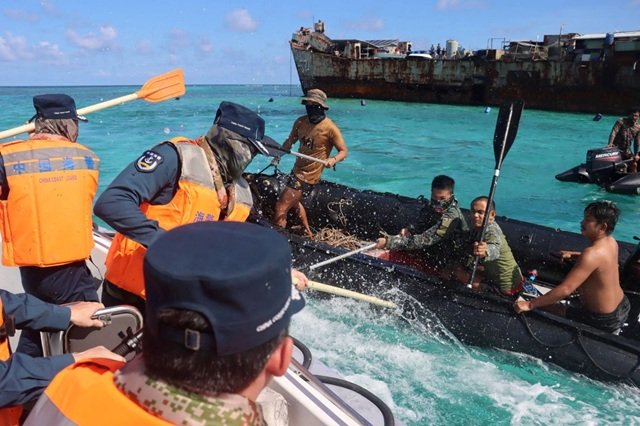
Meanwhile, tensions between China and the Philippines escalated after both governments summoned each other’s envoys following a violent confrontation at the Second Thomas Shoal in the South China Sea. China’s Foreign Ministry accused Philippine Navy personnel of deliberately approaching and ramming China Coast Guard vessels before attacking Chinese officers. The Philippines rejected the accusation, saying China Coast Guard personnel aggressively struck and injured a Filipino serviceman during what Manila described as an unlawful approach toward its military outpost.
Both sides released videos supporting their respective accounts of the incident, while the United States condemned China’s actions and called on Beijing to cease what it described as destabilising conduct. The clash ends a period of relative calm following a provisional agreement reached in 2024 and comes just ahead of this week’s Association of Southeast Asian Nations (ASEAN) meeting in Manila, where senior Chinese and Philippine officials, along with U.S. Secretary of State Marco Rubio, are expected to meet amid renewed regional tensions.