The appearance of Shahed-136-type kamikaze drones over northern Mali marks a significant development in a conflict that has evolved steadily since rebellion first erupted in the country’s north in 2012. A detailed open-source investigation by Bellingcat, conducted in collaboration with Jeune Afrique, has now provided some of the clearest independently verified evidence that these long-range one-way attack drones have been deployed in combat operations in Mali, confirming what had previously been reported but not conclusively documented.
Drawing on geolocation techniques, satellite imagery and expert weapons analysis, Bellingcat verified two separate drone strikes carried out in the villages of Inafarak on 12 July and Talahandak on 17 July. While investigators said the available evidence does not allow the precise drone variant to be identified, experts consulted by Bellingcat concluded that the systems were most likely manufactured in Russia, reflecting the broader pattern of Russian military assistance to Mali and the presence of the Kremlin-controlled Africa Corps in the country.
The findings build upon earlier reporting by Defence Blog and France 24, both of which had documented evidence suggesting that Russian drone systems were appearing in northern Mali. Photographs of drone wreckage first surfaced in May following strikes near the town of Savare, while France 24 later identified debris from several Russian drone systems. Until now, however, no independently verified footage had documented Shahed-136-type drones in flight and striking targets.
According to Bellingcat, the first verified strike occurred in the village of Inafarak, close to the Algerian border. Footage showing the aftermath of the attack was published on X on 12 July and was subsequently geolocated to coordinates 21.32330, 0.72980 through comparison with satellite imagery.
Investigators compared satellite images captured after the strike with imagery from 2024, confirming that several buildings standing previously had been destroyed by 15 July 2026. The visible damage matched destruction shown in the circulated videos. The strike appeared to have hit a commercial facility where investigators identified a damaged truck alongside numerous damaged fuel drums.
Among the debris visible in one of the videos was the remains of an engine that appeared consistent with an MD-550, a distinctive four-cylinder two-stroke engine associated with the Shahed-136 family of drones. Bellingcat presented the imagery to Trevor Ball, an independent weapons expert and former Bellingcat investigator, and Leo Jarry, a drone specialist with Tungsten Strategies. Both concluded that the engine was consistent with those used in the Shahed-136 family. Investigators also compared the component with verified reference imagery contained in the Open Source Munitions Portal database and the War & Sanctions component database, where close similarities were identified.
Bellingcat also noted that footage of the strike was republished by the Wagner- and Africa Corps-affiliated Telegram channel “White Uncles in Africa”, which the organisation has previously reported on. The channel described the drones as “Gerans”, the Russian-produced version of the Shahed-136, while also using derogatory language directed at people from Azawad, the name used by Tuareg separatists for northern Mali.
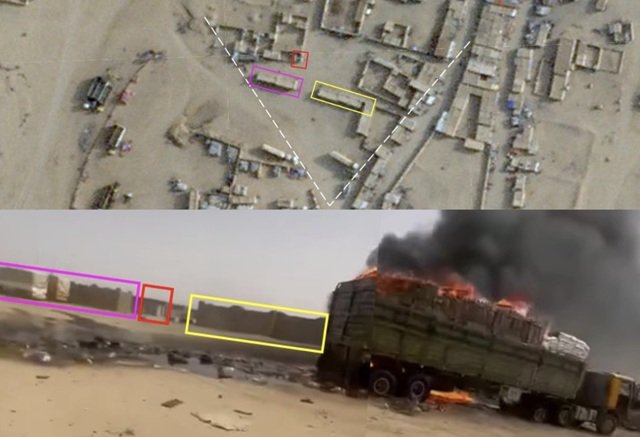
Five days later, another strike took place in the village of Talahandak, approximately 100 miles south-east of Inafarak and also near the Algerian border. Graphic videos posted online showed the aftermath of the attack, including one casualty and a burning truck. Additional footage indicated that bottles of cooking oil were spilling from the vehicle, suggesting it may have been a commercial transport truck.
Using satellite imagery, Bellingcat geolocated the impact site to coordinates 20.26369, 1.80095 by matching surrounding buildings visible in the footage. Shortly afterwards, a Wagner-affiliated account on X claimed that the drone responsible had been shot down by rebels before reaching its target and published video showing a Shahed-type drone in flight.
Investigators subsequently geolocated that footage to another location within Talahandak, nearly one kilometre from the impact site. Several independently uploaded videos also showed a distinctive smoke plume rising from the area following the strike. By geolocating each of these videos and matching the smoke plume across multiple recordings, Bellingcat concluded that the footage showing the drone’s final descent was authentic. The available evidence showed the drone descending directly towards the location where the truck and casualty were filmed, with no visible indication that it had been intercepted before impact.
Leo Jarry told Bellingcat that if the drones were indeed manufactured in Russia, their appearance represented “a visible demonstration of Russian support for Mali”. He further explained that the Shahed-136 provides Africa Corps and the Malian Armed Forces (FAMa) with an “expendable, cost-effective” long-range strike capability capable of reaching targets in northern Mali beyond the effective operational range of the Bayraktar TB2 drones already used by Mali.
Unlike the Bayraktar TB2, which launches precision-guided munitions before returning to base, the Shahed-136 is designed as a one-way attack drone that detonates on impact. Its expendable design enables attacks over much greater distances because recovery is unnecessary.
Jarry also cautioned that these systems present important operational risks. He noted that, unlike more precise remotely operated platforms, the Shahed-136 cannot verify targets during flight and instead relies on surveillance conducted before launch. In an environment such as northern Mali, where armed groups are highly mobile and frequently operate among civilian populations, delays between target identification and impact create a greater possibility of striking the wrong target. Combined with the drone’s larger warhead, he said, this increases the potential for civilian harm when employed in or near populated areas.
The deployment of Shahed-type drones comes as fighting continues to intensify across northern Mali. Russian forces, initially through the Wagner Group and now through its successor, Africa Corps, have supported FAMa in operations against Tuareg rebel groups and jihadist organisations. At the same time, rebel offensives have reportedly resulted in the capture of several military bases and heavy losses for both FAMa and Africa Corps.
Bellingcat noted that the arrival of these drones follows its recent joint investigation with Jeune Afrique documenting the use of banned Russian cluster munitions in Mali. It also observed that Shahed-136 drones have been employed extensively by Russian forces in Ukraine during long-range strike campaigns that have repeatedly targeted civilian infrastructure and caused civilian casualties.
While the appearance of the same class of weapon in Mali does not establish that identical operational practices will be followed, Bellingcat’s investigation provides the strongest verified open-source evidence to date that Shahed-136-type drones have entered the conflict. As long-range one-way attack systems become part of the battlefield, their deployment introduces a new capability for military operations while simultaneously raising fresh concerns over accuracy, civilian protection and the changing character of the war in northern Mali.