The confrontation unfolded within minutes. In the early hours of the morning, three patrol vessels operated by the Philippine Bureau of Fisheries and Aquatic Resources departed the small island outpost of Pag-asa, home to around 350 residents, on what appeared to be a routine mission across the South China Sea. Their destination was Sandy Cay, an uninhabited chain of sandbars just 1.5 nautical miles away, where they intended to inspect surrounding waters and deliver supplies to Filipino fishing vessels operating in the area.
Yet the patrol had barely begun before it encountered overwhelming opposition. As reported by The Observer UK, five Chinese coastguard vessels accompanied by at least 15 maritime militia ships emerged and manoeuvred to block the Philippine convoy’s path. The Chinese vessels, significantly larger than the 30-metre Philippine patrol boats, surrounded them at close quarters, bringing the crews within sight of one another. From the bridge of one Chinese militia vessel, a crew member photographed those aboard the Philippine ships before disappearing from view.
The encounter rapidly escalated despite urgent radio appeals from the Philippine crews urging their Chinese counterparts to cease what they described as unsafe actions and to avoid interfering with a lawful maritime patrol. Moments later, a Chinese coastguard vessel fired a powerful water cannon at the BRP Datu Pagbuaya, drenching the vessel with enough force to send it twisting as the crew scrambled for cover inside the ship.
The pressure did not end there. The same Chinese vessel accelerated and struck the stern of the Pagbuaya, damaging its railing before turning towards another Philippine patrol boat, the BRP Datu Bankaw. Crew members shouted warnings as another burst from a water cannon struck the vessel from behind. Outmatched in size and surrounded by Chinese ships, the Philippine convoy withdrew from Sandy Cay, retreating to the south-west while remaining under close observation.
According to The Observer UK, the clash represented another chapter in a long-running dispute that has steadily intensified over more than a decade. Although there had been a period of relative calm, tensions have once again risen around disputed reefs and shoals across the South China Sea, where competing territorial claims continue to place Chinese and Philippine vessels in frequent confrontation.
The roots of the dispute stretch back to 2012, when China took control of Scarborough Shoal following a months-long standoff with the Philippine navy. The reef lies approximately 125 nautical miles from the Philippine island of Luzon but nearly 470 nautical miles from China’s nearest coastline. For generations it served as both a rich fishing ground and a refuge for Filipino fishermen seeking shelter from typhoons.
China, however, continues to assert historical rights over much of the South China Sea through its so-called “nine-dash line”, claiming large sections of the strategically important waterway as its inherent territory. In response, the Philippines challenged those claims before an international arbitration tribunal in The Hague, securing a landmark ruling in 2016 that rejected China’s territorial assertions over Scarborough Shoal and other disputed features. Beijing has not accepted the ruling and has instead strengthened its presence, limiting access for both Philippine government and civilian vessels.
Recent developments suggest that the contest is entering another phase. The Asia Maritime Transparency Initiative has reported a substantial increase in the Chinese coastguard’s presence around Scarborough Shoal, while analysts cited by The Observer UK warn that expanding deployments increase the possibility of further confrontations and even armed conflict.
China has also continued reinforcing its physical presence elsewhere in the region. Last year, Beijing began dredging operations at Antelope Island, around 215 nautical miles east of Vietnam. Satellite imagery now indicates that what had previously been a small Chinese outpost is being transformed into a man-made island capable of supporting what could become the largest offshore military base in the South China Sea.
For Filipino fishing communities, these geopolitical disputes have translated into profound economic consequences. Fishermen describe years of being prevented from reaching waters they had traditionally relied upon for their livelihoods. Thirty-one-year-old Joseph Morados recalled that Chinese coastguard vessels routinely intercepted fishing boats approaching Scarborough Shoal, ordering them to leave over loudspeakers. Another fisherman, Geneberth Naelon, 48, compared the experience to “having to steal fruit from your own garden” while describing repeated encounters near Sabina Shoal, where he said Chinese vessels chased his boat and blasted it with water cannons.
According to fishermen interviewed during the mission, restrictions imposed around Scarborough Shoal have reduced catches by as much as two-thirds. The incidents have become increasingly routine, with Filipino fishing boats repeatedly driven away from waters that fall within the Philippines’ 200-nautical-mile exclusive economic zone, where Manila maintains rights to explore and manage marine resources under United Nations law.
Against that backdrop, the Philippine government has sought to increase international attention through what it describes as a transparency campaign. Rather than limiting access, authorities have invited journalists to accompany maritime patrols and witness encounters with Chinese vessels firsthand. The Observer UK joined one such Bureau of Fisheries and Aquatic Resources mission, supported by the Philippine coastguard, to document both the delivery of humanitarian assistance to fishermen and the continuing effort to demonstrate the country’s presence in disputed waters.
The voyage itself reflected the difficult operating conditions. Sailing beneath dark post-typhoon skies, the convoy endured rough seas before reaching Scarborough Shoal, where a floating barrier blocked the entrance. Beyond it stood at least seven Chinese coastguard vessels alongside ten maritime militia ships. Philippine commanders instructed the convoy to remain 30 nautical miles away to avoid further confrontation, even as the overwhelming scale of China’s maritime presence remained plainly visible.
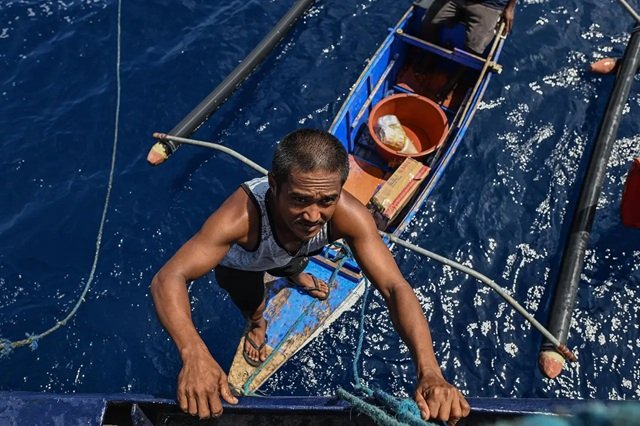
Despite the risks, hundreds of Filipino fishermen gathered alongside the patrol vessels to receive government assistance, including rice, fuel and groceries. Colourful fishing boats crowded around the convoy as men paddled canoes between vessels to collect supplies and refill fuel containers, underscoring both the humanitarian importance and symbolic significance of the operation.
Philippine coastguard spokesperson Jay Tarriela described the missions as evidence that his country’s maritime forces “will not be intimidated or driven away by China’s bullying tactics”. He also noted that the coastguard is strengthening its capabilities through the acquisition of 40 fast patrol boats from France and five multi-role response vessels from Japan.
After successfully completing the resupply operation near Scarborough Shoal, the convoy continued towards Parola, internationally known as Northeast Cay, where additional supplies were delivered to Philippine troops stationed on the island. China later declared that it had expelled what it described as “Filipino intruders and provocateurs”, stating that it would continue taking “resolute measures” to safeguard what it considers its territorial sovereignty and maritime rights.
More than eight days after departing, the Philippine fisheries convoy returned safely to its home port in Bataan province. Yet, as The Observer UK concludes from its firsthand reporting, the mission demonstrated that beneath the daily routines of fisheries patrols and humanitarian resupply lies an increasingly contested maritime frontier, where rival territorial claims continue to generate confrontation and where the prospect of further escalation remains ever present.