Europe’s prolonged spell of extreme heat and drought is inflicting severe disruption across the continent as historically low water levels in the Danube and Rhine rivers undermine electricity generation, interrupt commercial transport and threaten vital industries stretching from France to Serbia. Already grappling with deaths linked to heatwaves and widespread forest fires, Europe now faces an escalating crisis along its principal waterways, where shrinking river flows are exposing the vulnerability of critical infrastructure that depends upon them.
The exceptional summer, intensified by the climate emergency, has left many of Europe’s most important navigable rivers depleted, from the Netherlands to the Black Sea. The consequences extend well beyond environmental concerns, affecting energy security, manufacturing, logistics, tourism and public services. Governments across the region have begun implementing emergency measures in an effort to prevent a much broader economic and infrastructural crisis.
Hungary and Romania have, for the first time in their history, been forced to halt nuclear reactors because the Danube no longer provides sufficient water for cooling. In Hungary, the Paks nuclear power plant, the country’s largest atomic facility, has reduced output to below half of its normal capacity. Operating for 44 years and responsible for almost half of Hungary’s electricity generation, the plant has narrowly avoided a complete shutdown, with only a matter of millimetres in the river’s water level allowing its final reactor to continue operating.
The reduction in electricity production has already triggered nationwide conservation measures. Restrictions have been introduced for public lighting and freight rail services, while Hungarian Prime Minister Péter Magyar has appealed to businesses, public institutions, local authorities and citizens to reduce electricity consumption. The deteriorating situation has extended beyond the energy sector. Last week, authorities in Budapest closed the Margaret Bridge after an unexploded Second World War bomb emerged from the unusually shallow riverbed. Tourist cruise vessels have been forced to dock further upstream and cancel sections of their itineraries, while Hungary’s Ministry of Transport and Investments reports that freight traffic on the Danube has been almost entirely paralysed. With no significant rainfall forecast and temperatures expected to remain close to 40 degrees Celsius, officials anticipate further deterioration in the coming days.
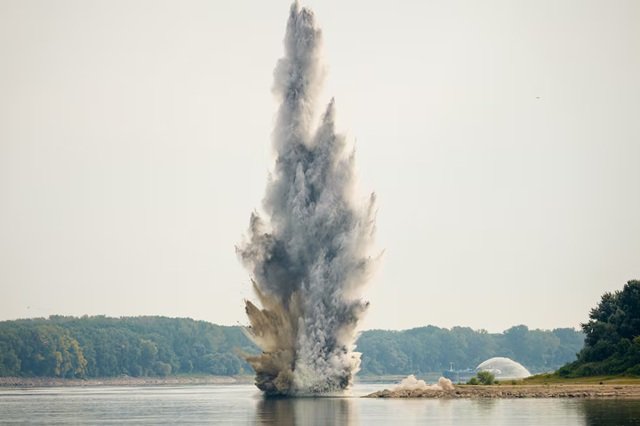
Across the border in Romania, the falling Danube has also prompted extraordinary intervention. Authorities shut down one of the two reactors at the Cernavoda nuclear power station early last week for safety reasons, while the future operation of the second reactor remains uncertain if river levels continue to decline. In an attempt to sustain water flow towards the plant, the Romanian military carried out a controlled underwater demolition on Monday, using 180 kilograms of explosives to remove a rocky spur and redirect part of the river channel. Additional measures are scheduled for Wednesday or Thursday, when vessels will be deliberately sunk to further guide water towards the Danube channel feeding the power station. Acting Defence Minister Radu Miruta said the intervention would allow both river navigation and continued operation of the nuclear plant, adding, “Each additional day of operation of Cernavoda represents a quantifiable benefit.”
Romanian Prime Minister Ilie Bolojan warned on Monday that electricity supply interruptions could continue for between one and two weeks, urging households and businesses alike to reduce consumption. Under the national state of emergency, the country’s two largest automobile manufacturers, Dacia and Ford, have suspended production until 19 August. Bolojan described the situation as a regional energy crisis, noting that the Danube’s flow had fallen to its lowest level in 40 years. “Due to the drought, the flow of the Danube is the lowest of the last 40 years; today (Monday) we reached approximately 1,450 cubic metres per second and the trend is downward; we will reach 1,400 cubic metres,” he said. He also stressed that “the difficulties arising from the drought are aggravated by the limited cross-border connections with Central and Western Europe.”
The effects of diminished river flows are being felt throughout south-eastern Europe. In Serbia, production at the Djerdap 1 hydroelectric power station, the country’s largest, has reportedly fallen to just 20 per cent of capacity, while insufficient water has also affected cooling systems at the Kostolac coal-fired power stations.
Further west, France’s nuclear sector has encountered similar challenges. The country operates 57 nuclear reactors that collectively provide around 70 per cent of its electricity. According to the state-owned utility EDF, three reactors at the Chooz and Cattenom nuclear power stations in north-eastern France have recently been shut down because of weakened river flows and higher water temperatures in the Meuse and Moselle rivers.
The crisis extends far beyond electricity generation. Declining river levels have severely disrupted inland navigation and freight transport from Germany to Slovakia. In Serbia, port authorities have limited vessel loading to just 30 per cent of maximum capacity in order to reduce navigational risks.
Germany faces particularly significant consequences along the Rhine, the country’s busiest commercial waterway and a critical artery for transporting grain, minerals, coal and petroleum products. Water levels have reached unprecedented lows in recent days. At Cologne, the Rhine fell to 68 centimetres on Saturday, one centimetre below the previous record set in 2018. Duisburg-Ruhrort also recorded a new historic low of 149 centimetres on Sunday. Forecasts from the Rhine Waterways and Shipping Office indicate that water levels are expected to fall even further at Cologne, Düsseldorf, Duisburg-Ruhrort and Emmerich, while the strategically important Kaub bottleneck between Mainz and Koblenz could decline to just 18 centimetres, seven centimetres lower than the previous record.
Germany’s new Transport Minister, Steffen Bilger, has convened a specialist conference in Bonn to discuss both immediate and long-term responses, while North Rhine-Westphalia has proposed establishing a national crisis committee. An analysis by the state’s Environment Ministry indicates that Germany has lost 60 billion cubic metres of water over the past 25 years. Federal Hydrology Agency data also show that many German rivers have reached dangerously low levels.
Although navigation on the Rhine is rarely suspended entirely, the exceptionally shallow conditions have sharply reduced cargo capacity. Vessels are forced to sail with lighter loads, creating bottlenecks, increasing transport costs and extending delivery times. Supply chains serving Germany’s chemical, steel and petroleum industries have consequently stalled, producing wider economic repercussions. The German Economic Institute (IW) warns that gross domestic product growth could be 0.4 percentage points lower than previously forecast.
Authorities have promoted adaptations to cargo vessels to improve operations under low-water conditions and reduce the need to shift freight transport onto roads. However, not all sectors are equally protected. Passenger navigation and tourism have also suffered, with cruise ships no longer able to operate through parts of the Middle Rhine.
The disruption is also affecting Europe’s largest seaport. Freight volumes travelling between Rotterdam and the Rhine have declined every week since early July and now stand around 10 per cent below normal levels, according to a port spokesperson. Alessandro Armenia, an energy analyst at commodities data company Kpler, told Reuters that the crisis is no longer confined to isolated regions. “It’s affecting not just one region, as we’ve seen in the past, but the entire European landscape,” he said. “Given the current dynamics, it means either we will see blackouts or we will have to invest much more.”
The consequences of the drought extend beyond rivers themselves. Groundwater reserves are also declining, German agriculture faces crop losses, entire ecosystems are under threat and experts warn that the risk of devastating forest fires continues to increase. Some local authorities have already imposed strict conservation measures. Munich has banned residents from using water for purposes including watering private lawns and courtyards, filling private swimming pools and fountains, and washing cars outside commercial car washes. Violations can result in fines of up to €50,000.
As Europe’s great rivers continue to shrink, governments are balancing emergency interventions with longer-term adaptation measures. The unfolding crisis demonstrates how sustained heat and drought are simultaneously affecting energy production, transport networks, industrial supply chains, tourism, agriculture and water resources, turning the continent’s principal waterways into a visible measure of an increasingly severe environmental challenge.