Five years after sealing itself off from the world during the coronavirus pandemic, North Korea has emerged with a stronger economy, deeper strategic partnerships, and a more confident international posture. The country’s transformation has been driven by a combination of domestic consolidation, expanding ties with Russia and China, and a leadership determined to strengthen both economic resilience and military power, even as the benefits remain unevenly distributed and the state’s grip on society has tightened.
For five years, North Korea remained virtually inaccessible to the outside world. When the coronavirus pandemic prompted Kim Jong-un’s government to close the country’s borders, tourism disappeared, most foreign embassies shut their doors, and one of the world’s most isolated nations became even more detached from international scrutiny. It was not until November 2025 that Australian tour guide Rowan Beard returned to Pyongyang with an international travel group, becoming one of the few Western eyewitnesses permitted to re-enter the country.
The city he encountered bore little resemblance to the Pyongyang he had known before the pandemic. Speaking to Die Zeit, Beard described a capital transformed by new skyscrapers, modern apartment towers, Mercedes limousines and newly manufactured Chinese electric vehicles. The streets appeared busier than before, and the hotel accommodating his group of 26 travellers even offered wireless internet access, albeit at a cost of US$1.70 for every ten minutes of use.
The changes observed by Beard reflect a broader transformation that has unfolded largely unnoticed beyond North Korea’s borders. According to estimates by the Bank of Korea, the country’s economy has grown by more than three per cent annually since 2024, with growth reaching 3.5 per cent in 2025. The Wall Street Journal recently described North Korea as “the most surprising economic success story”, while Foreign Affairs characterised Kim Jong-un’s achievements as a “strange triumph”, arguing that his regime has strengthened its grip on power while evolving from an international pariah into a significant global actor.
Although independent verification remains difficult, numerous developments point towards a substantial building boom. Official figures state that more than 10,000 apartments were completed in Pyongyang during 2024. Recent satellite imagery appears consistent with those claims, while a South Korean think tank reports that North Korea now appears three times brighter at night from space than it did just five years ago, suggesting expanding urban development and infrastructure.
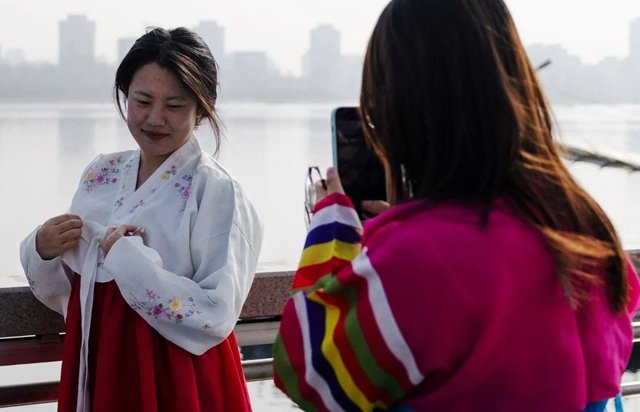
The transformation extends well beyond construction. Reports emerging from what some influencers have begun calling “Pyonghattan” depict a capital where a modest but growing middle class has emerged. Restaurants now serve wood-fired pizza, fried chicken and Nürnberger sausages with sauerkraut. Some shopping centres stock beauty products from foreign luxury brands. Locally manufactured smartphones have become increasingly common, operating within a tightly censored domestic 4G intranet rather than the global internet. Digital payments through QR codes are available in Pyongyang shops, while home-grown streaming and fitness applications have also appeared. Beard recalled seeing only two taxis during an eight-day visit in 2012. Today, residents make use of ride-hailing services resembling Uber, and rush-hour traffic congestion has become a regular feature of the capital.
Observers interviewed by Die Zeit attribute this economic revival to Kim Jong-un’s ability to turn two major international crises to his advantage: the coronavirus pandemic and Russia’s invasion of Ukraine.
The pandemic initially plunged North Korea into severe hardship. Border closures paralysed trade with China, disrupting food supplies and leaving the country facing acute shortages. Reports from defectors indicated that rice was diverted from provincial areas to sustain Pyongyang and the military, while shortages of medicine forced some sick individuals to drink tree bark sap. The number of people who died from Covid-19 or malnutrition during this period remains unknown.
Yet the same crisis enabled Kim to consolidate control over both society and the economy. During the pandemic, North Korea constructed a heavily fortified 1,370-kilometre border with China, expelled foreign diplomats and international non-governmental organisations, and cracked down on the semi-legal private markets that had previously facilitated the smuggling of South Korean television dramas and popular music into the country. Individuals caught distributing illicit digital media reportedly faced imprisonment in labour camps or public execution. Rachel Minyoung Lee, a North Korea expert at the Stimson Center, told Die Zeit that the regime used the pandemic as “a chance to reset”, allowing it to reassert firm control over both society and economic activity.
A second turning point arrived in 2022 following Russia’s invasion of Ukraine. As Moscow’s military campaign consumed enormous quantities of ammunition, Russia turned to North Korea for support. Pyongyang supplied millions of artillery shells, short-range missiles and anti-tank weapons, while also deploying up to 15,000 soldiers. South Korea’s intelligence service estimates that approximately 6,000 North Korean troops were killed. A newly erected memorial wall in Pyongyang honours the fallen, while BBC analysis of satellite imagery identified roughly 2,300 engraved names.
Russia responded with substantial economic and strategic assistance. Between mid-2023 and the end of 2025, more than US$10 billion reportedly flowed from Russia into North Korea through payments alongside shipments of oil, wheat and meat. Given estimates placing North Korea’s annual economic output at approximately US$27 billion, the scale of these transfers has been considerable. Russian military expertise has also supported the modernisation of North Korea’s air defence systems while Kim has continued expanding tactical nuclear weapons development and testing intercontinental ballistic missiles capable of reaching the continental United States.
The relationship has also reshaped North Korea’s diplomatic position. Formalised in a comprehensive partnership agreement signed in 2024, the alliance with President Vladimir Putin has provided Kim with an influential strategic partner beyond China. While Beijing initially appeared cautious about the growing Moscow-Pyongyang relationship, China subsequently expanded trade with North Korea from 2024 onwards. In September 2025, Chinese President Xi Jinping invited Kim to Beijing for commemorations marking the 80th anniversary of the end of the Second World War, where Kim appeared alongside both Xi and Putin. During their bilateral discussions, China’s official statement notably omitted its longstanding call for the denuclearisation of North Korea, signalling what appears to be a significant shift in Beijing’s position.
At the same time, international sanctions have steadily lost their effectiveness. Russia’s 2024 veto in the United Nations Security Council ended the mandate of the panel responsible for monitoring sanctions enforcement, while United States President Donald Trump has largely abandoned efforts towards North Korean denuclearisation, describing the country instead as “a great nuclear nation”.
Kim has used the improving economic climate to project an image of modernisation. In July 2025 he inaugurated the Wonsan Kalma beach resort, located approximately 120 kilometres east of Pyongyang near a missile testing area. The complex features hotels, shopping centres, a water park and accommodation claimed to be capable of hosting 20,000 visitors, reportedly modelled on the Spanish resort of Benidorm. Months later, five ski and spa resorts near the Chinese border were also opened. For now, only Russian tourists have been permitted to visit Wonsan Kalma alongside North Korean citizens.
The gains, however, have not been evenly shared. Rachel Minyoung Lee argues that the principal beneficiaries have been residents of Pyongyang, particularly members of the urban elite whose loyalty remains essential to the regime. Rural areas continue to face very different living conditions. Nonetheless, she contends that improvements in living standards across much of the country are difficult to dismiss entirely, citing better clothing visible in state television broadcasts and public information programmes now advising viewers how to protect their eyes from prolonged smartphone use.
Technology has simultaneously become an instrument of tighter political control. Analyses of smartphones smuggled out of North Korea indicate that domestically produced devices automatically capture screenshots of users’ activity every five minutes and transmit them to the authorities. Rather than opening a window to the outside world, expanding digital access has reinforced the state’s surveillance capabilities.
“Without meaning it as praise, Kim Jong-un has proved surprisingly competent,” Lee told Die Zeit. His long-term vision, she argues, is that of a centrally directed developmental dictatorship capable of standing independently, strengthening domestic industry, reducing reliance on China, and generating sustained foreign currency earnings through arms production.
That strategy may receive further support from infrastructure now nearing completion. A new two-lane road bridge stretching approximately one kilometre across the Tumen River will create the first direct road connection between North Korea and Russia. Ukrainian observers believe it could facilitate the transport of military equipment and personnel, with road transport offering advantages over rail by being more difficult to detect from the air.
Fifteen years into his rule, Kim Jong-un has achieved an outcome few anticipated. His authority appears more secure than ever, North Korea’s nuclear programme continues without significant external constraint, international sanctions have weakened substantially, and the country has evolved from an isolated recipient of aid into a sought-after supplier of military equipment. At the same time, economic growth, expanding consumer amenities and ambitious construction projects coexist with pervasive state surveillance, restricted freedoms and prosperity that remains concentrated primarily in the capital. North Korea’s transformation, as documented by Die Zeit, illustrates not only a remarkable period of domestic change but also a profound shift in the country’s place within an increasingly fragmented international order.