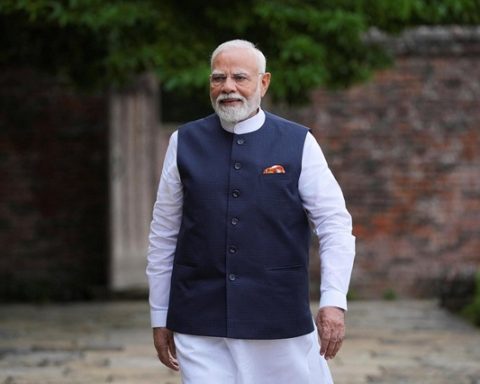
For historian Wang Gungwu, the rivalry between the United States and China cannot be understood without looking backwards. At 95, the internationally recognised authority on Chinese history remains convinced that the past provides essential clues to understanding the present, from Beijing’s determination to secure its maritime approaches to the Communist Party’s conviction that it alone can preserve China’s strength and unity.
In an interview published by the South China Morning Post, Wang, who has been a professor at the National University of Singapore since 2007 and emeritus professor at the Australian National University since 1988, examined the strategic rivalry between Washington and Beijing, America’s global position, China’s political system, Taiwan and the historical forces shaping modern Chinese governance.
He sees the current US-China confrontation as resembling the Cold War between the United States and Soviet Union, particularly because both Washington and Beijing possess nuclear weapons. The possibility of a nuclear conflict makes direct war unlikely, he argued, while competition through proxies could reproduce a familiar feature of the Cold War.
Wang said US strategists had, since the collapse of the Soviet Union, increasingly regarded China as the only power capable of becoming a long-term challenge to American predominance. One earlier American approach was to encourage China’s economic development on the assumption that integration into the global economy would eventually produce a more capitalist system and a large middle class, reducing ideological divisions.
China’s admission to the World Trade Organization in 2001 was part of that approach. Its economy subsequently expanded at a rapid rate, producing a country that, in Wang’s assessment, differed fundamentally from the Soviet Union. Unlike the Soviet Union, which was economically weak and had limited access to the oceans, China possessed an entrepreneurial population and extensive access to maritime trade.
That economic strength, Wang argued, has given Beijing the capacity to fund military expansion without suffering the kind of economic collapse that accompanied the Soviet arms race. Yet he believes China does not want a war with the United States. Its overriding concern is security against attacks from the sea.
The historical memory behind that concern is deep. Wang traced it to the 19th century, when Britain and France attacked from Southeast Asia using naval bases, followed by the Americans after taking the Philippines. With Southeast Asia under foreign control, China’s coastline became vulnerable, contributing to the circumstances that forced China to accept unequal treaties.
The lesson, he argued, has endured. Beijing will not neglect maritime power again. Its military preparations, including missile capabilities in the South China Sea designed to deter powerful naval forces such as aircraft carriers, should therefore be understood primarily through the lens of defence and preventing an attack from nearby.
That does not mean Wang believes the United States is in decline. Although America has lost credibility in some areas, particularly after the Iraq and Afghanistan conflicts and its difficulties in Iran, he rejects the idea that the country has entered an irreversible decline.
“The word ‘decline’ is not the right word because it is still the most powerful military force in the world,” he said.
The United States continues to possess extensive military bases, aircraft carriers, air power and nuclear weapons. Its economy remains powerful, while its capacity for technological innovation remains considerable. China, Wang said, is catching up but is still behind and continues to learn from people it has sent to the United States.
America also enjoys a geographical advantage that China cannot easily replicate. It is secure within its hemisphere, with no country in the Americas capable of threatening it. China, by contrast, has difficult relationships and security concerns around its borders, requiring it to maintain relations with Russia and North Korea on land while cultivating relationships with Southeast Asian countries at sea.
This asymmetry forms part of the wider dispute over the future international order. China advocates a multipolar system because it considers such an arrangement safer. The United States, Wang suggested, views multipolarity as difficult to control and potentially disorderly, while a bipolar system would allow Washington to concentrate more directly on China.
Economic competition would therefore be central. The United States and its partners could restrict Chinese access to major markets in North America and western Europe, while China could continue using the Belt and Road Initiative to reach markets and resources in the developing world. But if Chinese exports were constrained in wealthy Western markets, Wang argued, China’s economic growth could slow significantly.
Yet the historian sees China’s most serious difficulties not outside its borders but within them. The country’s political system, he argues, reflects a historical continuity stretching from the Shang-Zhou dynasty to the present. Dynasties changed, foreign powers ruled China at different times, and political systems were transformed, but the idea of China as a centralised bureaucratic state remained remarkably persistent.
The Qin-Han period established a combination of Legalist and Confucian principles in which authority was concentrated at the centre. The Qin dynasty collapsed after its harsh system provoked rebellion, while the Han retained the centralised bureaucracy but introduced Confucian officials and a stronger emphasis on moral government, social harmony and the welfare of the people.
The underlying principle, Wang argued, was performance. A ruler who protected the country and cared for the people could retain their loyalty. A ruler who failed could lose the mandate of heaven, providing a historical justification for rebellion and dynastic change.
The Communist Party introduced a different ideological framework after taking power in 1949, drawing on Marxist ideas of historical progress. But Wang sees an important continuity between the traditional notion of a caring ruler and the Communist Party’s claim to provide social welfare and national strength.
The crucial difference is that the Communist Party has effectively taken the position once occupied by the emperor. The emperor was above the law because he made the law; the Communist Party, Wang argued, similarly stands outside the ordinary legal system because it made the law.
This understanding helps explain Xi Jinping’s political approach, Wang said. Xi witnessed corruption in Fujian and Zhejiang and, after becoming general secretary of the party, urged its members to study the collapse of the Communist Party of the Soviet Union. Corruption, factionalism and the loss of revolutionary purpose had weakened the Soviet party, and Xi believes the same fate must be prevented in China.
“I think he genuinely believes that only the party can save China and make China strong so that it can recover its position in the world today,” Wang said.
But the anti-corruption campaign has created its own difficulties. After about 14 years in power, Xi is still confronting corruption among senior officials, including senior PLA generals. Wang argues that this demonstrates that corruption cannot be addressed through punishment alone and that important institutions require review and restructuring.
The resulting caution among officials may also restrict initiative. Bureaucrats can become reluctant to launch new projects because of the risk that colleagues involved might later be found corrupt. The safest course, Wang suggested, can become doing as little as possible.
He sees signs of wider domestic strain, including economic stagnation, unemployment and large numbers of graduates seeking work. Restrictions on foreign material and approved teaching resources have also contributed to a broader atmosphere of uncertainty. The greatest tensions, he said, are increasingly domestic, particularly among younger people.
Taiwan remains another major issue, but Wang believes the current status quo can persist. He sees historical continuity between the Republic of China established in 1912 and Taiwan’s present political identity, while noting Beijing’s opposition to any formal declaration of independence.
For Wang, neither side ultimately benefits from war. A conflict would involve Chinese lives and could draw other countries into the confrontation. Beijing’s principal concern, he argued, is that Taiwan should not be used as a base for attacks against China.
That leaves room, in his view, for the status quo to continue, particularly if Taiwan remains neutral or broadly sympathetic towards Beijing and maintains a sense of shared Chinese culture and civilisation. China’s historical perspective also encourages patience: periods of division have occurred repeatedly, but the prevailing historical assumption has been that China will eventually become unified again.
For Wang, this long view is ultimately the purpose of studying history. His legacy, he said, would be modest if he could persuade people that the past matters.
History does not simply provide a catalogue of facts. It offers a means of understanding how societies arrived at the present, what mistakes were made, what forms of governance succeeded and why political systems changed. Governments that ignore history, he warned, are likely to repeat mistakes.
China’s own history, with its periods of unity, fragmentation, foreign rule, revolution and extraordinary economic and technological transformation, demonstrates both the possibility of decline and the possibility of recovery.
The lesson Wang draws from that history is ultimately one of continuity and progress. China has survived repeated upheavals and risen again. Its future, he suggests, will depend not only on its ability to compete with the United States but also on whether its leaders can learn from the past, provide good governance and give its people sufficient freedom and opportunity to remain creative.
For a historian who has spent a lifetime examining China across centuries, the central question is therefore not simply whether China will rival America. It is whether the country can reconcile the strength of its centralised political tradition with the freedom needed to sustain its future progress.