Beijing is preparing for an intense spell of rainfall expected to deliver more than one-third of the Chinese capital’s average annual precipitation within 24 hours, as moisture from Typhoon Dolphin converges with cooler air over northern China.
From Tuesday evening through Thursday, most areas of Beijing are expected to experience heavy rain, with cumulative rainfall exceeding 100mm in six hours and 150mm in 24 hours, according to the city’s meteorological service. Rainfall in the districts of Tongzhou, Daxing, Fangshan, Mentougou, Huairou and Fengtai could exceed 200mm within 24 hours.
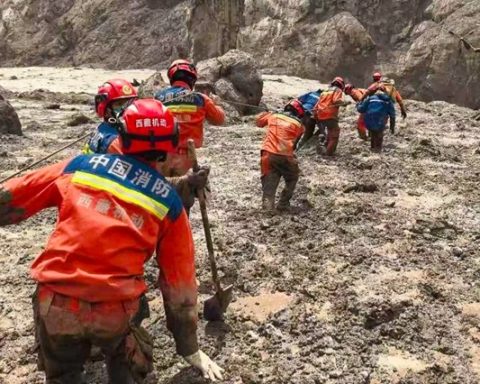
The forecast rainfall is significant compared with Beijing’s average annual precipitation of 528mm, most of which normally falls between June and September. In mountainous Mentougou district in western Beijing, authorities issued the highest-level flood emergency alert on Tuesday and advised residents to remain indoors unless necessary. People were also warned to avoid travelling to mountainous areas and rivers.
The extreme weather is linked to the remnants and peripheral circulation of Typhoon Dolphin, which moved deeper inland into China’s central Hubei province on Tuesday. Authorities there closed tourist attractions and suspended construction projects as forecasters warned of potentially dangerous rainfall, particularly in the mountainous northwest.
Dolphin is the strongest typhoon to hit China this year. Its storm system travelled nearly 6,000 kilometres before making landfall over the weekend, bringing heavy rain to China’s eastern coast and generating a vast cloud field that has continued to influence weather conditions farther inland.
Hubei, a major centre for automobile and high-tech electronics manufacturing with more than 58 million residents, is particularly vulnerable to the latest rainfall. The province was struck by two rare tornadoes last month following Typhoon Maysak, which killed at least 11 people.
The National Meteorological Center on Tuesday renewed an orange alert for heavy rain, the country’s second-highest warning level. Northwestern parts of Hubei could receive as much as 250mm of rain over 24 hours. Provincial authorities issued yellow warnings for cities including Xiangyang, Huanggang and Suizhou, citing increased risks of flooding and landslides.
The heavy rainfall has already disrupted activities across the province. Scenic areas have announced temporary closures, including the popular Three Gorges Dam tourist area in Yichang. Authorities have also suspended 26 of 107 major highway and waterway construction projects because they were considered high-risk.
Wang Xiaoling, deputy director of Hubei’s provincial meteorological observatory, told the Hubei Daily that Dolphin’s peripheral airflow would be forced upwards when it encounters mountains in western Hubei. The interaction could intensify rainfall several times over, increasing the threat of flooding and landslides in mountainous areas.
The weather system is also affecting neighbouring Henan province, where authorities issued a red flash-flood alert as the storm continues to channel moisture northwards. Its influence is expected to extend more than 1,000 kilometres north to Beijing, where four districts on the capital’s outskirts have activated Level I emergency flood responses.
The combination of abundant moisture from Dolphin and cooler air over northern China has created conditions for a prolonged period of heavy rainfall across a wide area. Authorities in affected regions are therefore facing simultaneous risks from flash floods, landslides and disruption to transport and construction.
The storm’s broader regional effects are not confined to mainland China. Japan is also preparing for possible landslides, flooding and strong winds after the Japan Meteorological Agency said Typhoon No. 15, Chan-hom, could move across the country’s mainland later on Tuesday.
As Beijing prepares for rainfall equivalent to more than a third of its annual average in a single day, authorities across central and northern China are confronting a weather system whose effects are extending far beyond the path of the original typhoon. The combination of mountainous terrain, saturated areas and intense rainfall has heightened the risk of further disruption as Dolphin’s moisture continues moving northwards.