North Korea is seeking to attract Russian holidaymakers to its newly built Wonsan-Kalma coastal resort, but the number of visitors remains small, offering a glimpse into an ambitious tourism project where foreign guests are permitted to enjoy beaches and leisure facilities under close supervision.
Russian Foreign Minister Sergei Lavrov has promoted the destination, describing its sea and conditions as “wonderful”. He visited the resort himself shortly after its opening last year. In April, another Russian delegation travelled to Wonsan-Kalma, including Russia’s environment minister and health minister, who were photographed with North Korea’s foreign trade minister at the airport.
Russia established a direct flight connection between Moscow and Pyongyang with Nordwind Airlines in July last year. The airline operates one return flight a month, supported by a Russian state subsidy from the state reserve fund. However, an analysis of Nordwind’s booking data since October 2025 found that only between 12 and 30 of hundreds of seats were typically booked shortly before departure. One notable exception was April 2026, when 48 adjacent seats were unavailable almost two weeks before departure.
That flight, however, did not travel to Pyongyang as expected. Aviation data showed that it instead landed at Wonsan-Kalma, on the same day that Russian and North Korean officials were photographed at the airport, raising questions about whether the service was being used solely for tourism.
For North Korea, the resort is part of a broader effort to generate hard currency. International sanctions imposed following repeated missile tests have severely restricted the country’s trade and financial transactions, although tourism has not been sanctioned. Kim Jong Un has sought closer economic ties with Russian President Vladimir Putin, following North Korea’s military support for Russia during the war in Ukraine. Russian officials have subsequently promoted travel to the largely isolated country.
Foreign tourists initially allowed into Wonsan-Kalma are restricted to Russians, whose visits are organised through travel agencies accredited by North Korea’s tourism authorities. Package holidays include flights, hotel accommodation with full board, transfers, guides and visas. Russian applicants must provide not only a passport but also a certificate of employment on company letterhead bearing the signature and stamp of the employer.
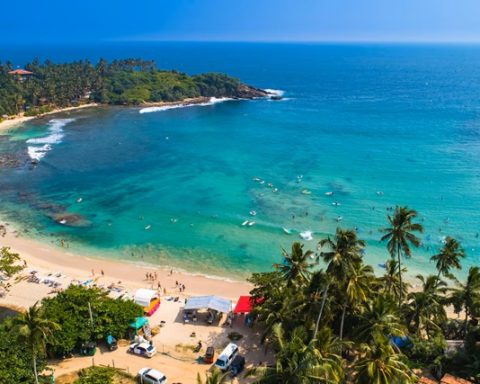
The resort itself is a vast prestige project developed along five kilometres of coastline since 2018. An official 2025 map lists 43 hotels and 43 restaurants and bars. Visitors’ accommodation and dining locations are generally determined by their tour operators, while daily activities are tightly scheduled.
Videos published by Russian travellers and North Korean tourism agencies show tourists arriving by bus, spending time on designated beaches, eating in specified restaurants and visiting facilities including mini-golf, bicycle rental, an arcade with virtual-reality games and older computer games. Evening programmes include a fountain show outside a hotel.
Interaction with local residents appears strictly controlled. Videos show Russian visitors attempting to communicate with North Koreans, while supervisors intervene. One Russian influencer approached North Korean children in the water before their carers removed them. Visitors are also accompanied by guides, limiting their freedom of movement around the resort.
A typical eight-day package offered by a Vladivostok-based travel operator in 2025 cost about $1,850, more than the average monthly income in Russia. Four days were spent at the resort and four in Pyongyang. More than three-quarters of the cost had to be paid in cash in US dollars shortly before departure, with the remainder paid in roubles. Purchases inside the resort are also priced in dollars and can be made using payment wristbands.
The resort is divided into areas for foreign and North Korean visitors. According to Russian travel influencers, their payment wristbands work only in the northern section, while another area is reserved for North Koreans. Foreign visitors appear to pass through the latter area by tram accompanied by guides rather than moving around independently.
Despite the scale of the development, the resort appears largely empty in footage recorded by Russian visitors. Official Russian figures show that about 5,000 Russians visited North Korea in 2025, the highest number recorded, but still a small figure for a country seeking to develop international tourism.
The resort is also being developed alongside wider infrastructure projects, including a new railway station. The area previously contained a Korean People’s Army training ground, and military aircraft remain there. By summer 2026, travel operators had adjusted programmes to incorporate rail travel and additional regional excursions, while one operator shortened the resort stay by a day.
For Pyongyang, Wonsan-Kalma represents an attempt to turn a heavily controlled coastal enclave into a source of tourism revenue and closer ties with Russia. Yet the limited number of visitors and the highly managed nature of their experience demonstrate the considerable gap between North Korea’s ambition to attract foreign tourists and the reality of operating a resort within one of the world’s most isolated states.