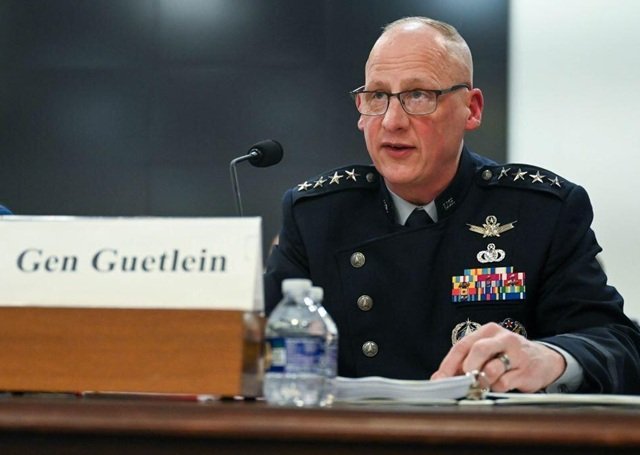
The United States’ ambitious Golden Dome missile-defence initiative is approaching a critical point, with its senior military leader expressing confidence in the programme’s ability to deliver its planned capabilities within a stated $185 billion budget while warning that the entire effort could be forced to stop if Congress fails to resolve a looming funding problem.
Gen. Michael Guetlein, Director of Golden Dome and presently assigned to the US Space Force, made the remarks at the annual Space & Missile Defense (SMD) Symposium in Huntsville, Alabama. Operational elements of the new architecture are currently scheduled to begin coming online in mid-2028, following an unusually rapid programme of contracting, testing and construction.
Guetlein insisted that the figure the administration is working towards remains $185 billion. “What is the bill to the nation? How much national treasure are we asking the American public to commit to the defense of the homeland?” he said in his introductory remarks. “I’m on record, and I’m still up here saying the exact same number: $185 billion. We started at 175 billion dollars, and we added 10 more billion [dollars] worth of accelerating space capabilities that we thought the nation needed, that were not part of our original architecture.”
He acknowledged that the figure represents an enormous national commitment. “That is a lot of money. It’s one of the biggest systems that we’ve ever put together as a nation. We [have] got to keep it affordable,” Guetlein said. He also acknowledged the existence of substantially higher estimates, while arguing that those calculations do not reflect the architecture the US is actually developing.
Independent estimates have nevertheless highlighted the potentially vast cost of Golden Dome. The Congressional Budget Office (CBO) estimated in May 2025 that the complete architecture could cost up to $542 billion to develop, deploy and operate over two decades. In May this year, the CBO issued a second estimate suggesting that the full cost might approach $1.2 trillion over the same 20-year period. The office also said that its assessment had been constrained by limited publicly available information about what the programme’s so-called “objective architecture” would ultimately contain.
Other independent estimates have placed the potential cost even higher. Space-based interceptors are particularly significant to those calculations. The CBO’s $1.2 trillion estimate projected that 7,800 such interceptors would need to be in orbit at any one time for the architecture to operate as intended.
Guetlein, however, portrayed the programme as moving rapidly from concept towards implementation. “We’re building something completely differently, and that architecture is coming together, and is being proven every single day,” he said. He listed radars, launchers, space-based interceptors, a hypersonic ballistic tracking system and a space data network as being under contract. Construction contracts have also been let, he said, as officials work towards the capabilities President Donald Trump asked them to deliver in the summer of 2028.
The programme has also begun testing elements of its proposed architecture. Guetlein said two tests had already taken place but that details could not be disclosed. According to him, those tests were “phenomenally successful” and demonstrated the effectiveness of command and control, the sensor network and the system’s effectors against the threats for which they had been designed.
He later described a major test conducted in the summer of 2026 as the most complex test with the most threats in the air in the history of the US Army’s White Sands Missile Range in New Mexico. The Missile Defense Agency executed the test within six months after Guetlein set the challenge in January, he said, and met every test objective he had specified.
The effort involved the Missile Defense Agency, the White Sands Missile Range team, the Army’s Space and Missile Defense Command, the Army’s Portfolio Acquisition Executive for Fires, Fort Bliss in Texas and other agencies. Guetlein described the exercise as the most complex integrated missile-defence test the United States had conducted, while stressing that it represented only a fraction of what would be required to meet the 2028 objective. The test planned for 2027, he said, would be even more complex.
Yet the programme’s technical momentum is now confronted by a financial obstacle. Golden Dome has so far relied on core funding outside the normal defence spending streams through a process known as reconciliation. Guetlein said that when the President submitted his Fiscal Year 2027 budget proposal to Congress, Golden Dome was not included in the defence “top line”. Instead, it was placed within mandatory funding associated with reconciliation.
That distinction could become decisive if Congress relies on a continuing resolution to keep the federal government operating. “So, yes, we have a CR [continuing resolution], and we’re not going to shut down the federal government, but a CR doesn’t help me under Golden Dome because I don’t have a top line to fall back to to get that percentage of the continuing resolution,” Guetlein explained.
The administration’s proposed Fiscal Year 2027 defence budget already carries a $1.5 trillion topline, comprising a $1.1 trillion base budget and $350 billion in additional mandatory resources through reconciliation. But Golden Dome’s particular funding structure means that maintaining overall defence spending levels does not automatically secure the money required by the programme.
“So we’ve got to figure out, as a nation, a different way of funding Golden Dome, at least for [20]27. Right now, that’s under reconciliation,” Guetlein said. “I will tell you that if they don’t figure it out, there is no Golden Dome because there is no funding.”
So far, $22.5 billion has been appropriated for the initiative, according to Guetlein, with 95 percent of that money already committed to specific work. He nevertheless expressed confidence that a solution would be found, citing the urgency surrounding the programme while acknowledging the difficulty of the current budgetary environment.
The funding challenge comes amid wider debate in Washington over the use of reconciliation and related mechanisms to increase defence spending outside the military’s base budget. Senator Mitch McConnell, a Republican from Kentucky, said during a hearing in June that “I think it’s safe to conclude there will not be another reconciliation bill.”
A prolonged delay could have consequences beyond Golden Dome itself. The Pentagon could attempt to redirect funds from other areas, but doing so could affect other military priorities. Guetlein said the Pentagon was examining contingency options, including the possibility that the Space Force could continue investing in certain capabilities that overlap with Golden Dome requirements.
He stressed that no decisions had yet been made. “Because we have diversified execution of a lot of these capabilities, and a lot of these capabilities are already requested by combatant commands, there are some alternatives that we can pursue. We have not made any decisions on any pathway,” he said.
The uncertainty comes as the US military is simultaneously pursuing other major modernisation programmes considered critical to national security, including costly efforts to update all three legs of America’s nuclear deterrent triad and the command-and-control architectures supporting them.
For Golden Dome, therefore, the immediate challenge is no longer simply whether its complex network of sensors, launchers, interceptors and space-based systems can be assembled on an accelerated timetable. The programme must also secure a sustainable funding mechanism capable of carrying it into its next phase.
Guetlein’s remarks place that question at the centre of Golden Dome’s next stage. After a year of contracts, construction and increasingly complex testing, the initiative now faces what its director described as a fundamental condition for its survival: securing the money required to continue.