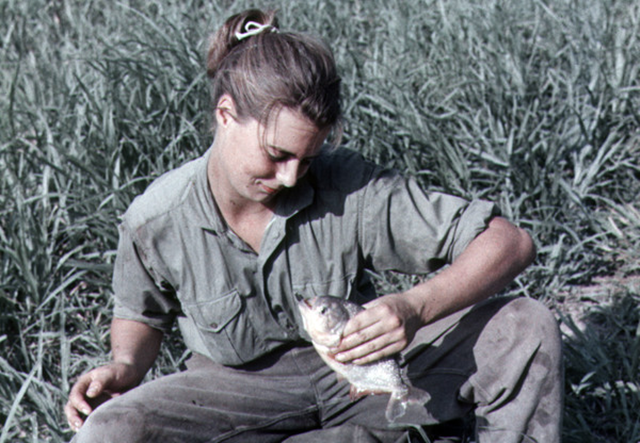
Monika Ertl’s life crossed some of the most turbulent political currents of post-war Europe and Latin America. Born to Hans Ertl, one of Nazi Germany’s leading propaganda filmmakers, she grew up in a family whose connections extended into the world of former Nazi fugitives who sought refuge in Bolivia after the Second World War. Yet Ertl would ultimately reject the political environment into which she had been born and become a revolutionary herself.
After the war, Ertl fled to Bolivia with her family, as did many Nazi fugitives. Her father continued to associate with figures from the Nazi past, including Klaus Barbie, the Nazi war criminal known as the “Butcher of Lyon”. Barbie would later become a central figure in the story of Ertl’s revolutionary activities, transforming a connection inherited from her father into one of the people she sought to confront.
By the late 1960s, Ertl had turned away from the world represented by her father. The poverty and injustice she encountered in Bolivia affected her profoundly, and she broke with the fascist environment surrounding her family. She became radicalised and moved towards revolutionary politics, eventually joining the National Liberation Army (ELN), the organisation founded by Che Guevara during his campaign in Bolivia.
Within the organisation, she adopted the codename “Imilla”, meaning “Little Girl” in an Indigenous language. Her transformation was striking: the daughter of a man associated with Nazi Germany’s propaganda apparatus had become part of a revolutionary movement inspired by one of the most prominent figures of the international left.
Che Guevara’s death in Bolivia became the defining event that set Ertl on the path for which she would later become internationally known. After Guevara was killed, she joined the ELN and became involved in its underground activities. Her most notorious operation came several years later, when she targeted Roberto Quintanilla, Bolivia’s consul in Hamburg and a former intelligence official regarded as one of those chiefly responsible for Guevara’s death.
Quintanilla was among the men who had posed beside Guevara’s lifeless body after his capture and death. He had also given the order for Guevara’s hands to be cut off. For those who viewed Guevara’s death as a revolutionary cause requiring retribution, Quintanilla became a symbolic target.
On April 1, 1971, Ertl travelled to the Bolivian consulate in Hamburg. Disguised as an elegant woman, she entered the building and came face to face with Quintanilla. She then drew her weapon and shot him three times.
The assassination reverberated internationally and became associated with the idea of “Che’s revenge”. At the scene, Ertl left behind a note bearing the words: “Hasta la victoria o muerte.” The act transformed her from an underground revolutionary into a figure whose story became inseparably connected with the legacy of Che Guevara and the political violence surrounding his death.
But the assassination in Hamburg was not the end of Ertl’s revolutionary activities. She returned to Bolivia and continued working underground. Her activities increasingly brought together the two worlds that had defined her life: the Nazi past of her family and the revolutionary movement she had embraced.
One of her principal targets was Klaus Barbie, the Nazi war criminal who had once been a friend of her father. By then, Barbie was advising the Bolivian dictatorship. Ertl sought to kidnap him, turning the connection between her father’s former associates and her own revolutionary struggle into a direct confrontation.
The attempt never reached its intended conclusion. On May 12, 1973, Ertl was ambushed by Bolivian security forces. She was killed during a clash in the streets of La Paz.
Her death brought an end to a life that had moved from one political extreme to another. Yet even after her death, uncertainty surrounded her final resting place. Her grave was kept secret, and her body was never handed over to her family.
Ertl’s story has endured because of the extraordinary contradiction at its centre. She was the daughter of Hans Ertl, a figure associated with Nazi Germany’s propaganda machinery, and grew up within a social environment that included people connected to the Nazi past. Yet she rejected that inheritance and eventually committed herself to a revolutionary cause that stood in direct opposition to the world from which she came.
Her transformation also connected two continents and two distinct histories. Germany’s post-war legacy of Nazism, the flight of Nazi fugitives to Latin America, Bolivia’s political turmoil and the revolutionary campaign of Che Guevara converged in the life of one woman.
Her assassination of Quintanilla gave her the enduring description “the woman who avenged Che Guevara”. But her significance extended beyond that single act. Ertl’s trajectory was defined by a radical rejection of her origins and privileged life, followed by a commitment to the revolutionary struggle she encountered in Bolivia.
As both a German and a Bolivian revolutionary, she became a symbol of the anti-fascist connection between Europe and Latin America. Her life remains an extreme example of how an individual’s political identity can be transformed by the society, conflicts and injustices encountered after childhood — and how, in Ertl’s case, the rejection of a family’s past became inseparable from a violent revolutionary cause.