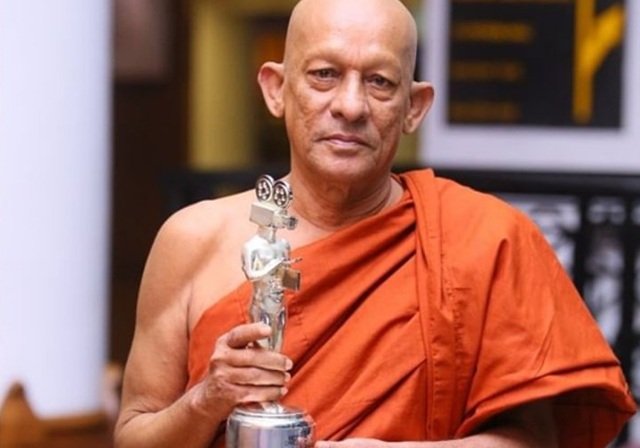
Ven. Rambukana Siddhartha Thera, one of Sri Lanka’s best-known Buddhist lyricists and authors, died on Tuesday at the age of 76 while receiving treatment at Sri Jayewardenepura Hospital, bringing to an end a career that had helped reshape the way Buddhist thought was expressed through popular Sinhala music.
For decades, Siddhartha Thera occupied an unusual place in Sri Lankan cultural life. He was a Buddhist monk who became a prolific lyricist, producing songs that reached audiences far beyond the confines of religious institutions. His work brought together Buddhist philosophy, human emotion and social values in language that was accessible, lyrical and easily remembered.
Among the songs associated with his name are La Dalu Bopath, Senehasa Puda, Sanda Tharu Mal, Sansare Api and Budu Hamuduruwo Wediya Wage. Through such compositions, he became particularly associated with the revival and popularisation of Buddhist devotional music, while his writing also addressed broader questions of human experience, including love, compassion, suffering, impermanence, morality and social responsibility.
His importance therefore extended beyond the conventional category of a devotional songwriter. His distinctive contribution lay in translating ideas traditionally encountered through Buddhist sermons and literature into the language of popular song. Complex religious and philosophical concepts could be presented through familiar emotions and images, allowing them to reach listeners in an entirely different form.
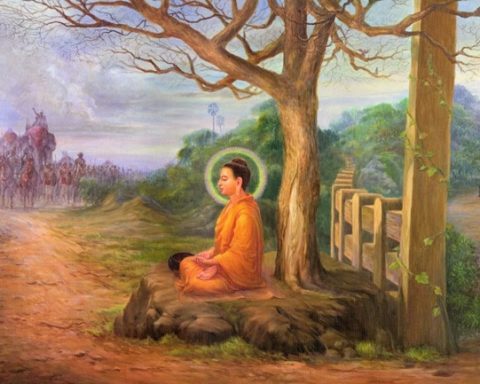
That quality is particularly evident in La Dalu Bopath, one of his most recognised compositions. The song approaches the story of the Buddha through the emotional perspective of Yasodhara, using poetic imagery to express separation, devotion and restrained grief. The lyrics were written by Rambukana Siddhartha Thera, with music by H. M. Jayawardena and vocals by Karunaratne Divulgane.
His work also crossed the boundaries between religious music and mainstream entertainment. His involvement with the 1988 Sinhala film Sandakada Pahana established another important dimension of his career as a film lyricist. For his contribution to the film, he received the Best Lyricist award at the 17th Sarasaviya Awards in 1989.
That recognition reflected the wider reach of his writing. Siddhartha Thera was not confined to a single musical tradition. His lyrics appeared within a broader culture of Sinhala music in which poetry, melody and social meaning were closely intertwined.
His career also illustrates the distinctive role that Buddhist literary expression has played in Sri Lankan culture. Academic writing on Theravada Buddhist religious cultures has examined the tradition of the monk as poet and preacher, including Siddhartha Thera’s work. His song Sansare Api has been discussed in this context, placing his popular compositions within a wider tradition of communicating Buddhist ideas through poetic expression.
His literary contribution extended beyond songs. He was also an author and an important figure in Buddhist literature. Commemorative volumes were produced in recognition of his work, including Hela Gii Magehi Yathi Pelahara in 2006 and Kiviyara Yathivara Nimavum Pelahara in 2016.
His contribution to Buddhist literature also continued into newer forms of communication. In 2022, he supervised the Sinhala Jataka Tales Audio Book project, undertaken with the involvement of the Indian High Commission in Colombo, the University of Colombo’s Centre for Contemporary Indian Studies and the Swami Vivekananda Cultural Centre. The project produced audio versions of Jataka stories, with the first and second volumes containing 50 stories each. The format also made the material accessible to audiences including visually impaired people.
The project reflected another dimension of Siddhartha Thera’s work: the effort to make Buddhist literary traditions available through contemporary forms of communication rather than restricting them to conventional printed texts.
His influence also extended into the institutional world of Sri Lankan literature. Siddhartha Thera served as Chairman of the State Literary Advisory Board, giving him a role in the country’s wider literary affairs beyond his own writing.
Yet it was through song that his voice reached perhaps the largest audience. Titles such as La Dalu Bopath, Sansare Api, Senehasa Puda, Sanda Tharu Mal and Budu Hamuduruwo Wediya Wage became part of a musical tradition in which Buddhist ideas could be encountered not only in temples or religious texts, but through everyday listening.
His approach was notable for its simplicity. Rather than presenting Buddhist philosophy solely in formal or doctrinal language, he expressed it through familiar human experiences. The result was a body of work in which religious devotion and ordinary emotion could exist alongside one another.
That distinction is central to understanding his legacy. Siddhartha Thera did not merely write songs about Buddhism. He helped make Buddhist concepts part of a popular cultural vocabulary, using poetry and music to communicate ideas about human conduct, compassion, attachment, suffering and the transience of life.
His death at 76 therefore marks the passing of a figure whose career crossed several boundaries at once: between monastic life and popular culture, between Buddhist literature and contemporary music, and between religious teaching and poetic expression.
For several decades, Ven. Rambukana Siddhartha Thera gave Buddhist ideas a voice in Sri Lankan popular music. His legacy will be measured not only by the songs he wrote or the books he produced, but by the unusual cultural space he occupied as a monk who transformed religious thought into words that could be sung, remembered and carried into ordinary life.