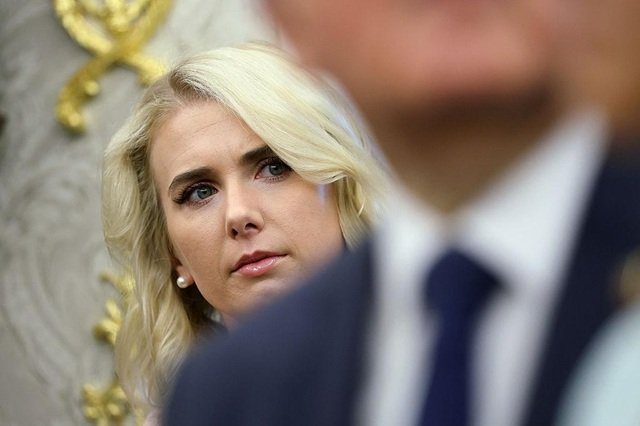
The White House personnel report lists Natalie Harp as a special assistant and personal aide to the US president, with an annual salary of $150,000. On paper, it is a significant position. Yet the formal description reveals little about why the 35-year-old has become one of the most visible figures in Donald Trump’s immediate circle.
Harp is wherever Trump is. During the president’s recent return from the Nato summit in Turkey, Trump was secretly moved to another aircraft amid fears of an attack. Even senior government officials, including Secretary of State Marco Rubio, were left unaware. Harp was among the three trusted aides who changed aircraft with the president. Whatever her formal title, her place among Trump’s closest confidants is therefore difficult to dispute.
The more consequential question is why.
The question of whom Trump allows close to him, and who receives direct access to presidential power, is not new. But it has assumed particular importance during his second presidency. From the beginning, much attention has focused on Susie Wiles, Trump’s chief of staff, frequently portrayed as a highly influential strategist behind the administration. Yet Wiles is apparently not the only important gateway to the president.
In their investigative book Regime Change, New York Times reporters Maggie Haberman and Jonathan Swan describe Wiles as being disturbed by the president’s extraordinary closeness to the young aide, particularly because the relationship appears largely beyond her control. They quote Wiles asking: “Wo bin ich hier eigentlich?” — “Where am I here, actually?” Her confusion reportedly followed the discovery of highly personal letters Harp repeatedly left for Trump. Their message was unmistakably intimate: “Du bist alles für mich” — “You are everything to me.”
This week, the US publication Daily Beast published two of Harp’s letters to Trump in full. Trump biographer Michael Wolff said he obtained them from people around the president while researching during the 2024 election campaign. In the letters, Harp reportedly wrote: “Du bist das Einzige, was mir wichtig ist” — “You are the only thing that matters to me” — and “Ich will dir Freude bereiten” — “I want to bring you joy”. She also wrote that she never wanted to disappoint him.
The declarations of admiration have continued to fuel speculation about the nature of the relationship between Trump and Harp. Her brother, who says he no longer has contact with her, told CNN recently: “Seit sie 16 ist, hat sie eine Obsession” — “She has had an obsession since she was 16.” He said she had previously written letters to other presidents and described her feelings for Trump as an “ungesunde Leidenschaft”, or “unhealthy passion”. Her dream, he said, had ultimately come true.
Harp’s route into Trump’s inner circle is closely tied to her belief that she owes him her life. Years ago, she was treated for bone cancer and brought her story into the public arena. The attention eventually led to an appearance at the 2020 Republican National Convention. There, at times in tears, she again claimed that Trump’s legislation had given her access to experimental therapies and saved her life: “Ohne Sie wäre ich gestorben” — “Without you, I would have died.”
Those claims were disputed. But the narrative of Trump as the person who had saved her resonated, particularly with the president himself. Harp subsequently continued praising him as a presenter for the far-right broadcaster One America News, persistently defending the myth of a stolen election and other claims made by Trump.
After his first presidency ended, Trump hired her. She accompanied him as he fought criminal charges and eventually became part of his new campaign team. It was during this period that Harp acquired the nickname “human printer”, because she constantly supplied Trump with sheets of paper, particularly printed favourable news stories and praise from the internet.
Her role has since reportedly expanded into the president’s social-media operation. Harp is said to provide Trump with stacks of printed drafts for posts and material from a wide range of sources that others in the White House do not see. According to the Wall Street Journal, she sometimes posts material approved by Trump in batches and outside normal working hours, while Trump himself may also use the material. The distinction between what comes directly from him and what originates with Harp can therefore be difficult to establish.
One post, later deleted, depicting Barack and Michelle Obama as apes was reportedly traced to her.
Her access has also raised security concerns. According to various US media reports, the Secret Service at one point classified Harp as a “potential danger to herself and the president”. For an entire year, she reportedly moved in and out of sensitive areas of the White House without the mandatory security clearance, tolerated by Trump. Some employees allegedly attempted to restrict her access to the president, but those efforts failed. Instead, she is now reportedly present almost everywhere, apparently without taking even a single day off.
The episode fits a broader pattern described in the source material: Trump has long valued unquestioning loyalty and deference over professional qualifications. During his first presidency, this was accompanied by the reassuring notion of the “adults in the room” — officials who might intervene with a voice of reason when necessary.
In the second presidency, however, it has become harder to identify such figures: people regarded as informed, far-sighted and measured who can genuinely reach the president because he takes them seriously. Instead, the emerging picture is that those most likely to be heard are those who follow Trump completely. Harp appears to embody that relationship.
Her prominence became a political issue after Democratic Senator Jon Ossoff of Georgia mocked Trump during a campaign appearance, saying the president merely played golf and traded stocks and did not want to do his job. Ossoff referred to Trump travelling with Natalie in an apparently vulnerable flying palace given to them by the Emir of Qatar. The White House reacted sharply.
Spokesman Davis Ingle called Ossoff an “embarrassing effeminate theatre child dressed as Barack Obama” and a “lightweight loser”. Trump himself confronted a CNN reporter who asked questions about Harp, telling her: “You are a loud, pushy person. You are fake news. Be quiet.” Further insults from his team followed.
The attention has nevertheless placed Harp at the centre of a much larger question about access to presidential power. According to Haberman and Swan, Trump has reportedly said in the White House that she is the only person who loves him as much as his wife loves him and his children. “Ihr alle werdet gehen und Geld verdienen. Sie wird mich nie verlassen” — “You will all leave and make money. She will never leave me.”
For an administration defined by the president’s insistence on loyalty, Harp’s position is striking not simply because of her formal role, but because of the extraordinary proximity that appears to accompany it. Her influence, access and personal devotion have become intertwined in ways that have made her one of the most closely watched figures around the president.
And the central question remains the same: in Trump’s second presidency, who gets close enough to shape what the president sees, hears and ultimately chooses to say?