
by Luxman
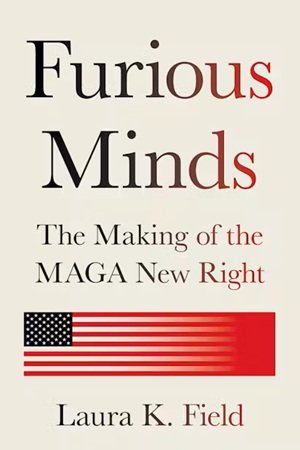
Laura K. Field’s Furious Minds is an ambitious and often unsettling attempt to explain not merely what the MAGA New Right believes, but how a movement once dismissed as a collection of marginal cranks acquired intellectual confidence, institutional reach and proximity to power. Its central provocation is that the New Right should not be understood as an accidental eruption around Donald Trump. Rather, Trumpism has exposed a much older ideological current that liberal conservatism had temporarily contained. Field argues that “Trumpism demonstrates the extent to which Reagan/Buckley fusionist conservatism was a temporary and fragile settlement” (pp. 12–13), revealing “the enduring id of old-fashioned American conservatism, including the Hard Right fringe” (pp. 12–13). This is a powerful thesis, but also one that demands caution. Field is at her strongest when tracing intellectual genealogies; she is less convincing when the genealogy begins to resemble a prosecution brief in which radically different actors are made to appear as manifestations of one coherent political will.
The book’s most important achievement is to take seriously the intellectual ambitions of a movement that liberal commentators have frequently treated as intellectually unserious. Field quotes Matthew Rose’s observation that “the alt-right is not stupid; it is deep. Its ideas are not ridiculous; they are serious” (p. 24), before insisting that “there is nothing to learn from these thinkers” is a “naive and dangerous” assumption (p. 25). This is a welcome corrective. Political movements do not become consequential merely because their arguments are correct; they become consequential because their arguments organise grievances, identities and aspirations into a compelling story. Field understands this, noting that New Right thinkers are “immensely successful propagandists and culture warriors” (p. 20). Yet there is an unresolved tension here. If these thinkers are serious enough to require intellectual engagement, the reviewer of the New Right must distinguish more rigorously between intellectual seriousness, rhetorical effectiveness and empirical validity. Field occasionally does this distinction herself, but at other moments the categories collapse into one another.
Her account of liberalism’s vulnerability is consequently more interesting than some of her descriptions of its opponents. “The naive view overestimates liberalism’s immediate appeal and underestimates liberalism’s fragility” (p. 25), she writes. That admission prevents Furious Minds from becoming a simple celebration of liberalism under siege. Field recognises that the New Right has identified genuine weaknesses in contemporary liberal societies: technocracy, managerialism, institutional distrust, campus orthodoxies, the crisis of masculinity, the alienating effects of elite culture and the political costs of treating every disagreement as a moral emergency. Indeed, in one of the book’s most intellectually generous passages, she concedes that there are “many things to be learned from the New Right” about “economics, trade, localism, technocracy and managerialism, campus silos and campus bureaucracies, and the crisis of masculinity” (p. 320). That concession is crucial, because without it her larger argument risks becoming circular: the New Right is dangerous because it attacks liberalism, while liberalism is assumed to remain fundamentally preferable because its critics are dangerous.
Field is particularly persuasive in examining the movement’s attraction to abstraction. Her criticism of the Straussian and Claremont traditions is not simply that they are conservative, but that ideas can become detached from consequences. “The Straussian love of abstraction,” she argues, “liberates them from any due diligence about on-the-ground facts” (pp. 46–47). Her discussion of Harry Jaffa is especially sharp. Jaffa’s claim to Martin Luther King Jr. as an intellectual inspiration becomes, in Field’s account, emblematic of an “Ideas First” politics in which “how it played out in real life was less concerning” (pp. 40–41). The charge is serious: political philosophy becomes dangerous when the purity of a principle excuses the consequences produced by its application. Yet the argument would be stronger if Field more systematically applied the same scepticism to liberal abstractions. Liberalism, too, has produced institutions whose lofty universalism can obscure unequal outcomes, bureaucratic coercion or failures of democratic accountability. A critique of abstraction cannot be intellectually satisfying if abstraction becomes a vice only when practised by the political right.
This asymmetry becomes particularly visible in the treatment of postliberal thinkers such as Patrick Deneen, Adrian Vermeule and Yoram Hazony. Field argues that Deneen’s postliberalism seeks “to forgo liberal freedoms and work toward wholly different political ends” (p. 87), while his intellectual method allegedly “wants to protect and cordon off moral and political living, even if that means sealing off critical thinking” (p. 89). Her warning about the “latent violence” of postliberalism is one of the book’s most consequential arguments, especially where she connects its language of “friends and enemies” to a failure to explain what happens to the “massive plurality of people in modern liberal societies” (p. 99). That question deserves to be asked. Any political philosophy that invokes a singular “common good” owes an unusually explicit account of dissenters. But Field sometimes appears to assume that because postliberals challenge liberal neutrality, their alternative must necessarily culminate in coercive domination. The possibility that liberal institutions themselves are normatively substantive is acknowledged by Ahmari’s critique of “liberal, pluralistic, modern constitutionalism” (p. 98), but not always explored with sufficient sympathy.
The sections on Christian nationalism and integralism are correspondingly among the book’s most disturbing. Field quotes common-good constitutionalist arguments that law may be “parental” and coercive, transforming subjects who may eventually “come to thank the ruler” (p. 235). She also cites Vermeule’s extraordinary call to sear the liberal faith “with hot irons” and facilitate “the final destruction of the liberal order” (p. 230). Such language deserves scrutiny, not dismissal. Field is right that the issue is not merely religious conservatism but the proposed political subordination of pluralism. Her formulation that Christian nationalism “seeks political domination” rather than simply another voice in democratic debate (p. 279) identifies the constitutional stakes. Yet the danger of grouping all religious conservatives under this heading remains. The distinction between devout Christians who seek influence within constitutional pluralism and activists seeking confessional political supremacy is essential. Furious Minds recognises that distinction in places, but its rhetoric sometimes threatens to blur it.
The treatment of the Hard Right is at once vivid and methodologically revealing. Field’s descriptions of figures such as Raw Egg Nationalist and the “white supremacy, ethnic nationalism, and neo-fascism” surrounding him (p. 259) expose the porous boundaries between ostensibly respectable intellectual movements and openly extremist subcultures. Her concept of “context collapse and selective disclosure” as a mechanism of “plausible deniability” (p. 260) is particularly useful. It explains how movements can circulate ideas across different audiences while allowing each faction to disavow the most extreme elements. But the same conceptual tool should arguably be used to distinguish the extremists from those who merely occupy adjacent intellectual territory. Political movements are coalitions, not syllogisms. Proximity is evidence of a relationship, not necessarily proof of ideological identity.
Field’s discussion of Project 2025 makes the stakes more concrete. Her account of the proposed dismantling of federal institutions, weakening of civil-service protections and politicisation of the executive (p. 214) shifts the book from intellectual history into institutional analysis. Here her argument becomes difficult to dismiss as mere culture-war commentary. The quotation from Rufo advocating a “propaganda war against public institutions” (pp. 193–194) captures Field’s broader claim that the New Right understood culture not as an arena separate from politics but as the preliminary battlefield for institutional power. Her observation that “the fringe became the weave” (p. 290) is one of the book’s most effective formulations. Yet the same metaphor risks overstating coherence: the New Right contains libertarians, national conservatives, integralists, populists, traditionalists, ethnonationalists and opportunists whose ultimate political objectives are hardly identical.
The book’s final argument is therefore its most important and its most difficult. Field does not simply demand a renewed defence of liberalism. She calls for a “liberal renaissance and reinvention” (p. 318), while insisting that liberals must develop “a hardened but steadfast toleration” for worldviews they find “incomprehensible, deeply offensive, or dangerous” (p. 320). This is the intellectual challenge Furious Minds ultimately sets for its own readers. Liberal democracy cannot survive merely by denouncing its enemies. Nor can it survive by pretending that its critics have no legitimate grievances. Field is right that “we do not have to like it” (p. 320); the more difficult task is learning how to argue with ideas one considers morally repugnant without allowing disagreement itself to become grounds for political exclusion.
Furious Minds is therefore most compelling not as a definitive anatomy of the New Right, but as a warning about the intellectual complacency that made the movement possible. Field’s central insight is that political extremism should not be underestimated simply because some of its arguments appear absurd. “Real brains,” she reminds us, “never chase after raw power” only at our peril (p. 25). The uncomfortable truth is that intelligence, conviction and political danger can coexist. Yet the same standard must apply in every direction. Liberalism must be capable of interrogating its own failures with as much severity as it interrogates those of its adversaries. Field leaves readers with the stark possibility that America may be witnessing either “the tragic end of the American experiment in liberty and pluralism” or “the cusp of a new way through” (p. 323). The value of Furious Minds lies precisely in refusing to make that verdict prematurely. Its strongest pages suggest that the battle will not be won by mocking the furious, but by understanding why they became furious in the first place—and by deciding whether liberalism still possesses the intellectual confidence to answer them.