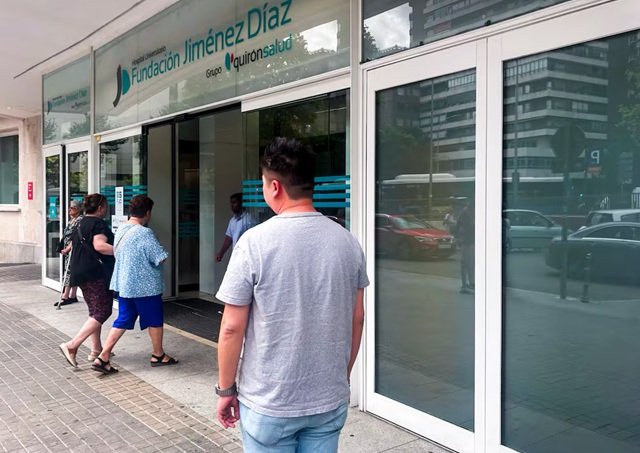
He does not wear a white coat and he is not a doctor. Yet for the past twenty years, Marcos has been a familiar presence at Madrid’s Fundación Jiménez Díaz, attending an average of 12 consultations a day and helping Chinese patients understand what doctors are telling them and what they must do afterwards.
Security guards and patient-information staff know him simply by the Spanish name he uses to avoid being identified. He asks that his real name not be published because he fears reprisals. They know his occupation too: he translates medical consultations for Chinese citizens who might otherwise find themselves struggling not only to understand their doctors but also to navigate the procedures and paperwork surrounding medical care.
Spain’s public health system has its own interpreters, usually available by telephone. But Marcos provides something different: a face-to-face service that can extend from the consultation room to appointments, documents, follow-up calls and other administrative procedures. He charges between €10 and €30 per consultation, usually around €20, and says he sees roughly ten patients a day. People who observe him working put the figure as high as 50. That can mean between €200 and €500 a day, or between €1,000 and €2,500 a week, passing from hand to hand.
The demand for his services is particularly visible on Saturdays. At the entrance to the hospital’s emergency department, Chinese citizens arriving by bus from Fuenlabrada gather for medical appointments and tests. Many also seek Marcos’s assistance.
“I start work at eight,” says the 37-year-old, who describes himself simply as someone who facilitates everything related to healthcare for many of his compatriots. The description understates the extent of the role he has built over almost two decades.
Many of his clients come from the Cobo Calleja industrial estate. With many businesses closed on Saturdays, workers use the day to attend consultations, undergo tests or resolve medical procedures. For them, Marcos has become a familiar companion through a system whose language and administrative requirements can be difficult to navigate.
There are 63,500 residents of Chinese nationality in the Community of Madrid, according to Spain’s National Statistics Institute, making it the largest concentration of Chinese residents in the country. Marcos occupies a small but significant space within that community.
Born in Italy in 1988 to parents from Zhejiang, a province in eastern China from which many members of Madrid’s Chinese community also originate, he arrived in Spain as a child. He grew up speaking Spanish, Mandarin and the dialect of his family’s home region. That combination now allows him to communicate with younger Chinese people born in Spain as well as older residents who speak little Spanish.
His unusual career began in 2007, almost by accident.
Marcos had gone to the Fundación Jiménez Díaz for allergy tests when he saw a Chinese woman crying outside the hospital. Her husband had fallen from the eighth floor while working on a construction site and had been admitted to the trauma department. The woman spoke little Spanish and was unable to understand what was happening.
Marcos decided to help. He accompanied her upstairs, spoke with the doctors and translated their conversation. Afterwards, he accompanied her to the office of the lawyer handling the workplace accident claim.
What began as an improvised act of assistance became a profession.
At the time, Marcos was studying Pharmacy and had begun training in medical translation at the University of Alcalá. The encounter showed him a need that had not disappeared. Almost 20 years later, he continues to walk the same hospital corridors, having watched generations of medical residents pass through them.
“I have seen them grow. From R1 to consultants,” he says, while vaping with one hand and rejecting patients’ calls on his smartwatch.
His work also reflects a problem that migrant associations have raised for years: the absence of stable interpretation services within Madrid’s health system for patients who do not speak Spanish well. Initially, Marcos advertised his services on a website used by Chinese citizens. He no longer needs to advertise. Patients now arrive through word of mouth.
“The Chinese are very closed. They always ask relatives or acquaintances before going to someone,” he explains.
His knowledge of hospital procedures has become almost as important as his ability to translate. He knows the corridors, departments and administrative circuits so well that he can navigate them almost with his eyes closed. That familiarity allows him to guide patients beyond the consultation itself.
His fee reflects that broader role. He does not charge simply for the minutes spent sitting beside a patient while a doctor speaks. The work begins before the consultation and can continue afterwards.
“It’s not just five minutes with the doctor,” he says. If a patient is going to undergo an operation, he may have to explain how to prepare, call the hospital to establish when the procedure will take place and manage documentation. Sometimes patients authorise him to handle those matters because hospital staff already know him.
In some cases, he does not charge patients directly. Chinese associations hire him to assist people facing language difficulties and pay his fees.
Yet Marcos rejects the idea that his work is fundamentally charitable. “It’s not that I’m Robin Hood. Whoever hires me hires me, whether they’re rich or poor,” he says.
What he values instead is independence. He chooses whom he works with and prefers to speak to patients personally before accepting an assignment. He also makes clear what he cannot do. Doctors make medical decisions, not him.
“I always tell them that the doctor decides and that I cannot and must not influence that.”
That principle has led him to refuse certain areas of work. He deliberately avoids cosmetic surgery, saying he does not want to spend his time helping people who simply want cosmetic alterations. He makes an exception for reconstructive procedures resulting from cancer or accidents. Cosmetic clinics have repeatedly tried to persuade him to bring them patients, but he has remained firm.
He also withdrew from assisting with voluntary termination of pregnancy after private clinics began offering him money to recommend particular centres. He recalls one Madrid clinic offering a commission of about €180 for each patient. “It was being paid to recommend. I didn’t like it.”
After two decades inside the system, Marcos has also developed a practical view of Madrid’s public healthcare service. He believes it works reasonably well for serious illnesses but can become frustrating for people who do not understand how to navigate it.
“If you have something serious, like cancer, there is no problem. But for less serious illnesses, if you don’t know how everything works, they can send you round in circles.”
That observation explains why his role extends beyond language. For patients unfamiliar with Spain’s healthcare system, translation is not simply a matter of converting words from Mandarin into Spanish. It can mean explaining what happens next, where to go, which appointment matters and why a particular document is required.
“Many times they go from one consultation to another, from one test to another, and in the end they don’t know exactly what is wrong with them. My job is to make them understand.”
For almost twenty years, Marcos has occupied the space between those two worlds: the Chinese patients trying to understand a foreign system and the Spanish medical institutions trying to communicate with them. He is neither doctor nor hospital employee. Yet every day, through language and familiarity, he helps make the system navigable for people who might otherwise struggle to find their way through it.