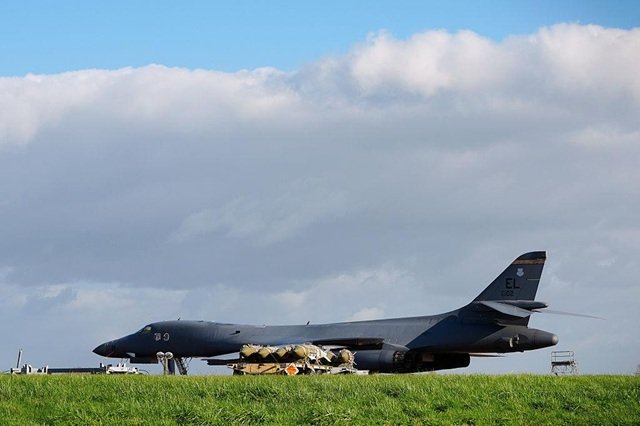
The United States faces a growing drone security challenge that extends beyond military installations overseas to bases on its own territory and civilian locations where large numbers of people gather. The threat was illustrated by the removal of all 12 US B-1 Lancer bombers from RAF Fairford in the United Kingdom after an unspecified new threat involving drones, following the arrest of five men near the base in connection with a suspected Iranian terror plot.
The incident demonstrates how the potential use of relatively inexpensive unmanned aircraft can force changes to the deployment of military assets worth billions of dollars, even without an attack taking place. According to an analysis by The Soufan Center, the growing accessibility of drone technology, the volume of flights across the United States and the difficulty of coordinating defensive responses are creating a security problem that extends far beyond conventional military targets.
Each B-1 Lancer bomber is estimated to cost upwards of $300 million. The removal of the 12 aircraft therefore involved more than $3 billion in strategic assets used in critical long-range operations against Iran. The Soufan Center notes that drones comparable in cost to those used by Ukraine during Operation Spiderweb, which struck Russian airfields and damaged 40 high-value aircraft, can cost fewer than $1,000 apiece. The comparison illustrates the disparity between the cost of deploying an inexpensive offensive capability and the value of the equipment that defenders may need to protect or relocate.
At RAF Fairford, the threat alone was sufficient to prompt the withdrawal of the bombers. The episode follows a wider pattern in which drones have demonstrated their capacity to damage expensive military equipment, disrupt operations and impose defensive costs disproportionate to the resources required for an attack.
The concern is supported by their use in conflicts across several regions. Iran has successfully targeted US assets throughout the Middle East using a combination of drones and ballistic missiles. According to a report by the Orion Policy Institute, violent non-state actors, including the Houthis, Hezbollah, Hamas and the Islamic Resistance in Iraq, have used drones against targets in Yemen, Syria, Saudi Arabia, Israel, Iraq, Burma, Lebanon, Turkey, Egypt and Mali. Drones have also featured prominently in the war in Sudan and are now widely used in modern conflicts.
The Soufan Center argues that the increasing threat to overseas military installations is an expected consequence of the relatively low cost of drone production and deployment, combined with the expense and difficulty of defending against attacks, particularly when drones are used in large numbers. The more difficult national security problem, however, is the growing vulnerability of military installations and personnel within the United States itself.
Between 2023 and 2024, drone incursions were reported at Langley Air Force Base in Virginia, a sensitive Department of Energy site in Nevada, near Edwards Air Force Base in California, around Naval Station Norfolk and the Newport News Shipyard in Virginia, and at military bases in Ohio and Utah. These incidents, alongside congressional pressure, contributed to the US Air Force developing its Point Defense of Air Bases Doctrine Advisory in 2025.
The White House subsequently introduced two executive orders in June 2025. Executive Order 14305, Restoring American Airspace Sovereignty, sought to improve public safety against potential threats, while Executive Order 14307, Unleashing American Drone Dominance, aimed to expand the production of drone technologies for global markets. The measures addressed two related priorities: strengthening protection against hostile drones and increasing US capacity to manufacture the technology.
Although the United States pioneered remote-controlled aircraft in the 1930s, developed unmanned reconnaissance aircraft during the Vietnam War and produced long-range, high-endurance unmanned aircraft in the late 1980s, its position in drone manufacturing and deployment has weakened in recent decades. The Soufan Center assesses that increasing production may prove easier than protecting the vast number of sites potentially exposed to attack.
Executive Order 14305 established the Federal Task Force to Restore American Airspace Sovereignty and the National Training Center for Counter-Unmanned Aircraft Systems. These bodies are intended to improve coordination and train federal, state, local, tribal and territorial law enforcement agencies. Yet the division of authority among agencies remains a significant operational constraint.
The US Air Force’s doctrine warns that the domestic environment presents a “unique and challenging context” for point-defence operations. It identifies engagement parameters, legal authorities and coordination requirements among local, state and federal agencies as constraints that can delay the defensive response and undermine its effectiveness if arrangements are not established in advance.
Incidents in February 2026 illustrated the risks of misidentification and coordination failures. The US military shot down a Customs and Border Protection drone near El Paso, Texas, and, in the same month and general vicinity, also shot down a party balloon after it was suspected of being a drone. Such incidents demonstrate that counter-drone operations can produce errors even when security forces are actively responding to perceived threats.
The scale of civilian drone activity makes comprehensive protection still more difficult. According to the Federal Aviation Administration, the United States has nearly 20,000 airports, 837,513 registered drones and 481,760 certified remote pilots. An estimated 38.4 million drone flights were conducted by recreational and non-recreational operators in 2024.
Beyond military bases and airports, hundreds of stadiums, amphitheatres and other venues can accommodate large crowds, while hundreds of thousands of schools, shopping centres, places of worship and parks host gatherings or recreational activities. Unlike major military installations and high-profile events, many of these locations are not routinely monitored by radar or security services and generally lack protection against drone activity.
The number of unregistered drones and uncertified pilots operating in the United States remains unknown. The Soufan Center also identifies uncertainty over the number of hostile actors who might use drones carrying chemical or explosive munitions, including gang members, cartel operatives, terrorists and disaffected individuals acting alone. The combination of inexpensive technology, extensive civilian airspace use and numerous lightly protected sites presents both accidental and deliberate risks, with civilian locations potentially more exposed than military and government facilities.