In 1991 President George H.W. Bush announced unilateral, sweeping reductions in U.S. tactical nuclear forces. Soviet President Mikhail Gorbachev was supposed to take parallel steps, but he hardly got the chance as the Soviet Union disintegrated.
Now, 35 years later, the Pentagon is nervous that Russia might use nuclear weapons in Ukraine or attack NATO.
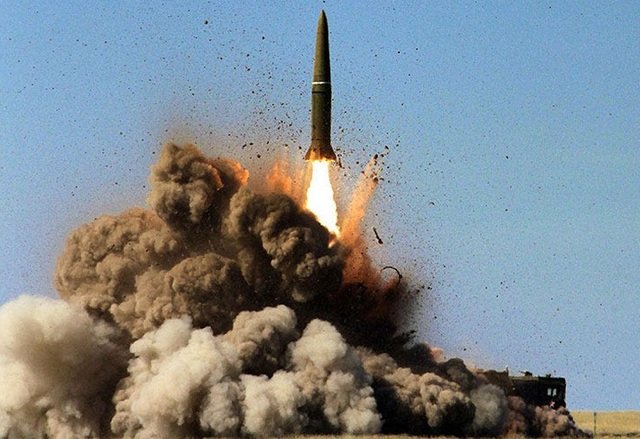
In June, 2023 Russia deployed Iskander-M missiles with nuclear warheads to Belarus, more as a warning to Poland and NATO than due to Russia’s “special military operation” in Ukraine. Reports also say Russia has been modifying Belarus’s Su-25 aircraft to carry nuclear gravity bombs. Poland (and Lithuania) have threatened Russian access to Kaliningrad, and the Poles and Lituanians have contended that Russia is also storing between 50 and 100 nuclear warheads in the enclave. Kaliningrad, previously Königsberg, was the military hub of the Prussian state. Under the Potsdam Agreement in 1945, the northern part of East Prussia—including Königsberg—was annexed by the Soviet Union, its German population was largely expelled, and the city was subsequently renamed Kaliningrad. It is connected to Belarus by a thin strip of territory along the Polish-Lithuanian border called the Suwalki gap or corridor. The city and the corridor is a flash point of strategic significance for both Russia and NATO.
Today the United States has a small arsenal of so-called tactical nuclear weapons, mainly in the form of the B-61 gravity “dial a blast” air delivered bombs. Undersecretary of Defense for Policy Elbridge Colby is currently leading a team updating US nuclear policy, focusing on refining flexible options for the President, particularly at the regional level.
Colby and his colleagues do not have many options if their approach is to strengthen “flexible options” at the “regional level.” Aside from the B-61 and a few US Navy weapons (including Trident submarine-launched ballistic missiles that can be equipped with a small, 5.7 kt warhead), almost all fielded US tactical weapons have been retired and the majority of their nuclear warheads dismantled.
The one possible exception, if you believe the Russian assessment, are dual purpose Mk-41 launchers in Europe. These can be used either for SM-3 air defense interceptors or for Tomahawk cruise missiles. The US has two major locations in Romania and Poland. Since 2014 the US has been operating an Aegis Ashore system at Deveselu, Romania. It features 24 MK 41 Vertical Launch System (VLS) cells. At Redzikowo, Poland the US has a mirror Aegis Ashore system with the same number of VLS cells. Meanwhile the US is implementing mobile, trailer-mounted MK 41 launchers in Europe. The mobile system is called Typhon, and is an emerging deep strike system (not air defense). The NATO center for Typhon is in Germany.
The US says that the Tomahawk is a conventionally armed cruise missile. The mobile, ground-launched nuclear Tomahawk variant—the BGM-109G Gryphon—was retired and fully destroyed much earlier, by 1991, to comply with the Intermediate-Range Nuclear Forces [INF] Treaty. The US withdrew from the INF Treaty in 2019. The Naval version (TLAM-N) warheads were destroyed between 2010 and 2013. Both used variants of the W-80 nuclear warhead. An updated version of the W-80 warhead is designated for the Air Force’s upcoming AGM-181 Long-Range Standoff (LRSO) cruise missile (which is air launched). It is planned to have a “dial a yield” weapon ranging from 5 kt. to 150 kt.
The Russians believe that the US is significantly increasing its tactical nuclear posture in Europe and likely do not regard the “retirements” of nuclear armed Tomahawks as reflecting their own intelligence assessments on the availability of nuclear warheads for Tomahawks.
The Pentagon generally divides US nuclear weapons (and their delivery systems) into two broad categories, namely strategic and tactical nuclear weapons. Strategic weapons are primarily delivered by long range ballistic missiles, either land based or by ballistic missile submarines (”Boomers”). Their purpose is to destroy an adversary’s ICBMs (and other ballistic missile and bomber assets) and to obliterate operations centers in key locations including cities such as Moscow or Beijing. The US Minuteman III, located in underground silos, has nuclear warheads (W-78 or W-87) with a yield between 335 and 350 kt. (Compare this to the Hiroshima and Nagasaki atomic bombs with much smaller blast yields. Hiroshima’s uranium bomb, called Little Boy, is estimated around 13 kt., Nagasaki’s Fat Man plutonium bomb 21 kt. or less.)
The US Atomic bombing of Japan was a city busting exercise. The US Minuteman system is primarily aimed at destroying underground silos by creating massive overpressure over top of the buried silos, destroying the underground missiles.
The strategic competition between the US and USSR was over whether either side was trying for a first strike capability, meaning the ability to neutralize the enemy’s nuclear strike capability. The US always contended it was not aiming for a first strike system, and often accused the Russians as trying to do so.
Tactical nuclear weapons were originally thought of as a way for smaller NATO forces to stop a Soviet attack in Europe based on the image of tens of thousands of Warsaw Pact forces including tanks, armored fighting vehicles and troop transports, and massive artillery flowing through the Fulda Gap into Germany and the heart of NATO. Tactical nuclear weapons, including land systems like the Honest John and the Lance missile, and nuclear gravity bombs delivered by NATO aircraft, were supposed to block a Warsaw Pact mass attack.
The value of tactical nuclear weapons was greatly diminished by the build up, on the Soviet side, of short and intermediate range ballistic missile systems that could knock out almost all of NATO’s military assets and destroy major cities. Perhaps the most worrisome development in the 1980s was Russia’s SS-20 mobile intermediate range ballistic missile that threatened Europe. It carried a 1 megaton nuclear warhead. Europe had no air defenses to deal with the SS-20, and still lacks integrated air defenses almost half a century later. The SS-20 was scrapped (along with the Pershing II) under the INF treaty. But modern cruise missiles like the Islander, used heavily in Ukraine, have replaced it. Iskander can be equipped with nuclear warheads with yields in the range of 50 kt.
At its peak the US had a vast arsenal of nuclear weapons, mostly tactical. In 1967, the United States nuclear weapons stockpile reached a total of 31,255 warheads. The U.S. weapons included nuclear artillery shells (like the 155mm and 8-inch projectiles), short-range ballistic missiles (such as Honest John, Sergeant, and Corporal), anti-submarine rockets, nuclear depth charges, surface-to-air missile warheads (like Nike Hercules), atomic demolition munitions (ADMs), and thousands of tactical gravity bombs deployed with dual-capable aircraft in Europe and Asia. Today the US has deployed some 100 B-61 nuclear gravity bombs in Europe (including Turkey). These weapons can be launched by designated US fighter aircraft and from aircraft belonging to some NATO partners.
Russia has fewer tactical nuclear warheads in its arsenal. While the numbers are far from reliable, the Russians probably have 1,500 to 1,900 warheads but these can equip a greater variety of land, sea and air platforms. China has even fewer, although numbers are hard to come by. Instead China has focused on ballistic missiles (short, medium intercontinental). From the mid-1980s the US paid minimal attention to China’s nuclear arsenal, but that is rapidly changing as China could mount credible threats against US allies and friends in the region, including the growingly volatile confrontation brewing over Taiwan.
We do not, of course, know what the latest Pentagon assessment of US nuclear forces will recommend. But the Pentagon does understand that the Russians are growingly frustrated with the SMO in Ukraine and attacks by swarms of Ukrainian drones on sensitive targets inside Russia. President Putin has warned that Ukraine has opened a pandora’s box in its drone and missile attacks on Russian territory. The Russians also are warning NATO countries, especially the UK, that its active participation with Ukraine targeting Russian cities could mean war with Russia and its consequences.
Relations between Russia and the UK are deteriorating. In July Russia recalled its UK ambassador and is not replacing him. Meanwhile the US has not made any effort to pull back from the escalating confrontation between America’s key NATO ally and Russia, leaving it to the Russians to take the next step. Nor has Washington apparently pressured Ukraine to de-escalate their drone and missile war with Russia.
Will this lead to either Russia or NATO to consider using so-called tactical nuclear weapons? The Pentagon clearly is worried.