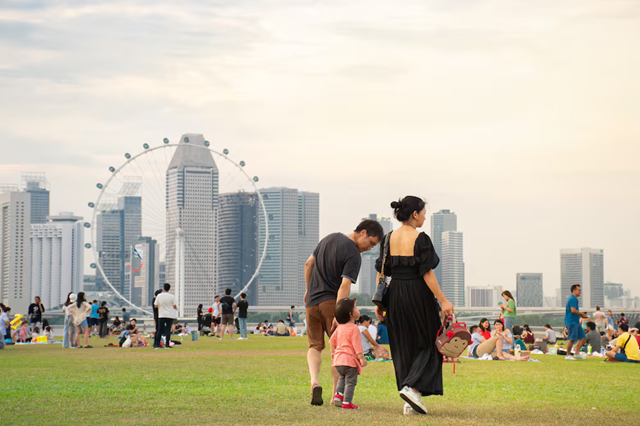
Singapore is offering families more than €47,000 for each child under the age of 18 as part of a new package announced by Prime Minister Lawrence Wong, in one of the city-state’s most ambitious attempts yet to reverse a record decline in births.
The measures are intended to make raising children cheaper and easier in a country whose fertility rate has fallen to one of the lowest levels in the world. The government hopes that reducing the financial burden of parenthood will encourage couples to have more children, even as previous efforts have shown the limits of what financial incentives can achieve.
Wong, 53, received applause and expressions of surprise and enthusiasm on Sunday evening when he unveiled the package during his National Day speech. The measures include direct support for each child until the age of 17, amounting to almost 70,000 Singapore dollars, or about €47,245. They include a “baby bonus” of 10,000 Singapore dollars, equivalent to €6,750, as well as increased subsidies for full-day childcare.
For Jason Gan, 28, who is expecting his first child in November, the additional support is welcome. “It has given me financial breathing room,” he said. As the first among his friends to become a father, Gan said the money could help pay for food and his child’s education, while reducing the need to travel to neighbouring Malaysia to purchase basic goods at lower prices.
But he is less convinced that the measures will persuade other people to become parents. “It is positive for those of us who are about to become parents, but I don’t think it is really the long-term solution,” he said.
Wong has gone further than Singapore’s traditional financial incentives to encourage childbirth. In June, he said his government would focus particularly on making family life easier. Yet it remains uncertain whether the expanded support will address concerns among young Singaporeans about the growing pressures and perceived constraints associated with raising children.
For Huang Ying Yi, 24, the country’s educational and working culture makes parenthood unattractive. “Some of us have no desire to bring a child into the world just for them to follow the same path as everyone else and join this rat race, becoming another cog in the machine,” she said.
A YouGov survey published days before Wong’s speech found that almost one-third of Singaporeans aged between 18 and 44 said no government policy would make them more willing to have children. At the same time, reducing the cost of pre-school education and childcare ranked highest among measures that could encourage people to become parents.
The demographic challenge is becoming increasingly urgent. Eugene Tan, an associate professor of law at Singapore Management University, described the latest measures as potentially “Singapore’s last chance to get it right” as declining birth rates accumulate across generations.
Wong’s plan goes beyond support during the earliest years of childhood. The government intends to finance virtually the entire period of childhood, expand the number of days of parental leave and improve families’ chances of securing highly sought-after public housing. Under the new system, families applying for newly built public housing through the allocation system will receive an additional ballot for each child they have or are expecting.
“What we can do is make it easier for Singaporeans who want to have children to form and raise a family, and we want all families to know that, if they decide to have children, the Government will be there for them,” Wong said during his speech at the Institute of Technical Education.
The scale of the demographic problem is particularly significant for a small but wealthy country. Singapore has a total population of 6.1 million, of whom nationals account for only about 60%. Its total fertility rate fell last year to a historic low of 0.87 children per woman, raising concerns as the country moves towards becoming a “super-aged” society.
Wong said Singapore would also need to continue accepting immigrants while ensuring that citizens remain the majority. “In the coming years, our total population will grow more slowly, and our workforce will also grow more slowly,” he said.
The current campaign to encourage births represents a striking reversal of Singapore’s earlier demographic policy. The “Two Is Enough” campaign, launched in the early 1970s, promoted smaller families when having too many children was viewed as a burden on the country’s development and resources. After the city-state changed direction in 1987, policies increasingly included financial incentives and longer leave for childcare.
Eugene Godfrey Lee, a 32-year-old senior financial consultant, said the latest measures could “get the process started” for family planning. “At the very least, it will make us feel that the Government supports us more,” he said.
Singapore’s predicament is shared across Asia. China’s birth rate fell last year to its lowest recorded level, while Japan’s fertility rate also reached a new low. Taiwan announced plans in May to establish government-subsidised investment accounts for people aged between six and 18 as it seeks to slow its rapid decline in births.
South Korea has seen its birth rate rise slightly for a second consecutive year, although it reached only 0.8 children per woman, while marriages have shown signs of recovering after a prolonged decline, supported by incentives intended to reduce the financial burden of raising children.
Singapore’s new package therefore represents more than another round of family payments. It is an attempt to confront a demographic problem that financial support alone may not be able to solve: whether young people can be persuaded to see parenthood as economically manageable and compatible with the pressures of modern life.