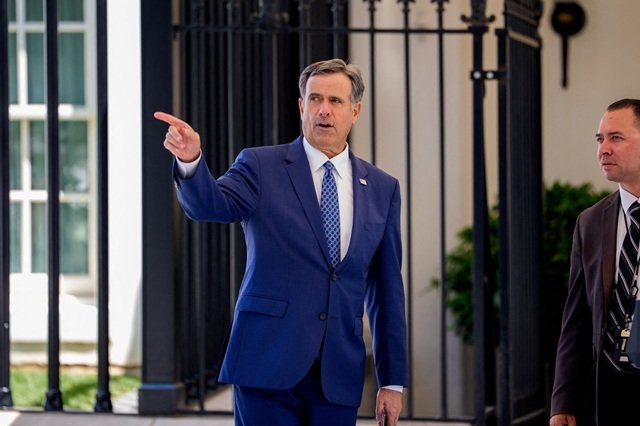
There is very little information on CIA Director Ratcliffe’s visit to Moscow. Even so, there is enough information to make some observations. One reason for Ratcliffe’s visit was to warn Moscow about replacing the Kiev regime which, Washington fears, may be on the verge of collapse.
The idea of a dying Ukraine is not part of the popular press. But there is growing evidence Ukraine cannot continue the war much longer.
The CIA Director departed from Joint Base Andrews in a C-17A Globemaster under the control of the 89th Airlift Wing located at the base. The flight started out in Charleston and departed Andrews on August 23rd. The exact time of departure was not announced. If it was heading straight to Moscow from Andrews the flight time would be between 9.5 and 10.5 hours. However, the plane landed in Riga, Latvia at Riga International Airport, which is about 525 miles from Moscow. Apparently it landed on August 24th and stayed overnight in Riga, departing for Moscow the next morning. The C-17 then flew to Moscow’s Vnukovo airport where Ratcliffe arrived at the VIP area. US Embassy supplied vehicles picked him up on the tarmac and his caravan was later observed transiting in Moscow. There is no word that any Russian official greeted Ratcliffe.
The C-17 used by Ratcliffe was specially equipped with a Roll On Conference Module (ROCC) that offers secure working space and sleep accommodations.
Even after Ratcliffe’s C-17 arrived at Vnukovo, the Kremlin seemed unaware of the visit, including Putin’s own office. In fact, the visit was only acknowledged after Ratcliffe left Moscow. Then the Kremlin said that Ratcliffe met with the Russian intelligence service, but not with Putin.
There are a few matters that deserve attention.
The first is that the US asked Zelensky to halt all drone operations over Russian territory for a few days, in order to clear the airspace over Russia. Had the drone strikes not been halted, the C-17 would not have flown into Moscow. The Russians also had to tell their air defense operators about the C-17 and not to shoot at it.
Ratcliffe’s departure to Moscow took place before his visit to Moscow was cleared by the Russians. The Ratcliffe trip was very urgent and Ratcliffe was aiming at a very high level meeting. It can also be supposed he wanted to see Putin.
It would seem that the decision for the C-17 to stop in Riga was an enroute choice because the Moscow authorities had not cleared either the aircraft arrival or the visit itself.
To say the least there was confusion and uncertainty in Moscow and it is possible that Ratcliffe needed help to get the Kremlin to approve the mission. It would be a good guess that help came from the White House, perhaps from President Trump speaking directly to Putin, and that the call cleared the way for the meeting in Moscow. This suggests that the Russians were far from happy about Ratcliffe’s visit. Putin did not meet with Ratcliffe, although Tass reports that he was “in the loop.” Exactly who Ratcliffe met with has not been officially disclosed but likely it was Sergey Naryshkin who heads Russia’s Foreign Intelligence Service (SVR). Last year Ratcliffe had talked to Naryshkin by phone (March 2025) mainly about crisis resolution.
Context
To send the CIA Director on an unannounced and unplanned trip to Moscow is unprecedented. The most famous “secret” trip to Moscow was by Henry Kissinger on October 21, 1973. It was in the midst of the Yom Kippur war and Kissinger was asked to come by the Soviet leadership (specifically General Secretary Leonid Brezhnev and Soviet Ambassador Anatoly Dobrynin). The Russians feared Israel was about to overrun the Egyptian army (maybe even march on to Cairo). Egypt was Russia’s top client, and because of the military situation, the Russians were threatening the use of Russian troops or the use of nuclear weapons to save Egypt. Kissinger would be asked to get Israel to stop and pull back, end the entrapment of Egypt’s Third Army in the Sinai which was surrounded by the IDF led by Ariel Sharon, and not expand their operations aimed at Cairo (which was largely undefended).
Today there is much tension between Moscow and Washington, exacerbated by the UK’s support for deep strikes on Russian territory. The Russians have threatened retaliation and there have been plenty of reckless statements by Russian politicians pressuring Putin to retaliate. The Kremlin has issued warnings about “inevitable consequences.”
Yet the British actions probably would not prompt Ratcliffe to go to Moscow.
There are recent reports that Russia is on the verge of a major military mobilization to win the war in Ukraine. A Russian mobilization could trigger a wider war in Europe. From public reporting it is clear there is talk in Russia about a Russian military push to defeat the Ukrainian army, but even if there was hard evidence collected by the CIA, it would not be a Ratcliffe task to “warn” the Russians about doing so. In any case, a mobilization would take time and recruits would need training. This does not seem to fit into Radcliffe’s urgent mission.
It is possible the CIA has intelligence about the internal situation in Ukraine and Ratcliffe came to Moscow to warn that the US and NATO would not tolerate a takeover of Ukraine by Russia. While much of the US press is flooded with “success” stories based on Ukrainian information, there are plenty of signs that Ukraine’s problems, even survival as a state, are growing worse. Compounding this is Zelensky’s hard line on Russia and lack of negotiating flexibility, now more stressed by internal political pressure including demands for elections. Corruption also plagues Zelensky’s government. On top of all this, Zelensky dismissed his defense minister Mykhailo Fedorov and fired the head of Ukraine’s armed forces, General Oleksandr Syrsky, hardly the sort of thing you do in the middle of a war.
Meanwhile Ukraine lacks air defenses, and its finances are in shambles. Russia’s shutdown of the ports in and around Odessa have dealt a significant blow to Ukrainian agriculture and materials exports. The Greater Odesa hub (which include Odesa proper, Chornomorsk, and Pivdennyi) serves as Ukraine’s primary maritime gateway to the Black Sea where 90% of Ukraine’s agricultural crops (wheat, corn, barley and sunflower oil) are exported to Europe, Africa and the Middle East. Ukraine will lose $2.5 billion in exports and its farmers will suffer. (The reaction in Europe will be different because cheap Ukrainian grain exports hurt farm production in Europe.)
The Russians, no doubt, would tell Ratcliffe that their intention is to settle the future of the annexed Ukrainian territories, not to replace Zelensky and his government or take over Ukraine. But Moscow may have said that a more Russia-friendly Ukrainian government would facilitate a negotiated settlement of the conflict. No doubt the Russians would say, as they have often, that Russia has no territorial ambitions either in Eastern Europe or the Balkans but would like to see a mutual reduction of tension in the border areas backed up by negotiated agreements to reduce threats.
But Moscow would also have warned Ratcliffe that Ukrainian strikes on Russian territory will be met by harsh Russian measures.
Ratcliffe spent around 8 hours in Moscow. How much of that time was in dialogue with his Russian interlocutors we do not know.
Could a Ratcliffe mission convince the Russians not to topple Zelensky and his government? Or stop Moscow from a push to take over Ukraine, if it wanted to do so. Or replace Zelensky with a Moscow-friendly regime?