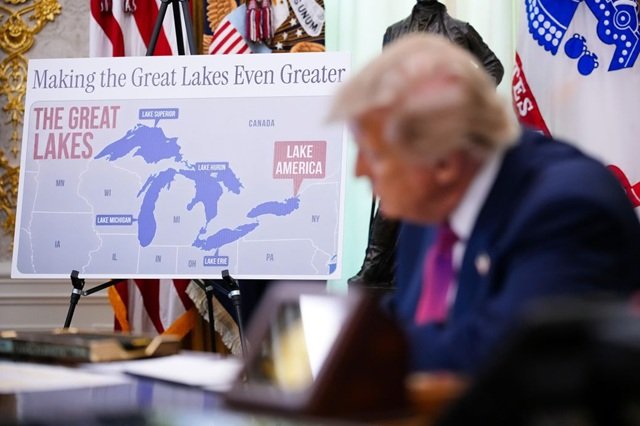
US President Donald Trump has escalated his confrontation with Canada by ordering the renaming of Lake Ontario as Lake America, turning a long-running trade dispute into a fresh diplomatic clash over one of the Great Lakes shared by the two countries.
Trump signed the directive on Thursday and said the name change would take effect “effective immediately”. The order gives the Interior Department 30 days to change the name in federal databases and materials. Trump had previewed the move earlier this week in a social media post.
Asked what message he was sending to Canada, Trump linked the decision directly to his criticism of Canadian trade practices. “Canada has been ripping us off for a long time on trade,” he told reporters. He added that Canada wanted to be treated “like they’re a state”, saying the United States could no longer accept that.
Lake Ontario straddles the US-Canada border between New York state and the province of Ontario and is one of the Great Lakes. The proposed US name change immediately drew a response from Canadian Prime Minister Mark Carney, who defended the lake’s existing name and its historical roots.
Carney said the name Ontario has Indigenous roots and predates both Canada’s confederation and America’s Declaration of Independence. “We know that America is changing. Their trading relationships, their foreign policies, their national monuments, their hydronyms,” Carney posted on social media. “Canadians also know that naming reality means calling it Lake Ontario — then, now and always.”
The dispute comes amid a broader deterioration in relations during Trump’s second term. The president has repeatedly referred to Canada as the 51st US state while accusing its trade practices of being unfair to American businesses. Critics, including some members of Trump’s own party, have condemned the attacks as counterproductive and an affront to one of Washington’s closest allies.
Trump has previously used geographical renaming as a political gesture. Last year, he ordered the Gulf of Mexico to be renamed the Gulf of America for US federal documents and communications. The change has not been broadly recognised by other countries, including Mexico.
Trump suggested the latest move could be followed by others. “If you think about it, we have a Gulf and we have a lake now. All we need is an ocean,” he said, adding that the Atlantic and Pacific might also be candidates for renaming.
The symbolism of Lake America, however, comes as the two countries remain locked in a much more consequential economic confrontation. The latest escalation follows the collapse of trade negotiations and the US imposition of a 50 per cent tariff on billions of dollars worth of Canadian goods. Carney responded with retaliatory duties scheduled to take effect on September 8.
Trump then vowed to double tariffs on Canadian automobiles and parts to 50 per cent starting in January. His administration is also discussing additional trade penalties and other measures following Ottawa’s countermeasures.
High-level trade negotiations have yet to resume. The talks broke down at the 11th hour following pressure from US Commerce Secretary Howard Lutnick, who regarded the proposed agreement as too generous to Canada, according to people familiar with the matter. Canadian officials have accused the Trump administration of attempting to alter the terms at the last minute.
Lutnick on Thursday accused Canada of abandoning negotiations for “political purposes”, arguing that Carney was seeking to consolidate support ahead of elections in Quebec and a preliminary vote on independence for Alberta scheduled for October.
Trump has repeatedly said the United States can afford to wait and does not need Canadian products to sustain its economy. Yet his own comments have highlighted the limits of that position. Earlier this week, he acknowledged that the United States relies heavily on Canada for aluminium while American efforts to expand domestic production continue.
“Selfishly, we need aluminum in this country,” Trump said during a telephone rally for Mike Mazzei, a Republican candidate for governor in Oklahoma. “We don’t have it. We get it all from Canada for the most part, and we need it badly.”
The renaming of Lake Ontario therefore arrives as more than a geographical dispute. It has become another highly visible symbol of a rapidly widening confrontation in which trade, national identity and political rhetoric are increasingly intertwined. While the name may be changed in US federal records, Canada’s refusal to accept it makes clear that the two countries remain sharply divided over both the substance and symbolism of their deteriorating relationship.