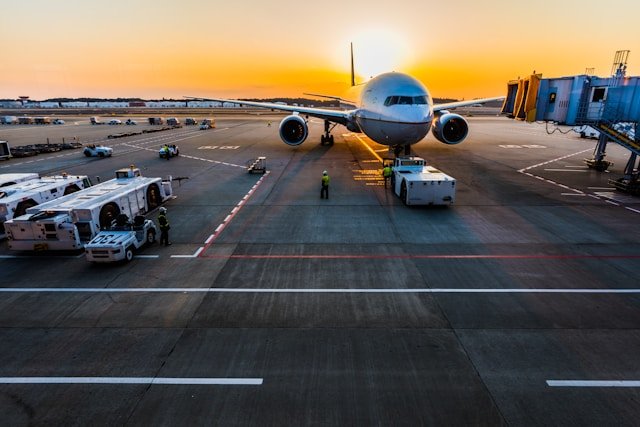
Introduction: The Airport as an Intelligent Ecosystem
The airport has traditionally been understood in functional terms: as a defined area of land or water intended for the arrival, departure and movement of aircraft. Such a conception, although legally serviceable, is increasingly inadequate as a description of the contemporary aerodrome. The modern airport is simultaneously an element of the national transportation infrastructure, a gateway to a city and a country, a commercial enterprise, a security environment, a logistics centre, a workplace, an interface between public and private authority and, increasingly, a sophisticated digital ecosystem. Its effectiveness depends not upon the excellence of any one of these attributes but upon the manner in which they interact. The airport that possesses excellent runways but dysfunctional passenger processing cannot be called world class; nor can an airport with magnificent terminals but inadequate airside coordination, weak cybersecurity, poor resilience or deficient governance.
This systemic conception of the airport is not new. In Law and Regulation of Aerodromes, I approached the aerodrome through the interrelated dimensions of the airport and the State, certification, planning, financing and economics, airport business, security and joint civil-military use. The architecture of that work reflected a proposition that remains valid today: the aerodrome cannot be examined as an isolated physical facility because its legal, economic, operational and institutional characteristics are mutually dependent. What has changed since that work was published is the emergence of artificial intelligence as a technology capable of creating a new relationship among those previously differentiated dimensions.
AI should therefore not be regarded merely as another item in the airport manager’s technological toolbox. It is more appropriately regarded as a potential connective architecture. It can connect aircraft movements with gate allocation, passenger flows with security staffing, weather with operational planning, baggage with aircraft turnaround, energy consumption with terminal occupancy, commercial activity with passenger behaviour, and safety data with anticipatory risk management. In this sense, AI does not merely automate the airport. It can enable the airport to perceive itself as a system.
The proposition that underlies this analysis is consequently simple but profound: a world-class airport is an airport that connects its dots, and AI may become the principal instrument through which those dots are connected. The qualification is equally important. AI cannot by itself create a world-class airport. Technology operating within poor governance merely produces technologically accelerated inefficiency. AI can identify a problem, predict a consequence and recommend a course of action, but it cannot supply the normative judgment of what ought to be done. That remains a human and, ultimately, a legal question.
My more recent work on algorithms has approached this problem from the perspective of air law. In Algorithms of Air Law – Connecting the Dots, I argued that rapid developments in autonomous systems, advanced air mobility, drones and other technologies require a re-examination of traditional legal assumptions because algorithms have moved from the periphery of aviation into the centre of questions of safety, efficiency, liability, governance and ethics. The airport is perhaps the most immediate terrestrial laboratory in which that proposition can be tested.
What Makes an Airport World Class?
Before asking how AI can create a world-class airport, it is necessary to determine what “world class” actually means. The expression is often used loosely, as though it were synonymous with size, passenger volume, architectural magnificence or technological sophistication. None of these attributes is sufficient.
A world-class airport begins with safety. Safety is not one objective among many; it is the foundational condition upon which every other airport objective depends. Runway safety, apron safety, aircraft ground movement, emergency response, fire and rescue, wildlife management, weather resilience and the prevention of operational errors must be integrated into a coherent safety-management philosophy. An airport should not merely react to accidents. It should possess the institutional capacity to identify conditions from which accidents could emerge.
Security represents a parallel imperative. The airport is both a transportation facility and a critical national-security environment. Yet security cannot be measured solely by the number of security personnel, screening machines or access-control points. Effective security requires intelligence, risk assessment, information sharing, proportionality and the capacity to distinguish genuine threats from ordinary operational anomalies. My earlier work on aviation security law approached security tools such as passenger information, travel documents and related technologies within their legal and regulatory context, emphasizing that security is inseparable from law.
Operational efficiency is equally fundamental. Aircraft must be able to arrive, taxi, park, turn around and depart without unnecessary delay. Passengers must be able to move from the curb to the aircraft and from the aircraft to their onward transportation with minimum friction. Cargo must move through the airport with comparable reliability. The airport is therefore a choreography in which thousands of movements must be synchronized within narrow temporal and spatial parameters.
Passenger experience is the human manifestation of this choreography. The passenger does not experience the airport through its departments. The passenger experiences a journey. A delay at security, a gate change that is not communicated, a baggage malfunction or inadequate ground transportation is perceived not as a failure of a particular department but as a failure of the airport.
The world-class airport must also be resilient. Disruption is inevitable. Severe weather, cyberattack, equipment failure, airspace restrictions, pandemics, labour disruption, geopolitical instability and infrastructure failures will occur. The appropriate measure of airport excellence is therefore not the absence of disruption but the capacity to anticipate it, absorb it and recover from it.
Sustainability is another essential dimension. Airports consume energy, occupy land, generate waste and noise, and contribute to the environmental footprint of aviation. The airport of the future must reconcile connectivity and economic development with environmental responsibility. Artificial intelligence may assist in that reconciliation, but only if sustainability is embedded within the objectives against which AI systems are optimized.
Finally, the world-class airport requires good governance. It must coordinate airport operators, airlines, air navigation service providers, security authorities, customs, immigration, ground handlers, concessionaires, passengers, local authorities and other stakeholders. If responsibility is fragmented, technology will not necessarily solve the fragmentation. Indeed, it may make the consequences of fragmented responsibility more difficult to identify.
The world-class airport is therefore best understood as a socio-technical, economic and legal ecosystem. AI becomes important because it can potentially supply the intelligence required to coordinate that ecosystem.
From Data to Intelligence
Every airport produces enormous quantities of data. Aircraft generate flight and operational data. Passengers generate movement and transaction data. Baggage generates tracking information. Security systems generate alerts. Meteorological systems generate forecasts. Vehicles generate location information. Buildings generate energy-consumption data. Retail establishments generate commercial information. Airlines, ground handlers, customs authorities and airport operators each possess information that is relevant to the operation of the whole airport.
The problem has historically been less the absence of information than its fragmentation.
One department may know that passenger numbers are increasing at security. An airline may know that a particular aircraft is carrying an unusually large number of connecting passengers. The ground handler may know that a baggage-loading process is behind schedule. The air traffic management system may know that an aircraft will arrive later than originally anticipated. The airport railway operator may know that a train is temporarily unavailable. Each piece of information is individually useful. The difficulty is understanding the relationship among them.
AI’s principal airport value may therefore lie in its ability to connect information that humans and institutional structures have traditionally kept apart.
Consider an aircraft approaching an airport. Its predicted arrival time can be combined with runway capacity, taxiway congestion, gate availability, ground-handler staffing, baggage requirements, catering, fuelling, maintenance and passenger connections. The system may determine that a seemingly insignificant delay in one activity will produce a significant downstream consequence. It can then identify alternative interventions before the delay becomes systemic.
The airport thereby moves from historical management to predictive management.
This distinction is critical. Traditional management often asks: What has happened? Digital management asks: What is happening? AI-assisted management increasingly asks: What is likely to happen, and what can we do now to influence the outcome?
The transition from reaction to anticipation is one of the most significant contributions AI can make to airport management.
The Airport Nervous System
The concept can be taken further. An airport may increasingly be regarded as possessing a kind of digital nervous system.
Sensors are its sensory organs. Communications networks are its nervous pathways. Databases constitute its institutional memory. AI provides analytical and predictive capacity. Airport managers provide judgment. The legal and regulatory framework defines the boundaries within which that intelligence may operate.
The analogy should not be interpreted as suggesting that AI becomes the airport’s brain. That would be both technologically and legally misleading. Rather, AI provides the means through which the airport can perceive relationships among events occurring simultaneously throughout its physical and institutional environment.
This is the real meaning of connecting the dots.
A runway closure should not be treated simply as a runway problem. AI should determine its consequences for taxiing, gate occupation, passenger connections, baggage, crew scheduling, security queues, ground transportation and commercial activity. A severe weather forecast should not be treated merely as meteorological information. It should be translated into likely consequences for aircraft movements, passenger processing, staffing, equipment, terminal occupancy and emergency preparedness.
The airport becomes intelligent when information acquires context.
AI and Safety: From Prevention to Prediction
Safety offers perhaps the most compelling application of AI.
A mature safety-management system seeks to identify hazards before they become accidents. AI can enhance this approach by processing historical incidents, near misses, aircraft movements, vehicle movements, weather conditions, workload indicators and other variables in order to identify patterns that may precede unsafe events.
Runway safety provides an obvious example. The movement area contains aircraft, vehicles and personnel operating within a highly constrained environment. An AI-enabled system may continuously analyze the positions and trajectories of those actors and identify potential conflicts before they mature into incidents.
The importance of this capability extends beyond technology. It may gradually influence the legal conception of foreseeability.
Traditional negligence law asks what a reasonable operator could reasonably have foreseen. If AI becomes sufficiently reliable and widespread to identify particular risk patterns, the question may eventually become whether a reasonable airport operator should have used such technological capability. The technological standard of care could consequently influence the legal standard of care.
This does not mean that every failure of AI should result in liability. AI itself is fallible. Data can be incomplete, models can be biased, sensors can malfunction and predictions can be wrong. But it does mean that the airport operator’s duty of care may increasingly encompass the responsible design, procurement, validation and supervision of AI systems.
The law must therefore move beyond the simplistic proposition that technology either creates liability or eliminates it. The more sophisticated question is whether the operator acted reasonably in circumstances in which technological assistance was available.
Passenger Facilitation and the Elimination of Friction
The world-class airport should be judged by the smoothness of the passenger journey.
AI can contribute at every stage. Predictive models can forecast passenger arrivals. Computer vision can monitor queues. Automated systems can adjust staffing according to predicted demand. Biometric systems can reduce repetitive identity verification. AI-powered information systems can provide personalized guidance. Digital assistants can communicate gate changes, connection information and disruptions.
The objective should not be automation for its own sake. The objective should be frictionless mobility.
A passenger should not have to understand the airport’s internal organizational complexity. The complexity should be absorbed by the airport’s systems.
There is, however, a danger in personalization. The passenger is not merely a data point or a consumer profile. Passenger facilitation must remain consistent with privacy, dignity, equality and autonomy. My work on aviation in the digital age has emphasized that technological developments affecting passenger identification and privacy cannot be separated from legal obligations and the duty of care. The book specifically examines digital passenger identification and privacy within the wider transformation of aviation by algorithms.
The world-class airport therefore should be passenger-centric without becoming passenger-surveillance-centric.
AI and Security: Prediction Versus Suspicion
AI may profoundly alter airport security because it can process information at a scale impossible for individual human operators. It may assist in baggage screening, anomaly detection, access control, behavioral analysis and risk-based allocation of security resources.
Yet security prediction introduces a difficult legal distinction between risk and guilt.
An algorithm may identify a pattern associated statistically with increased risk. That does not mean that the individual exhibiting the pattern has committed or intends to commit an offence. If an airport acts upon algorithmic classification without appropriate safeguards, statistical inference may become a substitute for evidence.
This creates questions concerning privacy, discrimination, explainability, procedural fairness and administrative accountability.
The answer is not to reject AI. It is to ensure that AI operates within an appropriate legal architecture. Human oversight, auditability, data governance, testing and avenues for review must accompany algorithmic security. The more consequential the decision, the greater the need for human judgment.
Security is consequently another dot that must be connected to law.
AI and Airside Efficiency
Aircraft turnaround is a particularly fertile field for AI because it is essentially a synchronized sequence of interdependent activities.
Disembarkation, baggage unloading, cleaning, catering, fuelling, maintenance, crew movement, boarding and baggage loading must occur within a constrained time period. A delay in one activity can propagate through the entire system.
AI can identify these dependencies and model their consequences.
If catering is delayed, the system can calculate the likely effect on boarding. If boarding is delayed, it can calculate the probable effect on gate occupancy and departure sequencing. If a gate becomes unavailable, it can identify alternative gates and calculate their effect upon passenger walking times, baggage routing and connecting passengers.
This is not merely automation. It is systemic optimization.
The airport manager is thus no longer required to manage every variable independently. AI can provide a dynamic operational picture, enabling the manager to intervene where intervention is most likely to produce the greatest systemic benefit.
Digital Twins and Institutional Foresight
The digital twin may become one of the most important instruments in the world-class airport.
A digital twin is not simply a three-dimensional model of an airport. Properly conceived, it represents the behavior of the airport as a dynamic system. It can simulate aircraft movements, passenger flows, terminal congestion, baggage operations, energy consumption and other variables.
The principal advantage is that management can test consequences before making physical interventions.
What happens if a security checkpoint is closed? What happens if a runway becomes unavailable? What happens if passenger numbers increase by twenty percent? What happens if an extreme-weather event lasts six hours? What happens if a cyberattack disables a critical operational system?
The digital twin permits the airport to rehearse the future.
This is a major philosophical change. Planning has traditionally been based on historical data and projections. AI-assisted simulation enables management to explore alternative futures and determine which interventions are most resilient.
In that sense, AI becomes an instrument of institutional foresight.
AI, Baggage and Cargo
The quality of an airport is often judged by mundane experiences. A passenger may not understand the intricacies of airport economics, but will immediately understand whether the baggage arrives.
Baggage systems are therefore an excellent example of the difference between technological sophistication and integrated intelligence. AI can forecast baggage volumes, identify abnormal routing patterns, predict equipment failures and assist in tracing misplaced bags. It can connect passenger itineraries with baggage movements and identify transfer bags at heightened risk of missing their onward aircraft.
Cargo presents a still broader opportunity. Air cargo is an interconnected supply chain involving shippers, freight forwarders, customs, warehouses, airlines, trucks and airports. My work on Law and Regulation of Air Cargo examines the air-cargo supply chain and the contractual and legal relationships that sustain it. AI can complement that legal and logistical architecture by identifying bottlenecks, forecasting demand, optimizing storage and improving the movement of information.
The legal dimension remains essential. AI cannot alter the contractual allocation of responsibility merely because it has become part of the logistics chain.
AI and Sustainability
The sustainable airport must use resources intelligently.
Terminal buildings consume energy according to passenger volumes, weather and operational conditions. AI can optimize heating, cooling, lighting and ventilation. Ground vehicles can be scheduled more efficiently. Electric vehicle charging can be coordinated with operational demand. Waste flows can be predicted. Water consumption can be monitored. Aircraft taxiing and gate operations can be coordinated to reduce unnecessary fuel consumption.
There is therefore a strong connection between AI and environmental performance.
Yet the environmental cost of AI itself must not be ignored. Computational systems consume energy. Sensors, servers, communications infrastructure and data centres have environmental footprints. An airport cannot legitimately claim to be sustainable merely because AI has reduced one category of emissions while increasing another.
The relevant question is therefore not whether AI is “green” but whether its net contribution to environmental performance is positive.
This again demonstrates the need to connect the dots rather than examine technological interventions in isolation.
AI and the Airport as a Business
The modern airport is also a commercial enterprise.
The development of airport business has transformed the traditional aerodrome from a facility principally concerned with aircraft into a complex commercial environment containing retail, restaurants, parking, hotels, offices, logistics and other revenue-generating activities. The airport business therefore cannot be separated from questions of management, corporate responsibility and economic sustainability. My work on airport law treats the airport business as a distinct dimension of aerodrome regulation.
AI can improve this commercial dimension by forecasting passenger demand, optimizing retail space, predicting purchasing behaviour, managing parking capacity, improving concession performance and assisting in property development.
But commercial intelligence must remain subordinate to the airport’s overall purpose.
The passenger is not simply a customer to be monetized. The airport is not merely a shopping centre through which aircraft happen to operate. An excessive emphasis upon commercial optimization can create congestion, interfere with wayfinding and undermine the passenger experience.
The correct commercial objective is therefore not maximum extraction of value from the passenger but sustainable value creation within the airport ecosystem.
AI and Airport Governance
Governance may ultimately be the most important dot of all.
The airport is characterized by multiple actors with overlapping responsibilities. Airlines operate aircraft. Airport operators manage infrastructure. Air navigation service providers manage airspace and traffic. Governments regulate. Security authorities protect the system. Customs and immigration perform sovereign functions. Ground handlers and concessionaires provide essential services.
AI introduces another participant: the algorithm.
Yet the algorithm is not a legal person.
This seemingly obvious observation carries considerable importance. When an AI system makes a recommendation that contributes to an unsafe or discriminatory outcome, responsibility cannot be assigned to the algorithm. Responsibility must ultimately rest with identifiable human or corporate actors.
My work on corporate management and executive liability in the airport industry is relevant here because the airport’s corporate structure inevitably raises questions concerning responsibility, negligence and the manner in which duties are delegated. AI complicates rather than eliminates those questions.
The principle should therefore be clear:
Delegating a function to an algorithm cannot mean delegating legal responsibility to an algorithm.
An airport operator remains responsible for the systems it deploys, the manner in which those systems are validated, the training of personnel who rely upon them and the procedures established for circumstances in which the system is wrong.
The Algorithm as Part of the Duty of Care
This leads to a broader jurisprudential proposition.
If AI becomes embedded in airport operations, the algorithm itself may become part of the infrastructure against which the airport’s duty of care is measured.
My Aviation in the Digital Age argues that technological change brings with it legal and regulatory implications connected to the duty of care. The book examines how algorithms affect subjects extending from sovereignty and cybercrime to drones, passenger identification, privacy, air traffic services and aeronautical communications.
The airport presents a concentrated version of this problem.
Suppose an airport uses an AI system to predict runway incursions. Suppose the system identifies a pattern indicating elevated risk. Suppose an alert is generated but ignored. The legal inquiry may involve the human operator, the airport’s procedures, the reliability of the system, the adequacy of training and the reasonableness of the decision not to intervene.
Now suppose the system fails to issue the warning because its training data were inadequate. The question may move toward procurement, validation and vendor responsibility.
Suppose the airport knew that the system had experienced repeated failures but continued using it without modification. The question becomes one of corporate governance and negligence.
AI thus creates a chain of accountability rather than a single point of responsibility.
The Need for Algorithmic Governance
The airport of the future will therefore require an algorithmic governance framework.
Such a framework should encompass data quality, cybersecurity, explainability, testing, validation, human oversight, auditability, incident reporting, procurement standards and contractual responsibility. The airport should know what an algorithm is designed to do, what data it uses, what its limitations are and what happens when it produces an anomalous result.
This is particularly important because aviation regulation has historically depended upon standards that can be communicated, audited and enforced. AI systems may behave dynamically and may be difficult for non-specialists to understand.
My work on rulemaking in air transport has emphasized questions of direction, purpose and structure in the development of authoritative aviation rules. AI presents precisely this challenge. Regulation must establish sufficient certainty to protect safety and rights while remaining sufficiently adaptable to accommodate technological development.
The solution should not be an enormous body of inflexible rules attempting to predict every technological development. Rather, aviation should establish principle-based algorithmic governance, supported by technical standards and continuous oversight.
The principles should include safety, accountability, transparency, proportionality, cybersecurity, privacy, non-discrimination and meaningful human oversight.
Cybersecurity and the Intelligent Airport
The intelligent airport will also be a more interconnected airport, and interconnectedness creates vulnerability.
If passenger processing, baggage, access control, aircraft turnaround, energy systems and operational communications become connected through digital platforms, a cyberattack against one component could potentially affect others.
AI can strengthen cybersecurity by identifying anomalies and recognizing patterns that may indicate an attack. Yet AI can itself become vulnerable to manipulation. Corrupted data, adversarial inputs or compromised systems can produce erroneous predictions.
The intelligent airport must therefore become a secure intelligent airport.
This is another manifestation of the central thesis. Safety is connected to cybersecurity. Cybersecurity is connected to data governance. Data governance is connected to privacy. Privacy is connected to law. Law is connected to accountability.
The airport is not a series of independent technological projects. It is one interconnected system.
Human Intelligence and Artificial Intelligence
The greatest misconception concerning AI is that its ultimate purpose is to replace human beings.
In aviation, that proposition is particularly dangerous.
AI is extraordinarily powerful at processing information, identifying patterns and calculating probabilities. Human beings possess judgment, contextual understanding, ethical reasoning and the ability to make decisions where values conflict.
The distinction can therefore be expressed simply: AI can help determine what may happen; human beings must remain responsible for determining what ought to happen.
This is especially important during abnormal operations.
An AI system may determine that closing a terminal entrance will reduce congestion. But perhaps that entrance is being used by persons with disabilities. Another system may determine that a particular security intervention maximizes risk reduction, while the intervention raises significant privacy concerns. A commercial algorithm may recommend a retail configuration that increases revenue but reduces passenger circulation.
Optimization is not the same as judgment.
The world-class airport must therefore be one in which AI augments human intelligence rather than displacing human responsibility.
From the Smart Airport to the World-Class Airport
The distinction between a smart airport and a world-class airport deserves emphasis.
A smart airport possesses technology.
A world-class airport possesses integrated intelligence.
The former asks where AI can be installed. The latter asks what prevents the airport from performing better and whether AI can address that problem.
A smart airport may install biometric gates because biometrics are fashionable. A world-class airport introduces biometric processing because it has identified passenger-processing friction and determined that biometric identification can reduce it without compromising privacy or security.
A smart airport may acquire predictive analytics. A world-class airport integrates predictive analytics into safety management, staffing, gate allocation, baggage handling and disruption management.
A smart airport collects data. A world-class airport converts data into decisions.
The distinction is therefore between technology acquisition and institutional transformation.
Connecting the Dots
The phrase “connecting the dots” has particular significance in this context because the airport itself consists of dots.
Safety is one dot. Security is another. Passenger experience is another. Aircraft operations, baggage, cargo, commercial activity, sustainability, transportation connectivity and governance are additional dots.
Historically, these dots have often been connected by people, telephone calls, meetings, procedures and institutional memory. AI offers the possibility of connecting them dynamically through a common information architecture.
The essential chain may be expressed as follows:
Data → Intelligence → Prediction → Decision Support → Human Judgment → Action → Accountability → Law.
The failure to complete any link in that chain can undermine the entire system.
Data without intelligence is merely accumulation. Intelligence without prediction remains descriptive. Prediction without judgment can become dangerous. Judgment without accountability can become arbitrary. Accountability without law lacks enforceability.
The world-class airport is therefore not merely a technologically sophisticated airport. It is an airport in which these elements function coherently.
AI and the Future Airport Manager
This transformation will inevitably change the airport manager.
The airport executive of the future will need to understand not merely runways, terminals, finance and human resources, but also data governance, AI procurement, cybersecurity, algorithmic accountability and digital ethics.
This does not mean that every airport manager must become a computer scientist. It means that management can no longer regard technology as the exclusive domain of the information-technology department.
The chief executive must understand what the airport’s algorithms are doing.
The safety manager must understand how predictive systems affect safety management.
The legal adviser must understand algorithmic liability and data governance.
The security manager must understand the distinction between predictive risk and individualized suspicion.
The commercial manager must understand how AI-driven personalization interacts with consumer rights and privacy.
The board of directors must understand the risks associated with delegating operational functions to algorithmic systems.
AI governance must consequently become a boardroom issue.
The Regulatory Airport of the Future
There is an additional institutional consequence.
Regulators will increasingly have to regulate not only physical infrastructure and human conduct but also technological systems that influence human and operational decisions.
This may require new approaches to certification and oversight. The regulator may need to know whether an AI system has been validated for the particular operational environment in which it is being used. It may need access to audit records. It may need to determine how changes to a model affect its certification status.
The regulatory challenge is complicated by the speed of technological development. Traditional legal and regulatory processes can be slow. Technology evolves rapidly.
My work on rulemaking has addressed precisely this tension between regulatory purpose and institutional capacity. The solution cannot be to abandon regulation in the name of innovation. Nor can it be to regulate technology so rigidly that innovation becomes impossible.
The appropriate objective is adaptive regulation.
Regulation should establish principles and outcomes, while technical standards, guidance and certification methodologies evolve as technology develops.
The regulator’s task will increasingly be to ensure that innovation remains within the boundaries of safety, legality, accountability and public interest.
AI and the Airport’s Social Contract
The airport has an important public dimension that is sometimes obscured by its commercial character.
It is an entry point to the State. It facilitates international mobility. It is a place where sovereign functions such as immigration, customs and security are exercised. It affects local communities through employment, economic development, noise and environmental impact.
The airport therefore participates in a social contract.
AI must operate within that contract.
Passengers should not be required to surrender fundamental privacy expectations simply because technology makes surveillance possible. Commercial optimization should not override accessibility. Predictive security should not become algorithmic discrimination. Automation should not eliminate the human assistance required by vulnerable passengers.
The world-class airport must therefore be technologically sophisticated and socially legitimate.
Legitimacy will become increasingly important as AI becomes less visible but more influential. The greatest danger may not be the spectacular malfunction of an AI system but the gradual normalization of decisions whose logic is invisible to those affected by them.
Toward an AI Architecture for the World-Class Airport
The airport should consequently approach AI not as a collection of unrelated projects but as an architecture.
At the operational level, AI should connect aircraft, gates, baggage, passengers, ground services and air traffic.
At the safety level, it should connect historical incidents, real-time information and predictive risk.
At the security level, it should connect information and risk assessment while preserving proportionality and rights.
At the commercial level, it should connect passenger demand, retail, property and revenue.
At the environmental level, it should connect energy, water, waste, emissions and climate information.
At the governance level, it should connect data ownership, contractual responsibility, cybersecurity, legal compliance and executive accountability.
The result should be a holistic airport intelligence platform rather than a collection of disconnected AI applications.
The airport should know not only what is happening but how events in one part of the airport affect events elsewhere.
This is what it means to connect the dots.
Conclusion: Intelligence Must Serve Purpose
The world-class airport of the future will not necessarily be the largest airport, the busiest airport or the airport possessing the greatest number of technological devices. It will be the airport that integrates its physical, digital, human, commercial and legal dimensions most intelligently.
AI can make an extraordinary contribution to that objective.
It can anticipate safety risks, predict passenger congestion, optimize aircraft turnaround, improve baggage reliability, strengthen security, reduce energy consumption, enhance commercial performance, increase resilience and assist management in making decisions based upon a comprehensive operational picture.
But AI is not the destination.
The destination is a safer, more efficient, more resilient, more sustainable and more humane airport.
The distinction is important because technological enthusiasm can easily obscure institutional purpose. An airport does not become world class because it has artificial intelligence. It becomes world class when intelligence—artificial and human—is deployed toward a coherent purpose.
The future airport should therefore be regarded as a living intelligent ecosystem in which data flows across institutional boundaries, AI identifies patterns and anticipates consequences, humans exercise judgment, managers accept responsibility and law provides the normative framework within which the system operates.
The essential equation is therefore not simply:
Airport + AI = Smart Airport.
It is:
Safety + Efficiency + Passenger Experience + Resilience + Sustainability + Commercial Viability + Human Intelligence + Artificial Intelligence + Governance + Law = World-Class Airport.
AI is the connective tissue, not the destination.
The airport of the future will succeed to the extent that it learns to connect the dots before the dots become crises. It will use algorithms not simply to tell it what has happened but to reveal what is likely to happen. It will use predictive intelligence not to surrender decision-making to machines but to improve the quality of human judgment. And it will recognize that every technological decision ultimately has a legal and ethical dimension.
That, in my view, is the central proposition of AI and a world-class airport: connecting the dots.
My Take
My work on aerodromes, airport business and aviation’s digital transformation has consistently proceeded from the premise that aviation cannot be understood through institutional or disciplinary silos. Law and Regulation of Aerodromes deliberately examines the airport and the State, certification, planning, financing and economics, airport business and security as interconnected dimensions of the aerodrome. That architecture becomes even more significant in the age of artificial intelligence because AI has the capacity to penetrate each of these dimensions simultaneously.
The airport is perhaps the most appropriate environment in which to demonstrate the proposition that I have described elsewhere as “connecting the dots.” In Algorithms of Air Law – Connecting the Dots, I observe that algorithms have moved to the heart of aviation’s evolution and that they present questions not merely of optimization but of “liability, governance, and ethical considerations.” This proposition applies with particular force to the airport because the airport is the place where aviation’s physical infrastructure, commercial activity, public authority and human interaction converge.
My Aviation in the Digital Age takes this argument into the wider legal sphere by examining how algorithms affect sovereignty, cybercrime, drones, passenger identification and privacy, air traffic services and aeronautical communications, and by connecting technological change with the duty of care. Legal Priorities in Air Transport similarly considers artificial intelligence against the continuing imperatives of safety and security and the necessity for a legal regime capable of responding to technological change.
The implication for airport management is therefore profound. AI should not be introduced into the airport merely because competing airports are introducing it, nor because it is commercially fashionable. The airport manager should begin with the question: What prevents this airport from being world class? Only then should the question be asked whether AI can provide an answer.
If passenger congestion is the problem, AI should predict passenger flows. If aircraft turnaround is the problem, AI should connect the operational variables that determine turnaround. If runway safety is the problem, AI should enhance anticipatory risk detection. If sustainability is the problem, AI should optimize energy and resource consumption. If resilience is the problem, AI should model disruption and enable the airport to rehearse alternative futures.
The legal question must accompany each of these interventions. Who owns the data? Who controls the algorithm? Who validates it? Who audits it? Who is responsible when it fails? What rights does the passenger retain? What happens when the algorithm’s recommendation conflicts with human judgment? These are not questions for the future. They are becoming questions of contemporary airport governance.
The ultimate lesson is that AI should not make the airport less human. It should make the airport more capable of serving human beings. The purpose of intelligence is not intelligence itself. The purpose is to improve judgment, safety, mobility, resilience, sustainability and human welfare.
A world-class airport will therefore not be the airport in which the machine has replaced the manager. It will be the airport in which the manager has been given the intelligence necessary to understand the entire ecosystem within which the airport operates. The algorithm should illuminate the dots; management must connect them; and law must ensure that the connections serve a legitimate public and aeronautical purpose.
That, ultimately, is where my earlier work on aerodrome law and airport business meets my more recent work on algorithms and air law. The airport is the physical manifestation of aviation’s infrastructure; the algorithm is increasingly becoming its cognitive infrastructure. Connecting the two is not merely a technological exercise. It is a question of law, economics, governance, ethics and, ultimately, the purpose of aviation itself.
Selected publications
Abeyratne, R., Law and Regulation of Aerodromes (Springer, 2014), particularly the chapters addressing the airport and the State, certification, planning, financing and economics, airport business and aerodrome security.
Abeyratne, R., Aviation in the Digital Age: Legal and Regulatory Aspects (Springer, 2020), particularly the treatment of algorithms, digital passenger identification, privacy, cybersecurity and the duty of care.
Abeyratne, R., Legal Priorities in Air Transport (Springer, 2019), including its consideration of artificial intelligence within contemporary aviation law and regulation.
Abeyratne, R., Rulemaking in Air Transport: A Deconstructive Analysis (Springer, 2016), concerning the direction, purpose, structure and principles of aviation rulemaking.
Abeyratne, R., Law and Regulation of Air Cargo (Springer, 2018), particularly its treatment of the air-cargo supply chain and the legal relationships underlying aviation logistics.
Abeyratne, R., “Algorithms of Air Law – Connecting the Dots,” Frontiers in Law, Vol. 4 (2025), pp. 98–123.