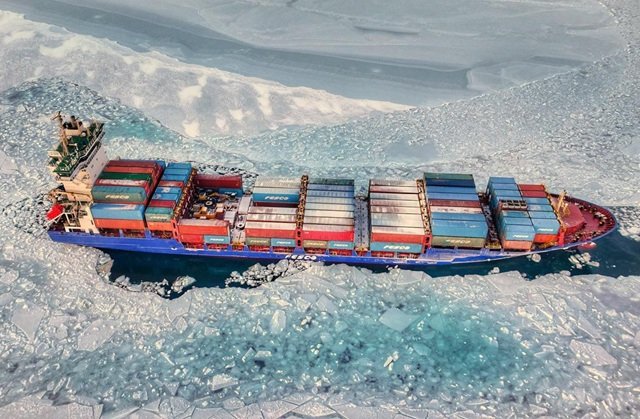
Last week, in the crowded ports of Qingdao in China and Busan in South Korea, two medium-sized cargo ships largely unknown outside the maritime industry slipped their moorings and headed towards Europe. The Dubai Tower departed Qingdao for Britain’s Teesport, while the PanStar Acro left Busan bound for Felixstowe. Their destination was not the familiar route through the Suez Canal, but the Arctic, before continuing towards other ports in northern Europe.
The voyages represent more than a change in shipping schedules. They signal the emergence of a maritime corridor capable of reshaping patterns of global commerce while shifting economic and geopolitical influence towards the northern hemisphere. At the centre of that transformation stands Russia, which controls much of the Northern Sea Route and has the power to determine who can navigate it and under what conditions.
Regular maritime connections between Asia and Europe through the Arctic would have been difficult to imagine only a few decades ago. The warming of the planet had already begun, but much of the Barents Sea remained covered by ice. Today, the shipping industry estimates that the route can be navigable for around three or four months, with the season extending from August to October and growing possibilities of extending it towards the end of that period.
The attraction is obvious. The Arctic passage can dramatically reduce journey times compared with the established route through the Suez Canal and even more sharply compared with voyages around Africa, south of the Cape of Good Hope. The Dubai Tower and PanStar Acro are expected to take approximately 18-19 days on the Arctic route, compared with around 40 days through Suez.
The Chinese company Sea Legend intends to make its Arctic connection weekly, while its South Korean counterpart remains in the testing phase. Kjell Stokvik, director of the Centre for High North Logistics, estimates that the route can reduce transit times by up to 40 per cent, with further reductions possible as transpolar routes develop.
For shipping companies, the benefits extend beyond speed. Faster voyages allow ships to make more journeys within a given period and reduce fuel consumption, an important consideration during periods of high energy costs. The Arctic route also avoids the risk of armed attacks encountered in other strategically important waters. Although insurance premiums for Arctic voyages are high, the cost of insuring ships in the waters of the Middle East has also risen significantly.
Yet the opening of the Arctic comes with a fundamental contradiction: the route is becoming commercially viable precisely because the Arctic is warming.
The melting of sea ice has reduced the physical barrier that once made regular navigation extremely difficult. Icebreakers are now required mainly towards the end of the season, particularly in October. But the same process that makes the route accessible threatens to intensify environmental damage in one of the world’s most distinctive ecosystems.
Despite the lower fossil-fuel consumption associated with shorter voyages, increased maritime traffic could bring more pollution and greater pressure on Arctic biodiversity. Javier Arnaut, a professor at the University of Greenland-Ilisimatusarfik, warns that cargo ships face the risk of colliding with mammals and other species in an area where communities also depend heavily on fishing.
The commercial figures show that the Arctic route remains small compared with Suez. In 2025, up to November, northern routes carried 1,927,000 tonnes of crude oil eastwards, 688,000 tonnes of coal, 162,000 tonnes of containers, 140,000 tonnes of liquefied natural gas, 36,000 tonnes of petroleum products and 2,000 tonnes of fish. There were 103 Arctic transits, either outbound or return, last year — six more than in 2024 and 60 more than in 2022. Most involved Russian and Chinese vessels.
Those figures remain dwarfed by the more than 24,000 vessels that passed through the Suez Canal in 2024. But the strategic importance of the Arctic cannot be measured by shipping volumes alone.
For Russia, the route represents a source of both revenue and influence. The nuclear company Rosatom, owned by the Kremlin, issues navigation permits, generating increasing sums for Moscow at a time of acute economic pressure. The arrangement gives Russia a role extending beyond infrastructure: it provides the country with leverage over a maritime corridor whose importance could grow as climate change continues to open northern waters.
Anjali V. Bhatt, a researcher at the Peterson Institute, points to the significance of that control. The comparison with the Strait of Hormuz is unavoidable: just as Iran — and now the United States — seeks control over that strategic passage, Russia possesses substantial authority over the Arctic route.
The consequences could extend well beyond Russia. Egypt, whose finances are heavily dependent on traffic through the Suez Canal, could suffer if Arctic shipping becomes an established alternative. Spain could also see its maritime position weakened. Its ports have benefited from diversions around the Cape of Good Hope, while Valencia and Barcelona have expanded their business and Algeciras has emerged as a critical global port. A sustained shift towards the Arctic could reduce that advantage.
There are also structural limitations. Jordi Torrent, consultant and secretary-general of the Mediterranean Ports Association, notes that ships travelling from Asia to Algeciras can stop at four or five ports, including Singapore, Dubai, Egypt and Malta. The Arctic offers no comparable network of intermediate ports. That absence remains a fundamental constraint on the route.
Nevertheless, the strategic contest surrounding the Arctic is already intensifying. North America, Europe and China are all responding to the region’s growing commercial, military and energy importance. Donald Trump’s administration has combined repeated annexation threats concerning Greenland with plans for a major expansion of the US icebreaker fleet, while Canada has announced the construction of six additional vessels.
The commercialisation of the Arctic is therefore becoming inseparable from the struggle for strategic influence. Arnaut argues that the opening of the northern routes increases Greenland’s value to Washington because the island holds rights connected to the Northwest Passage.
Europe, meanwhile, is preparing its own Arctic strategy. Brussels is expected to unveil its priorities in the coming weeks, while Finland has called a high-level summit in Rovaniemi, in Lapland, for 13 and 14 September. The EU says the Arctic is becoming an increasingly important part of Europe’s security environment and that the bloc has direct interests in the region’s stability, security and sustainable development.
The challenge for Europe, Stokvik argues, is not a lack of involvement but the need for greater coordination and a clearer strategic direction. Michael Bravo of the Scott Polar Research Institute at the University of Cambridge believes the EU has both the opportunity and the capacity to help shape the region’s future while ensuring environmental protection and economic stability.
Others are less convinced. Alla Pozdnakova of the Scandinavian Institute of Maritime Law at the University of Oslo doubts that Arctic routes will have positive implications under current circumstances. She warns that their development could increase geopolitical tensions and expose Arctic coastal states such as Norway to greater risks of pollution accidents in exceptionally difficult waters.
For Moscow, however, the Arctic represents something larger than a shipping shortcut. Vasco Sánchez Rodrigues of Cardiff University argues that Russia can vary the fees charged to shipping companies and potentially block the route, giving it leverage comparable to that associated with the Strait of Hormuz. The route also provides an outlet for Russian oil and gas and a potential corridor for the movement of weapons and troops.
Carlos Santana, director of the IE advanced programme in supply chains, describes the transformation as a “change of feudal lord”. For China, the Arctic route is not merely shorter; it is a new strategic option. For Russia, the stakes are even older.
As Jordi Torrent puts it, the Arctic has been an obsession for Russia for 400 years. Its historic maritime access was constrained by the Black Sea, controlled by Turkey, and the Baltic. Developing the Arctic route was therefore one of Vladimir Putin’s five priorities for this century.
Now, the changing climate has made that ambition increasingly tangible.
The Arctic is no longer simply a remote frontier at the top of the map. It is becoming a commercial corridor, a source of revenue, an environmental test and a strategic arena. Its melting ice is opening a new route between Asia and Europe — and, with it, a new contest over who will control the roads of the future.