In Burkina Faso, even a photograph of a person receiving a sack of rice is becoming a matter of state regulation.
This summer, the Council of Ministers approved a decree that prohibits humanitarian organisations from publishing photographs or videos showing vulnerable people receiving aid or posing alongside donated goods. The full text of the decree has not yet been published in the Journal Officiel, the equivalent of Spain’s BOE, but the Government of Captain Ibrahim Traoré has presented the measure as part of a broader effort to reinforce what it calls “humanitarian sovereignty”.
The Minister for Family and Solidarity, Lieutenant Colonel Passowendé Pélagie Kaboré, defended the measure by pointing to what she described as “numerous deficiencies” in the management of humanitarian assistance. She said the new rules would allow the authorities to “accredit organisations and structures authorised to intervene in the humanitarian field”.
Her argument goes beyond the question of imagery. In a country battered by terrorism and poverty, where 410 NGOs and foundations operate and 87% are foreign, the decree establishes a new framework for how humanitarian assistance is delivered, financed and publicly presented.
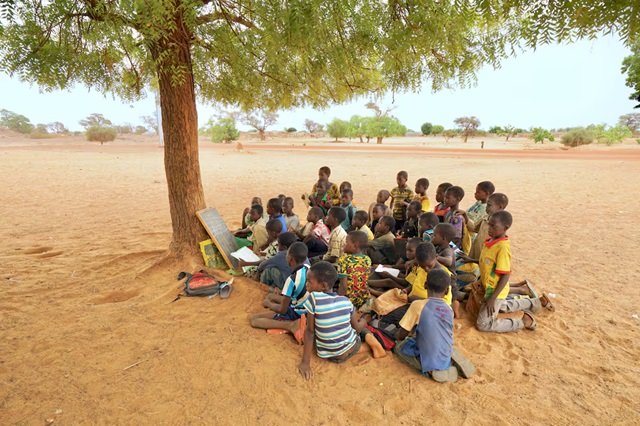
Kaboré said the rules were necessary because photographs accompanying humanitarian donations were frequently produced without sufficient regard for the dignity of beneficiaries. “Frequently, they are done from the absolute ignorance [of the importance] of the dignity of the beneficiaries,” she said in remarks to the press. “From now on, it is prohibited, for example, to show images of vulnerable people behind the sacks of rice, sacks of millet and barrels of oil being distributed on the ground.”
The prohibition is not limited to the familiar image of white volunteers delivering aid. Security conditions mean there are relatively few such volunteers in Burkina Faso. Instead, the rule also targets a widespread practice among local associations and international organisations: photographing donated goods together with the people receiving them.
For humanitarian organisations, such images can serve a practical purpose. International cooperation agencies frequently use photographs to account for their work to donors and headquarters and to demonstrate what their programmes are achieving. “The publications have allowed us to obtain funds and save lives. Limiting communication has consequences, but I understand that it is controlled for a useful purpose,” said a person working for an NGO in Burkina Faso who requested anonymity.
The decree, however, reaches considerably further than communications. The State will be able to “exercise special control” over the distribution of humanitarian interventions throughout the national territory. It also requires 60% of the financing of these agencies to be “obligatorily allocated to early recovery” — programmes intended to help people affected by an emergency recover and achieve economic autonomy as quickly as possible, reducing dependence on external assistance.
Donations, meanwhile, are to be purchased “as a priority” on the local market.
The Government’s stated objectives therefore combine several elements: greater supervision of humanitarian organisations, stronger local purchasing, an emphasis on economic recovery and restrictions on how vulnerable people are represented. But the measures have emerged amid a much wider tightening of the space available to NGOs and civil society.
Asier Hernando Malax-Echevarri, co-director of Acápacá and a founding member of the Permanent Latin American Forum for the Decolonisation of Cooperation, acknowledges that the humanitarian sector “has very colonial logics”. He describes a model in which the North arrives to help a supposedly “passive” South “without knowledge”.
The use of images, he says, is part of a generalised practice that has increasingly been corrected. But he draws a distinction between changing the way humanitarian organisations operate and placing humanitarian assistance under state control.
“Decolonisation of the humanitarian sector does not mean the nationalisation of humanitarian aid,” he warns. Humanitarian responses, he argues, should be transferred to Burkinabe civil society organisations. Yet the Government’s restrictions create another problem. “It is a little jarring that the Government restricts these spaces. In this case we would be moving from non-democratic logics at an international level — with foreign countries deciding what should be done — to non-democratic logics at a national level,” he says.
That concern comes against the backdrop of measures introduced since the coup of 2022 that have progressively increased state control over NGOs, civil associations and independent scrutiny, according to Ilaria Allegrozzi, senior Sahel researcher at Human Rights Watch.
Allegrozzi does not dismiss the possibility that some of the new requirements may be legitimate in a humanitarian context. Her concern is how they will be implemented and how much authority state officials will have to determine the consequences for organisations that fail to comply.
The distinction matters because humanitarian organisations do more than distribute food, medicine and other assistance. They can also function as what Allegrozzi calls the “eyes and ears on the ground”. They see what happens, ask questions and can establish why people are living in particular conditions or why they have fled a village after attacks by government forces, jihadist groups or militias.
For her, the summer decree therefore represents “a significant expansion of state control over humanitarian organisations”, building on restrictions that began months earlier.
The previous summer, Burkina Faso approved the Law on Freedom of Association, increasing state control over associations and strengthening requirements and monitoring mechanisms for national and foreign NGOs. Organisations were required to submit budgets, annual accounts and financial reports to several ministries and became subject to state control mechanisms. They were also prohibited from having “political objectives”.
In January, the Government dissolved political parties.
Associations were given one year to comply with the new rules. Yet by this spring, the authorities had begun dissolving them by the hundreds, citing non-compliance with the law. In April, Émile Zerbo, Minister for Territorial Administration and Mobility, announced the dissolution of 118 organisations working on human rights, women’s and children’s rights and environmental protection. Amnesty International condemned the decision, describing it as part of “broader efforts aimed at silencing civil society through repressive measures”.
Days later, Zerbo signed another document suspending 359 associations involved in women and gender issues, religion, development and private-sector promotion. In May, 247 and 205 organisations were dissolved through two decrees. In June, another 245 were suspended.
In total, the authorities suspended or dissolved close to a thousand organisations, including NGOs and associations, before the deadline for adapting to the new rules expired.
Not all of them were active. Some had been created in the past to serve as “local counterparts” or partners for international organisations implementing projects in Burkina Faso. In some cases, those projects had ended while the local associations continued to exist, at least on paper.
Another measure affecting NGOs and smaller associations requires their bank accounts to be held at the Banque des Dépôts du Trésor, the state bank. Fatoumata Bako, the Minister Delegate in charge of the Budget, said the measure was adopted to “control and pursue the fight against money laundering”.
For organisations dependent on international transfers, the consequences can be immediate. One NGO employee said, “many structures are suffering”. “Two months ago, I asked an organisation in Italy for help. I still have not received the money because they say they have to check the origin of the funds,” she said.
The restrictions extend beyond civil society organisations. Last September, Burkina Faso withdrew from the Rome Statute and therefore from the International Criminal Court. This summer, it ordered the suspension of the activities of the Office of the United Nations High Commissioner for Human Rights after the office called on the Government to “end all forms of repression of civic space and reconsider its intention to ban political parties”. The office will close permanently in November.
The new humanitarian decree has also attracted international attention because of Traoré’s growing popularity among young people, particularly as an icon of anti-colonial and African sovereignty discourse. Behind that public image is a network of influencers and communicators coordinated by Kassoum Traoré, the president’s younger brother.
What began as a dispute over how aid recipients are photographed is therefore part of a much larger transformation in Burkina Faso’s humanitarian system. The Government says it is addressing dignity, accountability, local economic recovery and dependence on external assistance. Humanitarian actors and rights researchers accept that some questions surrounding international aid are legitimate.
But the expanding reach of state oversight is changing the conditions under which those organisations operate. The central question is no longer simply whether a photograph of a vulnerable person should appear beside a donation. It is how far a Government can regulate humanitarian assistance while preserving the independent organisations that deliver it — and the scrutiny that comes with them.